

In 2016, I attended a NetApp Tech Field Day presentation during which co-founder Dave Hitz discussed the concept of the Data Fabric. From idea to reality, NetApp created a Cloud Business Unit, making a flurry of acquisitions. Now, the NetApp public cloud story is essentially over, as most of the portfolio is sold off to Flexera. So, does this mean NetApp is, once again, purely a data storage company?
Background
NetApp first started discussing the idea of the Data Fabric in 2016. At a Tech Field Day event, co-founder Dave Hitz addressed the concept of embracing rather than competing with the public cloud. This position was pretty radical for a company 100% focused on selling infrastructure for the data centre.
Around three months later, I completed a small consulting project with then-CTO Mark Bregman. We reviewed the early concept thoughts on NetApp’s Data Fabric strategy, which looked pretty promising. Through the NetApp platform, customers would be able to export data to a range of NetApp and third-party services accessed through standard APIs.
Here’s a podcast I recorded with Bregman in November 2016, where we discuss various aspects of the Data Fabric concept (link).
NetApp The Service Provider
By late 2017, NetApp had released Cloud Orchestrator, a tool to provision and manage on-premises and cloud-based storage resources. At the time, I questioned whether NetApp was becoming a service provider (post here) as the concept of the data fabric began to take shape. The cloud portal was extended further, introducing backup and sync capabilities, as well as “Cloud Volumes” (post here).
In parallel, NetApp was working with the major cloud platforms to integrate ONTAP into the fabric of their cloud platforms as a native service offering. We discussed Azure NetApp Files in 2019 (link), FSx for NetApp ONTAP in AWS (link) in 2021 and Google Cloud NetApp Volumes in 2023 (link).
Acquisitions
Meanwhile, NetApp was on the acquisition trail. The Cloud Business Unit, led by Anthony Lye (who joined NetApp in March 2017), acquired Greenqloud in 2017, StackPointCloud in 2018, Cognigo in 2019, Spot, Talon, and CloudJumper in 2020, CloudHawk, Data Mechanics, and CloudCheckr in 2021 and Fylamynt and Instaclustr in 2022.
Some of the acquisitions were a little confusing, such as StackPointCloud, a Kubernetes orchestration service (coverage here), resulting in the short-lived NetApp NKS (coverage here)
As we wrote in February 2022, NetApp appeared to be turning into two separate companies, with a degree of experimentation on cloud orchestration as well as data management. We felt the messaging on the NetApp public cloud strategy could be improved (coverage here), as there didn’t feel like an overall strategy but rather two sides to a “split brain”. Ultimately, the Cloud Business Unit felt to us like a separate company.
Two Businesses
Anthony Lye left NetApp in July 2022 to be replaced in April 2023 by Haiyan Song, renaming CBU to Cloud Operations. The Spot business seemed to operate like a company within a company, holding a portfolio of products spanning FinOps, Containers, Infrastructure Management and Desktop.
What was the strategy?
BlueXP
NetApp announced BlueXP at Insight 2022 and the term “Evolved Cloud”, which has subsequently been discontinued. BlueXP appeared to be the opportunity to bring together traditional infrastructure services with the Spot family, integrated through “NetApp Common Services”.
This strategy appeared to have echoes of the original Data Fabric concept, but the synergy between the two platforms was weak. We highlighted some of the issues in an analysis piece (available here).
IDI
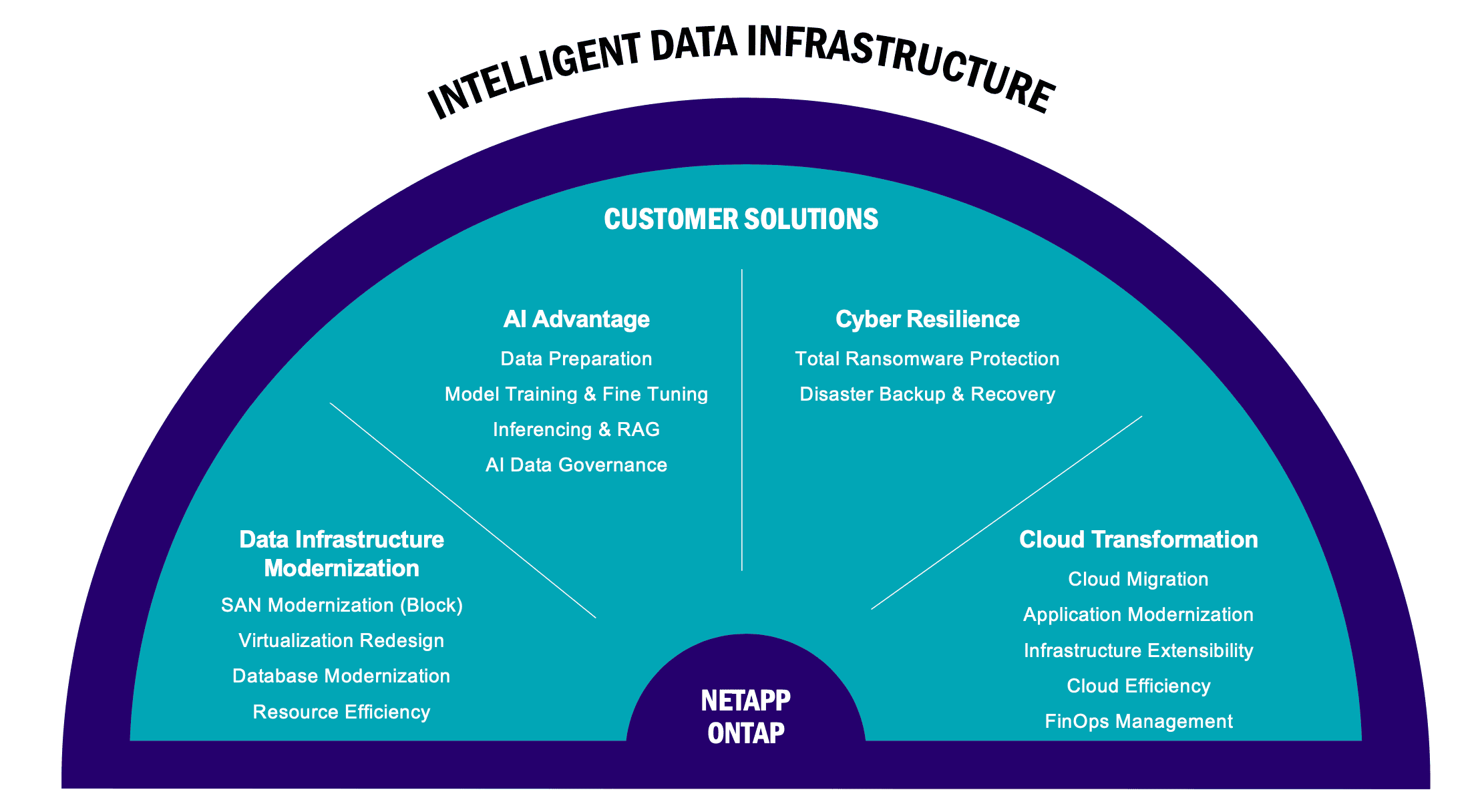
Over the last two years, the “Evolved Cloud” concept has morphed into “Intelligent Data Infrastructure” or IDI. BlueXP gained the Workload Factory (automation capabilities), while InstaCluster was rebranded as a NetApp company. The Spot portfolio was offloaded to Flexera in January 2025 for approximately $100 million (coverage here). We estimate that NetApp spent $1.3 billion on acquisitions over five years, with the sold assets representing at least $687 million. Not a great return for NetApp’s public cloud “experiment”.
Current State
Obviously, ONTAP is now integrated with three of the leading public cloud vendors, providing around 10% of NetApp’s annual revenue. As our latest financial coverage shows (available here), growth that was initially strong is now a little erratic. The current data will be affected by the offloading of Spot, so we may see a return to increased revenue in the coming quarters.
Elsewhere, there is an increasing focus on hardware, with a revamped ASA range of solutions and C-Series cost-optimised flash. The TAM for ONTAP has been broadened significantly, firstly as a direct answer to competitor solutions from Pure Storage but also to take business from the likes of IBM, Dell and HPE.
NetApp teased a new disaggregated architecture at Insight 2024 (coverage here). This new solution appears to be similar in design to VAST Data and HPE solutions. We think ONTAP will be retained and updated to work on this new design, perhaps incorporating object storage natively into the platform as a replacement for StorageGRID.
What about software?
NetApp’s current branding now refers to Intelligent Data Infrastructure, which comprises Data Infrastructure Modernisation, Cloud Transformation, Cyber Resilience and AI Advantage. Workload Factory appears to be the vehicle to deliver the software capabilities of orchestration and template building, accessed through the BlueXP portal.
The Architect’s View®
After almost ten years since the Data Fabric concept was first mooted, what has NetApp gained?
The Data Fabric idea, as initially conceptualised, no longer exists as a separate platform with APIs, particularly not exposed to 3rd party vendors. This move may be very wise, especially in light of the risks and exposures from ransomware attacks.
The idea of NetApp as a data orchestrator and manager, addressing the issues of data mobility, also appears to be gone. Instead, NetApp has doubled down on ONTAP (again), sold off non-core assets and kept only those that are applicable to data management. New capabilities continue to be developed in-house (such as the AI features of Workload Factory).
NetApp’s public cloud ambitions have been radically scaled back. However, we think this is a good thing. The future vision of the company is now clearer. NetApp is a data infrastructure and data management company operating in hybrid and public clouds. As Figure 2 shows, NetApp addresses the bottom three layers and some of the content management layer of this diagram.
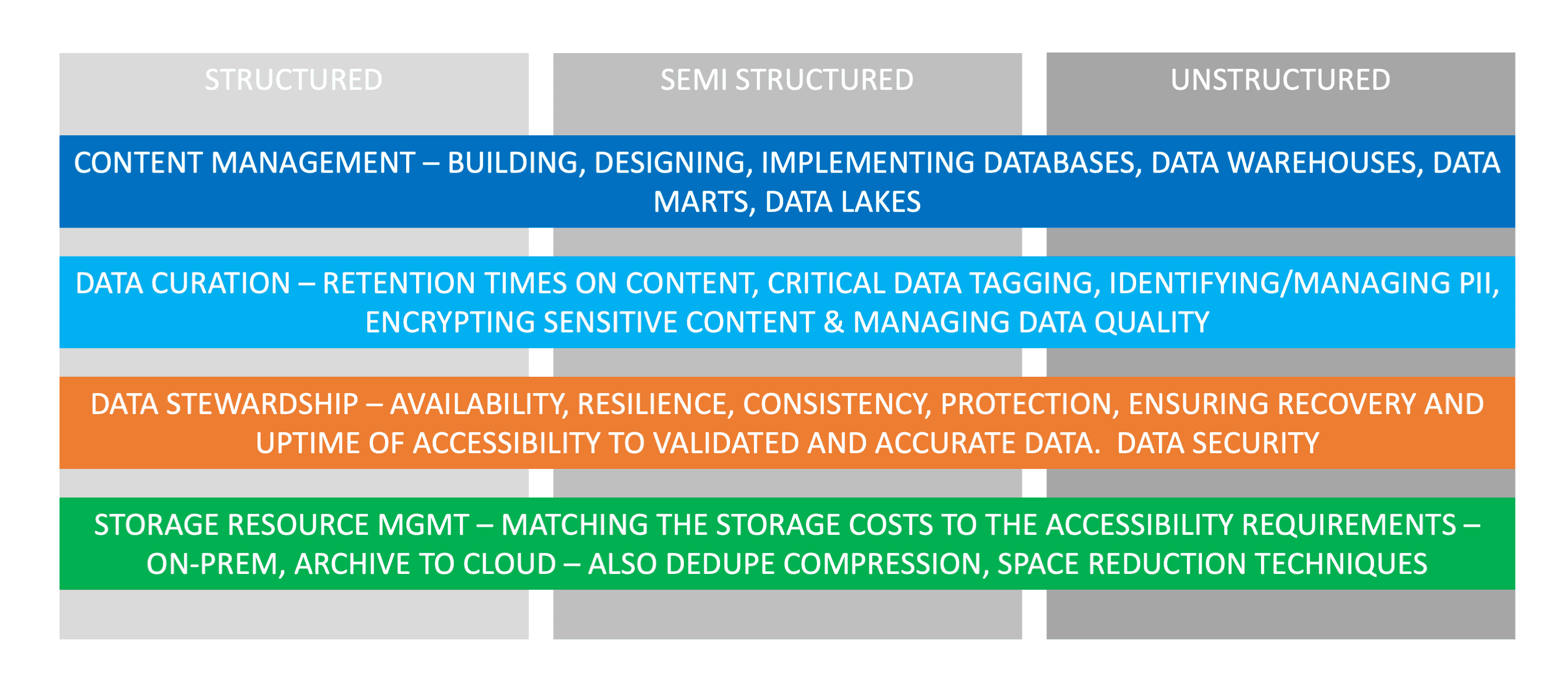
As a data company, the delivery mechanism doesn’t need to be explicit – hybrid or public cloud, it depends on the application, its data and its location. NetApp can operate in both environments, which still remains a unique proposition.
Referring back to Figure 2, NetApp would be best served to act on the four tiers of data management, continuing to provide in-depth capabilities that justify either on-premises deployments or using ONTAP in the public cloud.
There is still opportunity for growth because the insatiable desire to create data will never abate.
Related Content
- Is NetApp Becoming a Service Provider? (November 2017)
- NetApp embraces cloud for future business growth (April 2018)
- NetApp buys into Kubernetes Orchestration with StackPointCloud (January 2019)
- Azure NetApp Files goes GA (June 2019)
- NetApp Delivers Cloud-Native Storage for AWS with FSx for NetApp ONTAP (September 2021)
- NetApp – Transformation, Bifurcation or Re-Invention (February 2022)
- NetApp delivers solid FY2022 growth, but there’s work to do in public cloud messaging (June 2022)
- NetApp needs to make more of the Spot portfolio, as businesses cut storage spending (February 2023)
- NetApp takes Cloud Volumes Cloud-Native in GCP (August 2023)
- Research Note: NetApp teases new disaggregated storage architecture for ONTAP at Insight 2024 (September 2024)
- Insight 2023: NetApp goes back to basics with the launch of ASA C-Series (November 2023)
- Research Note: NetApp introduces updated ASA A-Series hardware at Insight 2024 (September 2024)
- Analysis: NetApp offloads FinOps assets to Flexera (January 2025)
- Analysis: NetApp, Inc. announces Q4 FY2025 and Full Year financial results (June 2025)
Copyright (c) 2007-2025 – Post #cd31 – Brookend Limited, first published on https://www.architecting.it/blog, do not reproduce without permission. NetApp is a Tracked Vendor for data storage solutions.