

At Insight 2022, NetApp announced BlueXP and the standardisation of platforms across the data management and application workload management portfolios. Why is NetApp doing this, and what does it mean for customers?
Background
It’s no secret that NetApp is on a mission to embrace the public cloud, using a hybrid multi-cloud mantra. In recent years the company has developed a cloud portal with many data management features that leverage existing products. The most successful solution to date is probably AWS FSx for NetApp ONTAP, which we reported on earlier this year.
Evolved Cloud
At Insight 2022, NetApp CEO George Kurian talks about a concept called the “evolved cloud”. This is an aspirational position rather than a product and describes a state where data and applications can be deployed and moved around with ease, free from what the company terms “data silos” and “disparate services”.
If we look at the state of the hybrid multi-cloud today, this desire is no surprise. As with most technologies, the adoption of the public cloud, in IaaS or SaaS forms, will have been piecemeal for most organisations. Tentative steps taken to use the public cloud translate into tactical adoption across one or more vendor solutions. Eventually, for many reasons, some or all clouds end up being adopted.
NetApp itself highlighted this situation in some recent survey data. From work commissioned at the end of 2021, we see that 77% of respondents intended to operate a hybrid model into the foreseeable future. While in data presented at a Tech Field Day event in June 2022, we learn that 93% of respondents using the public cloud are using multiple clouds, meaning on premises with two or more public cloud platforms.
Fragmentation
The widespread adoption of many technology solutions won’t be a surprise for any long-running business. Since the days of the mainframe, technology has been adopted tactically and replaced only when necessary. Business decisions made at the time of replacement will look at the technology of the day, not that of the past. Refreshing hardware and software only occur when the business benefit (or implicit risk) outweighs the cost.
The same scenario is now playing out in the public cloud. Organisations have adopted multiple clouds because each has different benefits, whether that be first adopter, cost, alignment to existing enterprise licensing, geographic location, or specific services. After 15 years of public cloud solutions on offer, it’s no surprise that multiple platform adoption exists.
With that in mind, what is NetApp’s strategy?
BlueXP
At Insight 2022, NetApp announced BlueXP, a new platform and portal for the data management components of the NetApp suite of products and solutions. Presumably, the name derives from NetApp’s original blue colour branding with “XP” representing “experience”.
At first instantiation, the BlueXP portal looks remarkably like the existing cloud portal, but the aim is to do much more than that. There are two main reasons we can see for BlueXP.
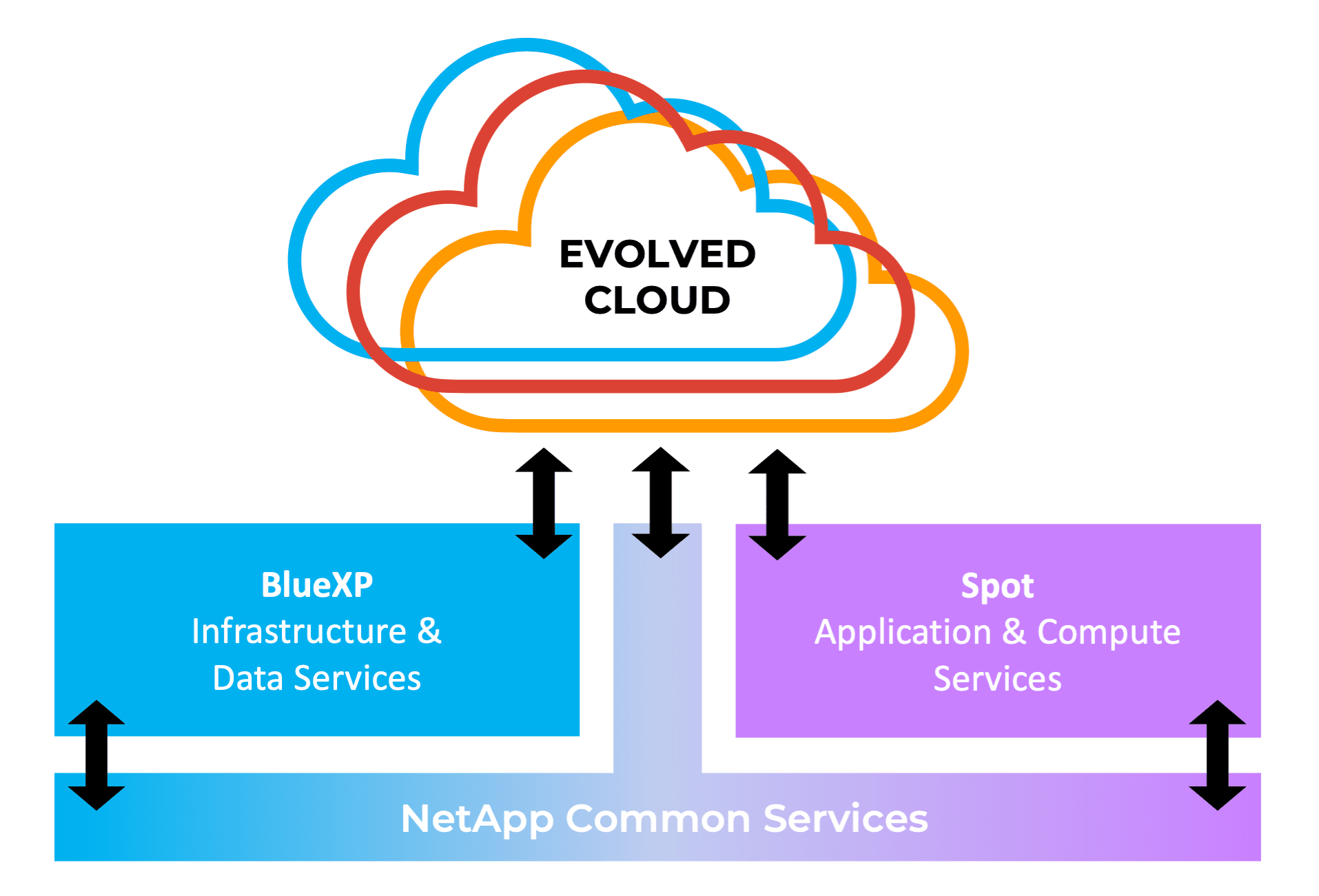
Transition to Services. Every feature of the public cloud is consumed as a service. On-premises vendors are rushing to brand all their existing products as service-based (Dell with APEX, HPE with GreenLake). NetApp is no different, having announced Keystone back in 2019. However, BlueXP is not about delivering storage as a service but instead offering services that are backed by products and solutions from the NetApp portfolio. Customers don’t need to know which products (and in the future, there will be new ones), simply that the service is being delivered as described. Five years ago, we first suggested NetApp was transitioning into a service provider (see this post). The evolution continues with BlueXP.
Emphasise the Spot Portfolio. As shown in figure 1, the announcement of BlueXP also represents a move to harmonise the data management and application management features of NetApp’s portfolio, otherwise known as Spot. In June 2022, we highlighted that the Spot acquisitions could do with greater exposure. With many additions since Spot joined the NetApp family in June 2020 (see this post for more background). The portfolio repositioning places emphasis on a new set of common API services, initially covering aligned credentials/authorisation and reporting. The API bridge offers the promise to do much more, which we’ll discuss in a moment.
Service Tenets
Digging deeper into BlueXP, we can see that NetApp has aligned the existing portfolio of products and solutions against six tenets.
- Storage – hardware on-premises products, software, and service-based delivery in the public cloud.
- Health – Digital Advisor with ActiveIQ, ONTAP Essentials
- Protection – Backup & recovery, replication, ransomware protection
- Governance – Data classification, digital wallet (Keystone, STaaS, licence management)
- Observability – Cloud Insights
- Mobility – Copy & Sync, tiering, edge caching.
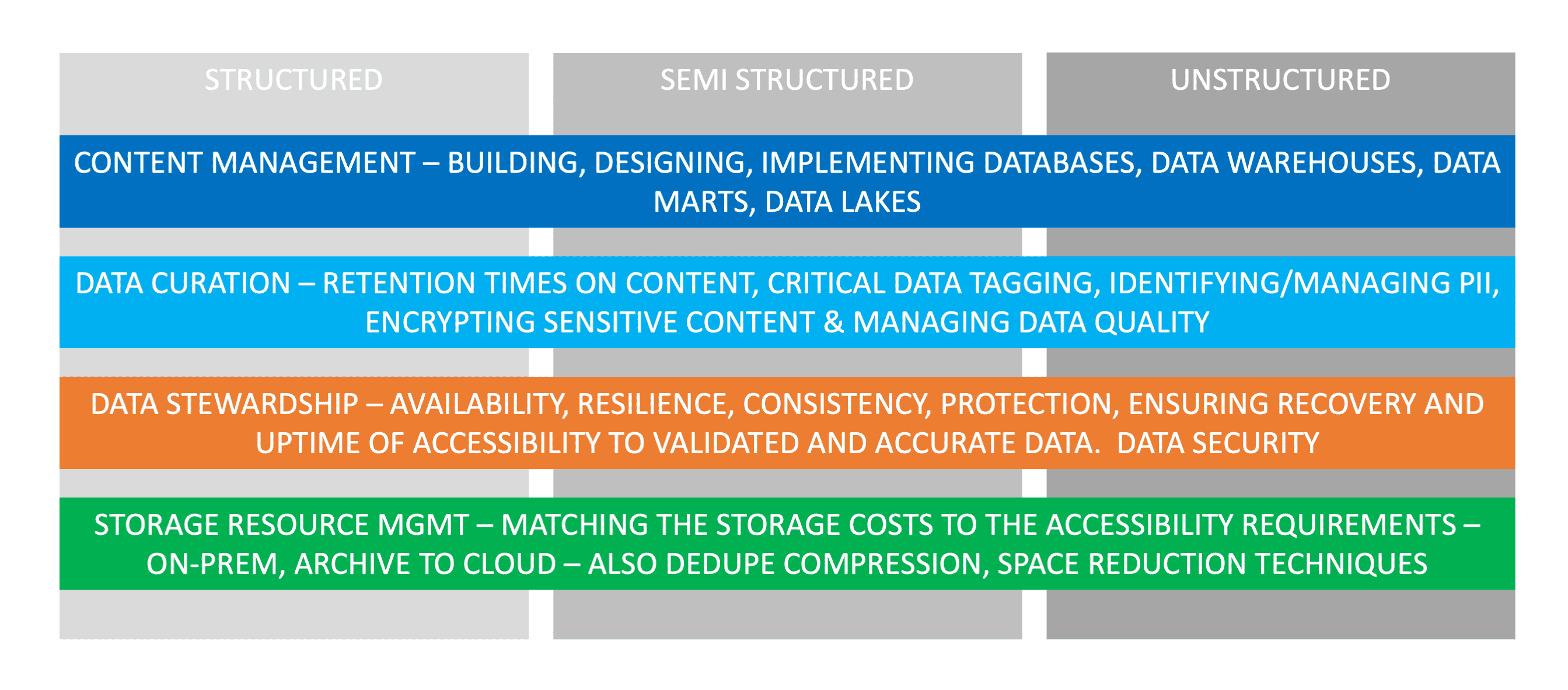
This positioning addresses the service model much better than individual products. NetApp already has the pieces there but wasn’t quantifying them in a way that explicitly called out the service model. Think about how these services fit into our data management hierarchy (figure 2), and we can start to see the jigsaw pieces coming together.
Holistic
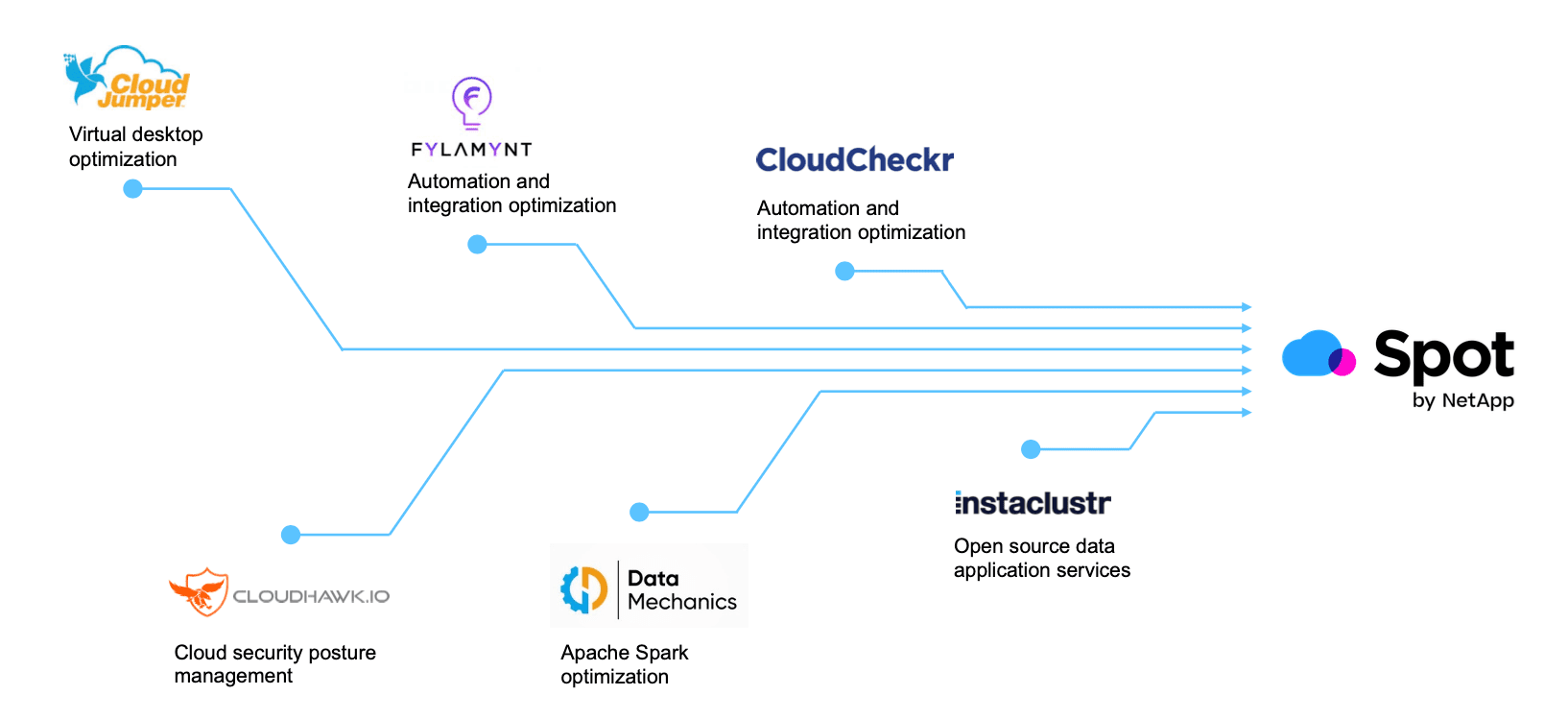
What about Spot? NetApp finds itself in an interesting position, having acquired Spot and half a dozen other optimisation start-ups. None of these is particularly aligned with the data management solutions, creating a degree of bifurcation in the portfolio. However, BlueXP offers the chance to correct that. We can envisage an opportunity to bring features of Spot together with the BlueXP portfolio and build something greater than the two parts. For example, Spot networking tools could identify increased ransomware threats and automatically retain additional snapshots. NetApp could also create new services, such as a platform to show sustainability metrics across data storage and applications. The opportunities are endless and subject only to the creativity of the teams exploiting the new sets of data BlueXP and Spot represents.
The Architect’s View®
Re-invention can be a long journey and one that’s fraught with risks. Vendors don’t want to jeopardise existing revenue, but at the same time, they have to recognise that the IT world doesn’t stand still. Inflection points exist and must be taken. The alternative is to risk falling into obscurity. Whether NetApp has taken the right approach (or not) remains to be seen. We talked about NetApp hitting an inflection point back in 2014 and covered the topic from a customer perspective back in 2020. The company has definitely taken the lead in transforming from a hardware vendor. We hope to see more about the Spot/BlueXP synergy and how this takes NetApp further away from the dependency on selling storage hardware.
Copyright (c) 2007-2022 – Post #cfa2 – Brookend Ltd, first published on https://www.architecting.it/blog, do not reproduce without permission.