

In October 2023, NetApp held its annual Insight event, announcing a QLC-based version of the All-SAN Array, known as the ASA C-Series. The company is focusing on the basics and core technologies in an attempt to kickstart growth.
Background
In October 2023, NetApp returned to Las Vegas with the first in-person Insight event since 2019. Leading the announcements was news of the new ASA C-Series, a cost-conscious or capacity-optimised version of the All-SAN Array (ASA).
The ASA was first introduced at the last in-person Insight event in October 2019. As a “block-optimised” version of a traditional AFF ONTAP filer, the ASA simplifies certain failover features that enable active-active I/O paths and no downtime impact for block protocols (file protocols have a delay factor). As NetApp has many customers that use AFF ONTAP purely for block-based workloads, the ASA addresses an issue that competitive products didn’t have. Check out NetApp Technical Report TR-4968 for details on the availability improvements in ASA.
Fast forward to May 2023, when NetApp relaunched the ASA as part of a revamp of the ONTAP portfolio. This announcement followed on from the introduction of a cost-optimised AFF, the AFF C-Series, launched in February 2023.
QLC
In isolation, introducing a QLC NAND-based solution makes a lot of sense for customers. Flash continues to encroach on HDD-based arrays, while not all applications need sub-millisecond I/O response times. The C-Series enables NetApp to address a broader market and replace HDD or hybrid arrays for its own customers and in competitive take-outs.
The following table summarises the customer choices now available.
| Use Case | Low-Cost, Secondary Data | Cost/Performance optimised | High Performance/Tier 1 Workloads |
| Unified Block/File | FAS | AFF C-Series | AFF A-Series |
| Block-Only | ASA C-Series | ASA A-Series |
Note that the original platforms that offer high-performance NAND flash are the A-Series solutions, with sub-millisecond latency (potentially as low as 100µs). It’s unlikely that NetApp will choose to fill the final box with a low-cost ASA, as the premise of the ASA platform is to address uptime and failover for mission-critical applications.
Models
The new ASA has three model configurations, as follows.
- ASA C250 – 122TB – 734TB raw in 2U, 4.4PB raw maximum when clustered.
- ASA C400 – 122TB – 1.46PB raw in 4U+2U drive shelf, maximum clustered 8.8PB raw.
- ASA C800 – 182TB – 3.7PB raw in 4U, maximum 22.2PB raw when clustered.
All systems support NVMe/FC, NVMe/TCP, FCP and iSCSI. There’s no doubt that these systems scale and will deliver in the same manner as the existing NetApp portfolio.
Competition
In our May 2023 post covering the ASA relaunch, we highlighted the alignment of the NetApp portfolio with Pure Storage FlashArray. Here’s how things look now.
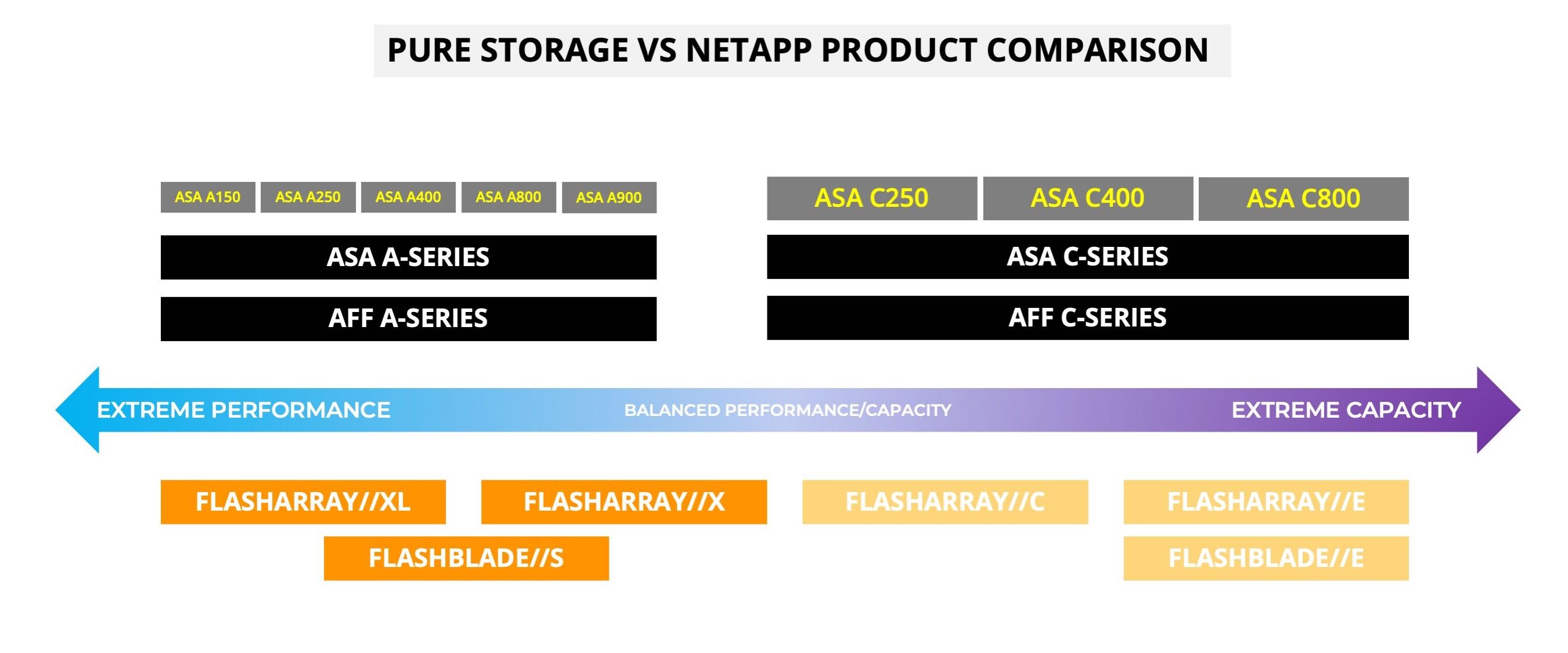
FlashArray is more aligned to ASA, while FlashBlade is more aligned to AFF, although there are issues with making this direct comparison, so we should use it only as an approximation. The lighter orange-coloured Pure arrays use QLC, whereas the darker orange models use standard NAND flash. The equivalent NetApp products scale ASA and AFF solutions in two distinct families.
It’s not possible to make a direct comparison between platforms, but we can see that NetApp has widened its portfolio to address the capabilities in performance and scale of its competitors. However, where Pure Storage is being open about charging $0.20/GB for FlashBlade//E at scale, we haven’t seen any NetApp competitive pricing being announced, other that $0.50/GB mentioned in this blog post by Sandeep Singh.
The Architect’s View®
NetApp is clearly building out the ONTAP portfolio to address areas where the competition (particularly Pure Storage) has competitive solutions in place. Unfortunately, NetApp is well behind the curve; FlashArray//C was first announced in September 2019, over four years ago.
Either NetApp didn’t see this gap in its portfolio, or the QLC media required to deliver AFF and ASA C-Series at scale simply wasn’t available. If the former premise is true, then we can posit that NetApp is in catchup mode and will continue to be more forward in bringing new solutions to the market. If the issue is the latter, then this demonstrates Pure Storage’s advantage with the DirectFlash strategy.
We see the evolution of NetApp’s all-flash ONTAP portfolio as positive but still lagging behind in innovation compared to its competition. Additionally, the launch of a new ONTAP platform as the lead story for Insight 2023 underlines a return to core values and the software engineering that launched the company 30 years ago. Back in 2021, we thought that NetApp might use the public cloud as an escape route from the decline in on-premises spending. Unfortunately, that view is changing, as we see a stumble in the public cloud and a return to basics, with more focus on ONTAP. This is a path NetApp has travelled many times, most notably when times get tough.
Copyright (c) 2007-2023 – Post #a2a2 – Brookend Limited, first published on https://www.architecting.it/blog, do not reproduce without permission.