

NetApp Inc. recently posted positive results as the company recovers from the effects of business downturn during the coronavirus pandemic. With ONTAP deployed across three major public cloud platforms, will this be enough diversity to create the momentum for a complete transformation of the business?
Background
NetApp is part-way through a multi-year journey of reinvention that will move the company closer to public and hybrid cloud. This strategy has seen the deployment of ONTAP into Microsoft Azure, Google Cloud and now AWS as native service offerings. The term “native” is important as these services are directly integrated into the cloud ecosystem, specifically for billing, identity management/security and API automation.
As part of the strategy change to cloud, NetApp now breaks revenue down into the following two categories:
- Hybrid Cloud offers a portfolio of storage and data management solutions that help customers build and integrate on-premises and private cloud environments. This portfolio is designed to operate with public clouds to unlock the potential of hybrid, multi-cloud operations. Hybrid Cloud is composed of software, hardware, and related support, as well as professional and other services.
- Public Cloud offers a portfolio of products delivered primarily as-a-service, including related support, and made available on the world’s leading clouds. This portfolio includes storage services, cloud automation and optimization services, and cloud infrastructure monitoring services.
From briefings we’ve received in the past, we believe that Hybrid is still essentially on-premises infrastructure with links to the public cloud for features such as data protection, data mobility and platform management. Public covers the services delivered through NetApp’s cloud portal and the cloud-native storage services in each environment.
Small Base
Although NetApp highlights a 155% year on year revenue increase, this figure is from a small base relative to other earnings ($31million in 1Q2021 to $79 million in 1Q2022). As a percentage of overall revenue, the portion attributed purely to the public cloud was 2.4% in 1Q2021, rising to 5.4% in 2Q2022 (although total revenue was down for the quarter). As we might expect, the gross margin on revenue from the public cloud is slightly higher than hybrid, although not that significantly better (70.9% compared to 69.2% in the latest quarter). The latest reported data may have some cost implications for pre-seeding the AWS environments as previous quarters have seen greater differences in margin values.
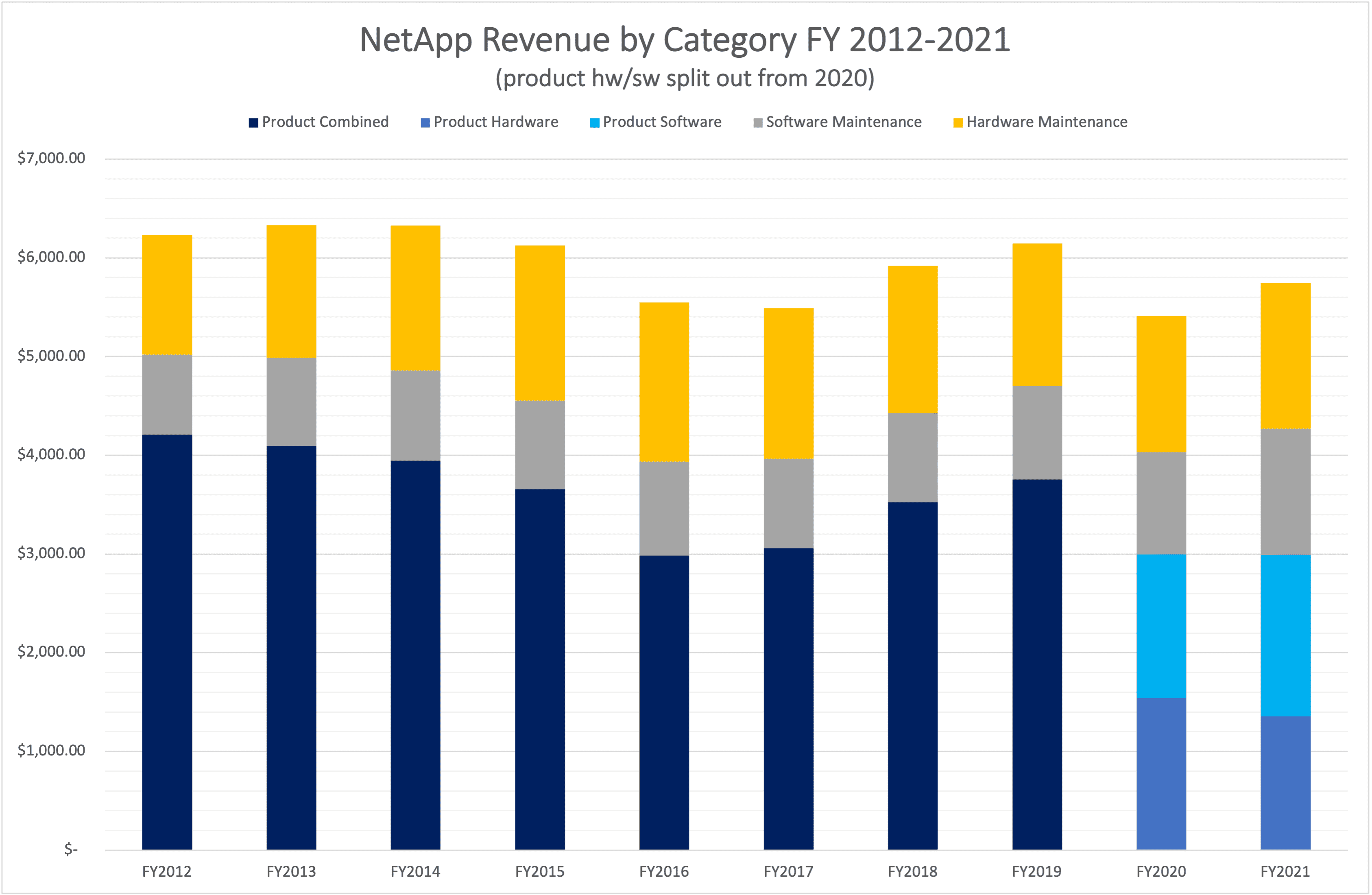
Beginnings
Naturally, every new service needs to start somewhere. In 2014 we wrote an opinion article that suggested NetApp was at an inflection point. ONTAP was seen as the answer for everything, while new vendors came to the market with creative solutions using all-flash or software-defined storage.
It’s interesting to note that 12 months after that article, NetApp acquired SolidFire and started the road to cloud-focused services. We first started hearing about the concept of the data fabric in 2016, including a Storage Unpacked podcast we recorded with then CTO Mark Bregman. Looking back at the presentation notes from a meeting I had with Bregman in June 2016, we see the beginnings of the cloud services that are now available from NetApp today. The journey we highlighted in 2014 is very much a strategic direction for NetApp in 2021.
Growth
How does NetApp now grow this new business into one that can sustain the company for the future? There are some key factors that will be essential to ongoing success.
Innovation – NetApp has been successful for the last 30 years because the company was an innovator in data storage. The company pioneered the concept of network-attached storage (although it didn’t directly invent it), gaining significant momentum in the 1990s and early 2000s. This success was driven by features such as snapshots, efficient replication, and the ability to provide multi-protocol access to one data set.
Data growth – The last three decades have seen an incredible explosion in unstructured data, created by many different sources, both human and machine-made. This growth is unlikely to abate. However, the volume of data generated will require some degree of pre-processing or edge technology.
Partnerships – NetApp has already forged strong partnerships with major public cloud service providers to the extent that storage services from NetApp are provided natively within public cloud infrastructure. The cloud vendors need to continue to feel that using NetApp technology is more practical than building their own solutions.
Demand for hybrid computing – If the public cloud vendors have their way, there will be no on-premises computing infrastructure in the future. This scenario has been (and likely will always be) an unattainable dream. The hybrid model will remain for IT organisations that must guarantee data availability and manage their data (and risk) as key corporate assets. As we’ve seen in the market, public cloud scales to a point where a return to on-premises infrastructure becomes financially viable.
Future
How do these requirements translate into a positive NetApp future? Going back to the idea of the Data Fabric, it’s clear that where data lives and how it is managed will influence the long-term strategy for NetApp. Some components are in place, while others still have gaps. Ongoing success means creating solutions for customers that differentiate and complement the public cloud.
Edge data processing is one area NetApp could offer differentiation. ONTAP and StorageGRID offer virtual deployments without needing to install dedicated appliances. NetApp has already demonstrated an Edge ONTAP solution (see figure 2, Barcelona 2018).

Interoperability between clouds also offers benefits. Today customers can move data from on-premises to the public cloud with SnapMirror, but not directly between clouds. The advantage of using SnapMirror is the highly granular level of differentials maintained between active and replicated data. This feature reduces network data costs and helps make data mobility between clouds a practical reality.
Service-Focused
The ideas already discussed are very hardware-focused and represent a legacy approach to infrastructure deployment. NetApp already offers service-based consumption through Keystone, which we discussed in more detail last year. As part of the move to a service model, there’s an opportunity for NetApp to align object and file services into a single platform. This would require some product engineering but ultimately could offer the promise of “any protocol, any location” for customers to choose where and how to store their data. Rather than thinking “StorageGRID” or “ONTAP”, the customer deploys a Keystone appliance with the relevant services enabled.
The core for this architecture could have been delivered through NetApp HCI (including greater flexibility with SolidFire) and is, in our opinion, a missed opportunity. In any event, Keystone and the associated services need greater focus and a more compelling use case story.
The Architect’s View™
The green shoots of growth a clearly visible in recent financial statements. Taking the strategy to the next level will be the success/failure point for NetApp, as we’re arguably at another inflection point for the company. File services are “done”, but the constant need to evolve demands more innovation. There’s a balance to be made between generating revenue from hybrid solutions and the opportunity of pure public cloud. The public cloud model is a long-term risk, as cloud vendors could choose to introduce new competing services or build proprietary solutions, shutting out NetApp over time (hence the previous reference to ongoing partnerships). As a result, the hybrid approach will be critical for success for some time to come.
One other aspect to bear in mind is that all of the discussions so far are storage, not data orientated. Content-focused solutions could be another area of future growth. What can we expect next, and will some of the future thinking be demonstrated at Insight in October 2021? We look forward to finding out.
Copyright (c) 2007-2021 – Post #df75– Brookend Ltd, first published on https://www.architecting.it/blog, do not reproduce without permission.