
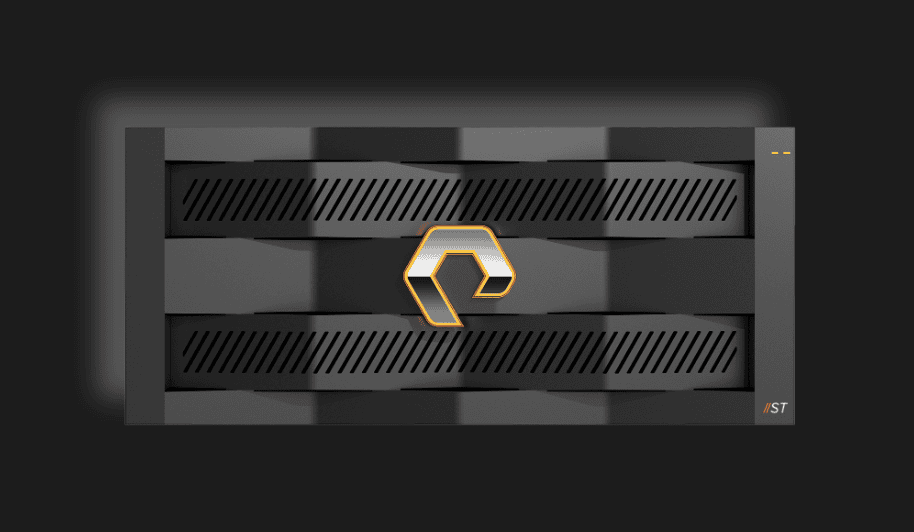
Pure Storage, Inc. has announced a new member of the FlashArray family – FlashArray//ST. This latest appliance is built with high-endurance flash and standard SSDs, addressing the needs of the highest-performing applications.
Background
Pure Storage has announced FlashArray//ST, a new member of the FlashArray family. Built with high-endurance flash, FlashArray//ST is targeted at latency-sensitive workloads that need high I/O density, such as OLTP applications, databases and healthcare solutions.
“ST”, as we shall call it from now on, differs from the traditional FlashArray products in that the storage media is not “homegrown”. In all existing FlashArray and FlashBlade products, Pure Storage uses DirectFlash modules, a custom design that enables drive capacities up to 300TB (by comparison, the largest competitor SSD is 122TB). However, in ST, the modules are a high-endurance “SCM” (Storage-Class Memory) device, typically built with SLC NAND.
SCM Array
Why use SCM? The concept of a storage array built from storage-class memory is not new. We discussed the Vexata platform many years ago, which had a proof-of-concept design using Intel Optane (discussed here). Super-high-performance devices have also been built by Violin Memory and EMC (when it acquired DSSD). Infinidat currently markets the SSA, which, although not using SCM per se, delivers similar levels of performance to ultra-low latency systems.
A storage appliance built from SCM-like NAND storage can deliver much lower latency than traditional systems while offering a level of I/O density (IOPS per TB of capacity) not capable in most all-flash systems.
Media
Although we don’t know the specific media in use by the ST platform, we do know that the drives are 3.2TB in capacity, for a total of around 100TB per system. We can see media such as the KIOXIA FL6 fitting the bill here. The FL6 is built from 96-layer BICS SLC flash with 60 DWPD (device writes per day) endurance and write latency as low as 8µs (microseconds).
An endurance level of 60 DWPD is huge. For 3.2TB drives, this equates to just over six petabytes of write I/O that can be absorbed per day over the lifetime of the media, typically five years (we haven’t included any RAID/protection I/O overhead in that assumption). There are very few, if any, workloads that could compromise this level of endurance.
Tiering
Although tiering is not part of the Pure Storage lexicon, we are seeing a greater acceptance within the company for the need to offer multiple levels of performance for applications. Zero move tiering, for example, enables a form of QoS for existing systems.
Similarly, the ST platform is an effective “tier-0” performance tier in the same way that all-flash systems were initially used as a top tier around fifteen years ago.
Some concepts in technology (and storage in particular) never change. There’s always a requirement for a faster tier of storage than currently available in the market, and when it is delivered, the use case is typically a small subset of all applications (the classic cost/performance/capacity calculation).
In this respect, ST will be no different. However, the platform does support all the existing data mobility capabilities of FlashArray that are delivered through Purity, such as replication and snapshots. As a result, we can expect to see Pure Fusion providing the ability to move data into and out of a FlashArray//ST layer.
The Architect’s View®
FlashArray//ST won’t be needed by all of Pure Storage’s existing customer base. However, the product has been shipping secretly to selected customers for two years. As a result, this is not an entirely new market for the company but one they have clearly come to believe is worth further investment.
Tiering can risk data fragmentation, with workloads placed incorrectly on the wrong type of storage. So, it will be essential that Pure Storage provides the data mobility capabilities for businesses to fully exploit the new platform. Tie that into a commercial model that enables customers to buy/rent ST capacity by the terabyte, and we can see ST being a popular add-on to traditional FlashArray.
Once again, Pure Storage does what it does best – spotting a niche in the market and building a new product around it. Although, as we’ve highlighted, the ultra-high-performance appliance is not new, the Pure ecosystem (and commercial models) provides the opportunity to make the product a success.
Where could things go next? Obviously, Pure Storage has chosen to go “off-piste” and build a product using traditional SSDs. Some people might question this decision. However, creating a new product in a relatively niche media category is a risk; using commodity SSDs mitigates this in the first instance.
It is possible (subject to demand) that SCM NAND could be incorporated directly into DFMs, even mixed within systems. This is potentially possible with the recent //EXA announcement that uses standard disk shelves. A decision to go down this route is likely to be based on customer demand and the R&D cost of development.
It will be interesting to watch the relative success of FlashArray//ST, especially in a mixed portfolio of products. In addition, it will be even more telling if Pure’s competitors decide to release equivalent products.
Time to dust off DSSD, Dell Technologies?
Copyright (c) 2007-2025 – Post #1a2b – Brookend Limited, first published on https://www.architecting.it/blog, do not reproduce without permission. Pure Storage is a Tracked Vendor for data storage solutions.