
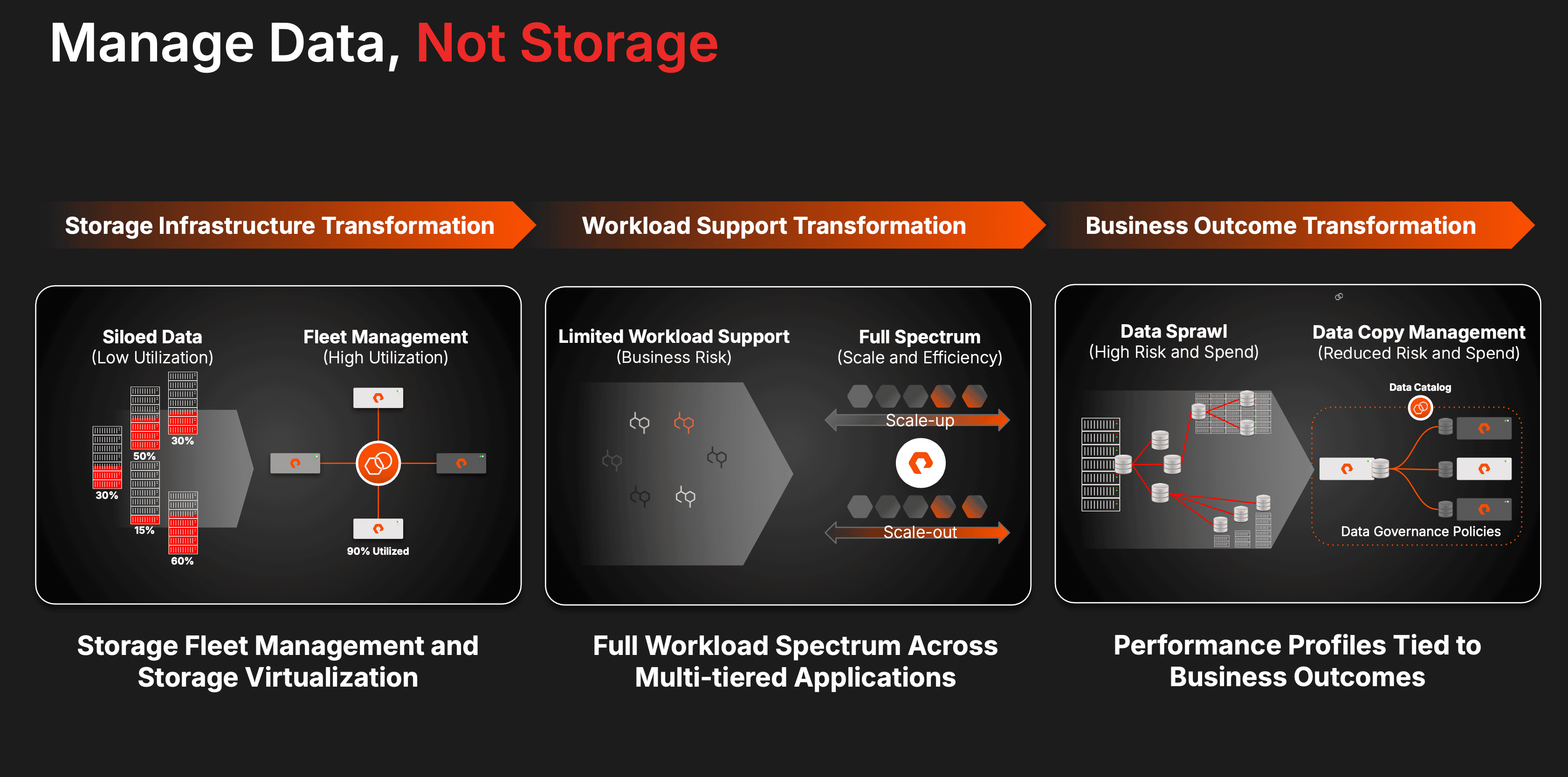
Pure Storage has announced Enterprise Data Cloud, a strategy focused on managing data rather than physical infrastructure. The concept is supported by a series of hardware and software upgrades that underpin the ability of customers to manage data assets, while Pure Storage focuses on managing the infrastructure.
Background
At Accelerate 2025, Pure Storage, Inc. introduced a new strategy called the Enterprise Data Cloud (EDC). Although the name may be new, the concept already existed in previous messaging from the company that focused on data storage as a platform. You can listen to some of the background on the thinking behind EDC in a recent podcast episode we recorded with EMEA Field CTO at Pure Storage, Patrick Smith (embedded here).
Platform
The aim of EDC is to remove the management overhead of storage from the customer and abstract much of the complication in dealing with hardware that has been part of the industry for the last quarter of a century.
Looking back to the start of the new millennium, we can observe that the discipline of the storage administrator was one widely employed across enterprise IT. Unfortunately, “administration” describes the majority of tasks performed by storage admins – routine provisioning and decommissioning, with constant workload balancing and reallocation (especially in larger environments).
Storage administration tasks don’t scale. This represents a challenge to accommodate increasingly greater volumes of data storage without an intervention to resolve the problem. This is the benefit offered by the Enterprise Data Cloud vision.
EDC
Enterprise Data Cloud, which creates a name for the framework that Pure Storage has been delivering for many years, addresses many aspects of storage infrastructure management.
- Automation – everything from self-service provisioning and workflow automation to workload balancing, identifying and resolving performance hotspots, data replication and data protection (for ransomware protection).
- Policy Driven – the definition and application of system-wide business policies to infrastructure, for example, to ensure consistent application of security rules or data protection standards. This is true “fleet management” in action.
- Interchangeable infrastructure – with just two platforms, FlashArray and FlashBlade, Pure Storage can address every type of customer data requirement while matching performance and capacity with a “plug and play” architecture that needs no “forklift upgrade” work.
None of these capabilities should surprise regular readers of our research. We discussed true storage-as-a-service back in 2022 with Pure Storage GM of the Digital Experience business unit, Prakash Darji (link here, video embedded below).
Both Fusion (platform management) and Pure1 (platform analytics) provide the basis for customers to deploy and operate infrastructure at scale without needing extensive teams of storage administrators.
Of course, the benefits work both ways – for customers and for Pure Storage. With a flexible infrastructure design, Pure can optimise the physical hardware used to deploy the service delivered to a customer, mixing and matching the hardware and minimising the overhead of “seeding” locations or potential future requirements. This is a capability enjoyed by public cloud vendors but challenging to implement on-premises without the proper hardware and software solutions.
New Hardware
So, what was announced at Accelerate 2025? We’ve already covered the new FlashArray//ST platform in a separate research note (available here). The remaining announcements cover FlashArray, FlashBlade and DFMs.
FlashArray
FlashArray//XL has been upgraded to R5 (release 5), with support for Emerald Rapids processors and up to 1.9PB of capacity (7.4PB effective) in a single system. The new hardware uses PCIe Gen 5.0 and supports 400Gb Ethernet connectivity.
We discussed FlashArray R4 in a research note from 2023 (available here), where we highlighted the FlashArray cadence and internal architecture. FlashArray//X was first introduced in 2017, with R2 in 2018, and R3 in 2020. Generally, new releases have followed the roadmap of Intel server processors and associated capabilities, including memory and I/O interfaces.
A regular cadence of hardware upgrades is essential because it increases system performance in the same footprint, provides support for higher capacity DFMs and enables other data services. For example, as DFM density increases, PCIe 5.0 will be essential to gain the most throughput without creating internal bottlenecks.
FlashArray will also now support object storage, which is useful for edge environments that don’t financially justify a FlashBlade deployment.
FlashBlade
FlashBlade//S, first announced in June 2022 (coverage here), is upgraded to release 2 (R2), also supporting Emerald Rapids processors. Pure Storage claims up to 50% performance improvement for specific workloads, compared to R1, with support for new 300TB DFMs on S200 and S500 models.
DirectFlash Modules
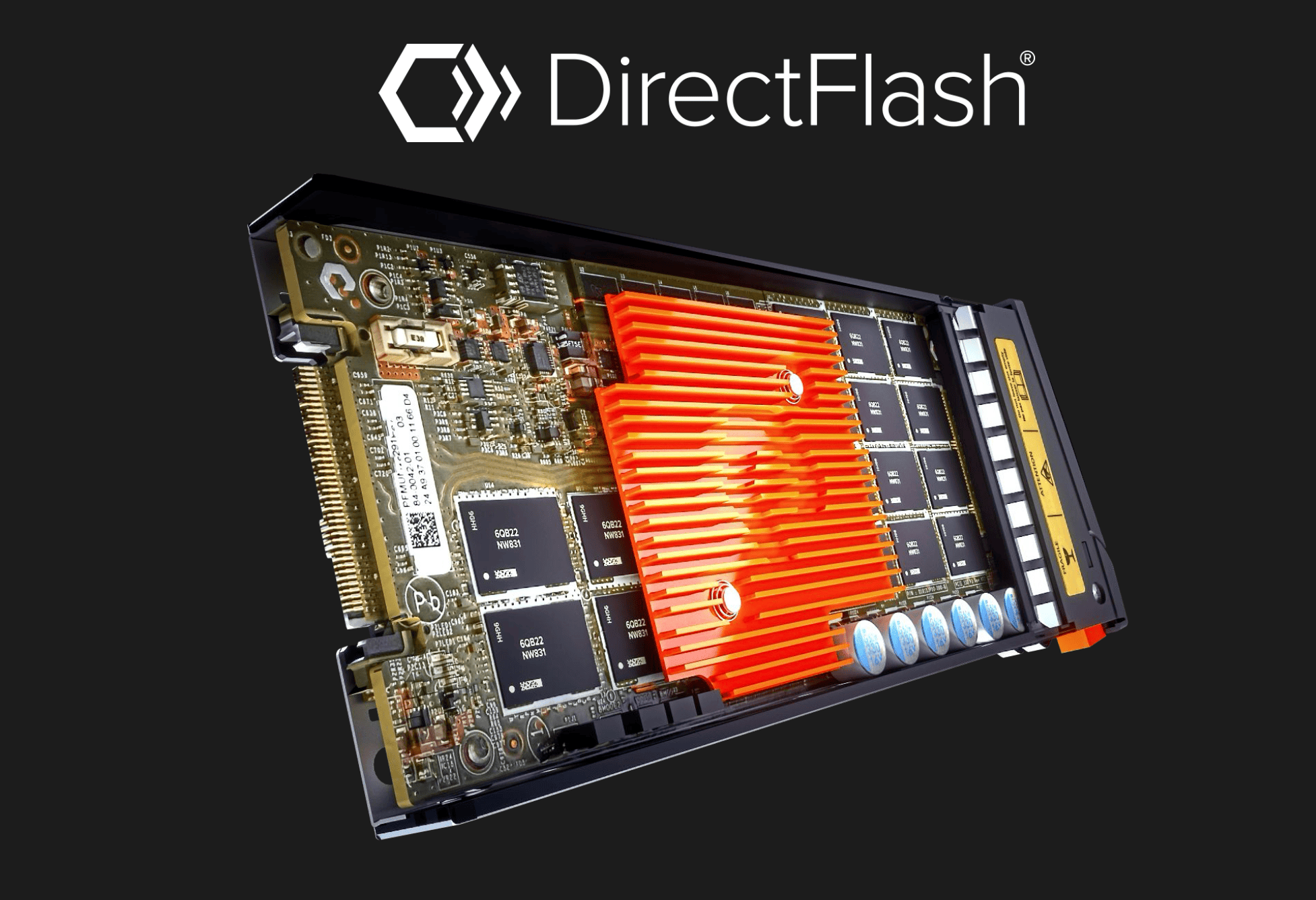
After much teasing and “pre-announcing”, 300TB DFMs are finally here. Based on QLC technology, the latest iteration doubles capacity again. In our coverage from 2023 (available here), Pure Storage promised 300TB drives by 2026 and has delivered as predicted.
Of course, since the 300TB DFM was pre-announced, the market has been catching up with several vendors introducing 100+TB SSDs (see our coverage here). Looking purely at the space occupied by a standard U.2 SSD compared to a DFM, the difference (if any) might not be significant. However, most of the 100+TB SSDs on the market are read-biased devices and not designed for general write I/O. In addition, each drive acts independently, compared to an abstracted FTL in DFMs (see this article for a discussion on the differences).
Vendors of traditional SSDs need to add software enhancements to compensate for the issues of imbalanced device performance, as we discuss in this article from 2023. What this means is additional complexity, as larger drives are not just a drop-in replacement for smaller ones.
Software
From a software perspective, EDC introduces additional workflow orchestration capabilities. This includes automation templates and “ecosystem connectors” that deliver pre-built integrations for Pure Storage hardware, including popular automation solutions.
New integrations have been released with Rubrik Security Cloud and Crowdstrike LogScale. We see these relationships as increasingly important, where centralised storage offers a “last line of defence” against malware and ransomware attacks. Using the storage platform for data recovery in disaster-type applications is also likely to be much quicker than restoring from secondary media. However, businesses should have the choice of multiple recovery techniques to mitigate against attacks on the backup infrastructure.
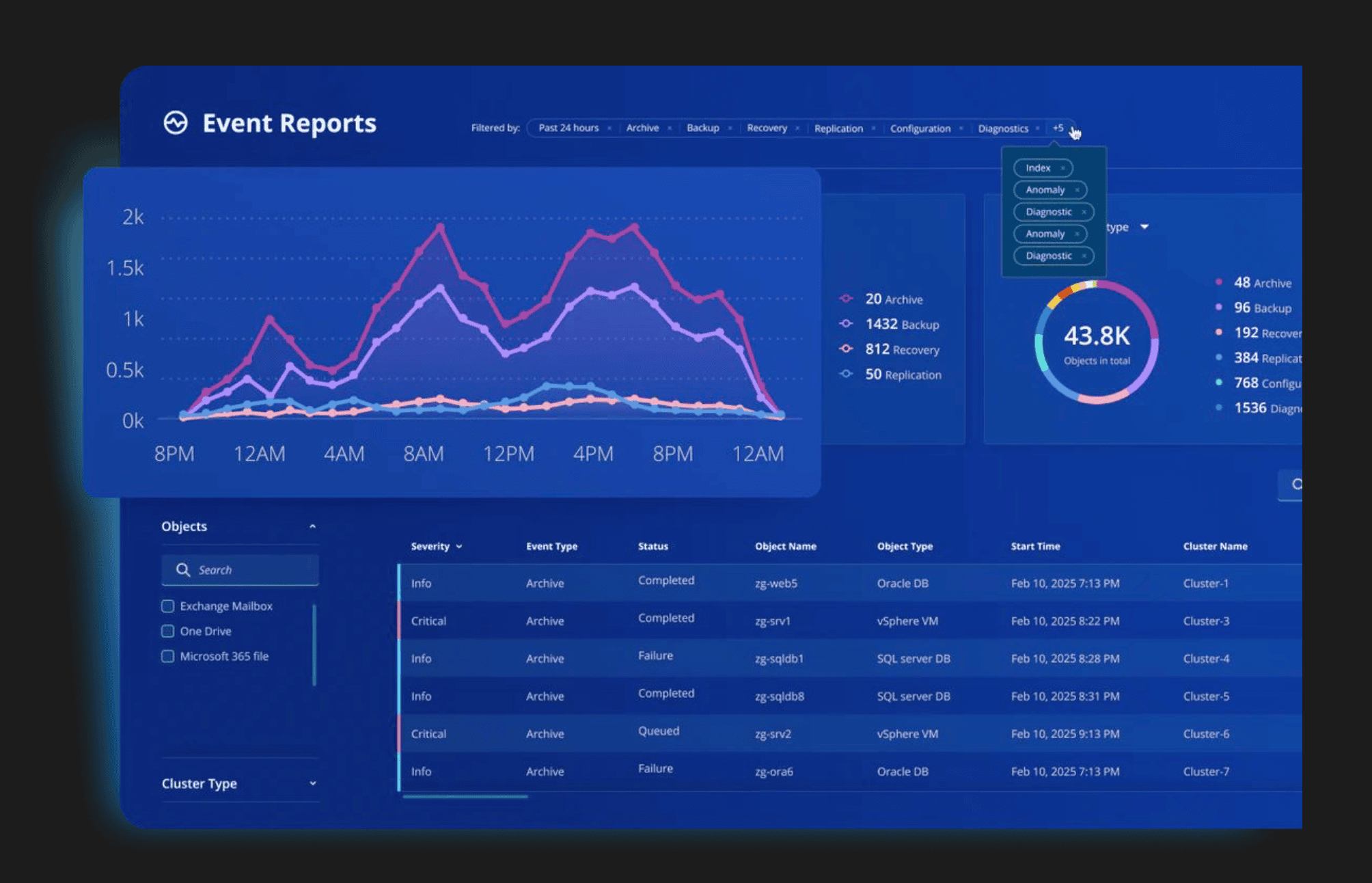
Pure Protect (for VMware workloads) now supports site-to-site recovery. AI Copilot has gained additional enhancements as Pure Storage experiments with the best way to add AI capabilities to storage management tasks.
Evergreen//One
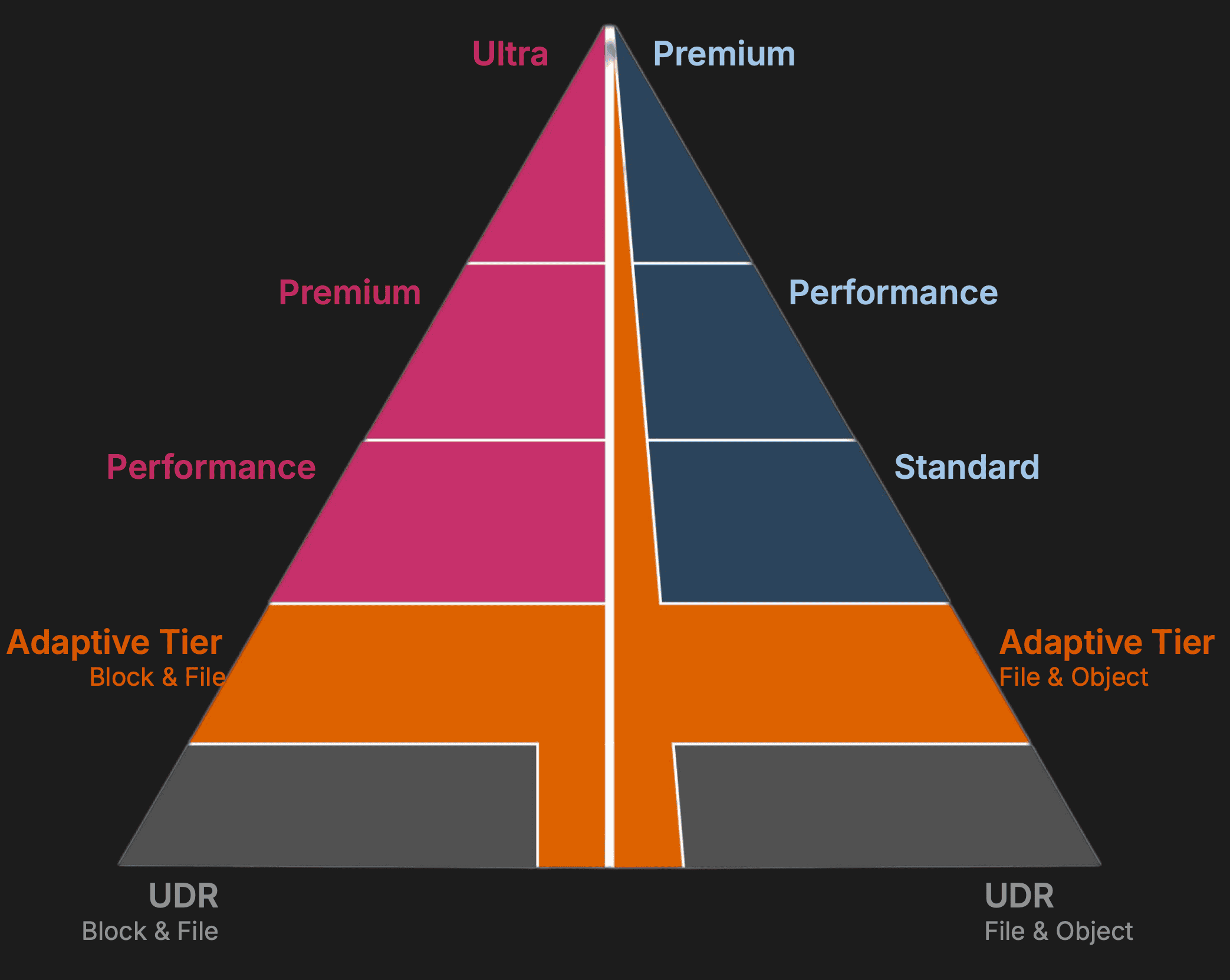
Evergreen//One continues to expand on the capabilities offered through the “as-a-service” model. Customers now have access to an “adaptive tier” of performance in addition to higher levels of capability. In-place adaptive tiering is more of a quality of service (QoS) model rather than physical tiers of storage.
The benefits of this approach are clear; data can be left in place and doesn’t need to be moved. Traditional tiering is a reactive process and inevitably plays “catch up” to real performance needs. However, many storage architectures deliver fixed levels of performance determined by the hardware used. This makes tiering a much more complex process, wasting CPU and I/O cycles to constantly chase a moving target.
We’re interested to see how Pure Storage will evolve adaptive tiering, particularly adding more options than just “hot” and “cold”, which are the choices today.
The Architect’s View®
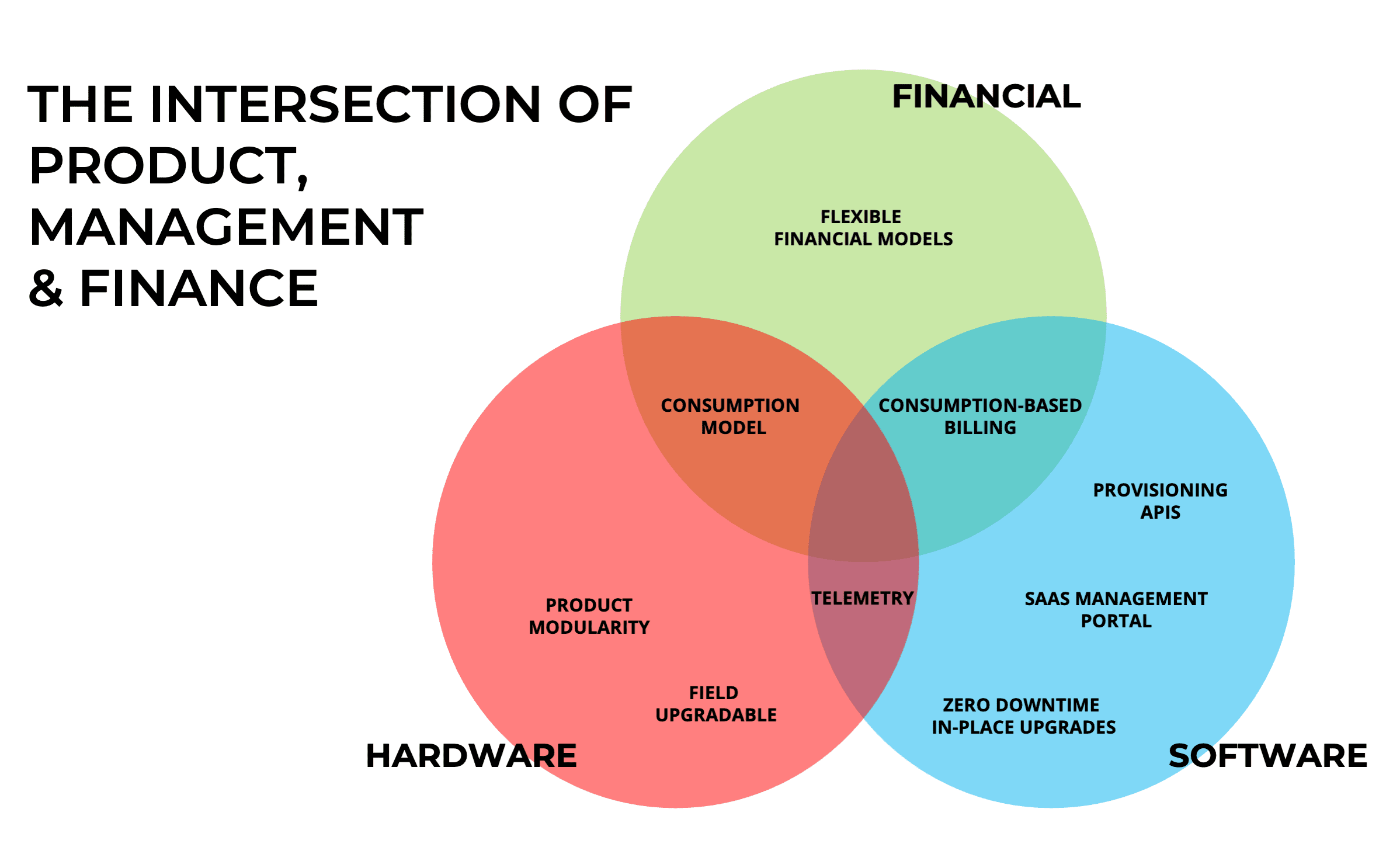
Enterprise Data Cloud represents a crystallisation of a story Pure Storage has been telling for many years. The company has already discussed the concept of a “platform”, but now we see this manifested in an architecture that combines dynamic hardware (FlashBlade & FlashArray), and software (Fusion & Pure1) combined with flexible commercial models.
We represented this triumvirate in previous content, shown here as Figure 4. This diagram indicates that neither software, hardware, nor financial alone can deliver the most comprehensive solution, as at each of the four intersections, these aspects must be designed to work with each other.
So, from an infrastructure perspective, EDC takes away complexity for IT organisations, allowing much greater scale to be achieved without an equivalent increase in the workforce. It also benefits Pure Storage by making infrastructure deployment in a SaaS model more efficient.
Let’s just focus for a moment on the “data” aspect of EDC. In reality, EDC today is focused on infrastructure management, but increasingly, businesses want to manage data assets (a topic we discussed in a podcast over five years ago).
We are interested to see where Pure Storage will go next and how efficient storage management will be transformed into data management. We believe that data management is a greater challenge and a bigger prize for infrastructure vendors. However, it requires a greater level of abstraction than discussed today. Data management needs to be abstracted further from the hardware infrastructure, a challenge that most vendors seem to ignore.
We believe Pure Storage is in a strong position to evolve the narrative and introduce data management capabilities, especially data workflows and building data repositories. This area may represent the next area of growth for the company, especially if Pure Storage wants to establish a greater presence in the public cloud.
Copyright (c) 2007-2025 – Post #24ab – Brookend Ltd, first published on https://www.architecting.it/blog, do not reproduce without permission. Pure Storage is a Tracked Vendor by Architecting IT in storage systems and software-defined storage.