
Pure Storage has unveiled a new member of the FlashBlade family, specifically targeted at AI workloads. The FlashBlade//EXA is a disaggregated solution with all the core FlashBlade IP at its heart. Why create a new platform, and why is it needed for AI workloads?
Background
Before diving into a technical discussion on the EXA platform, it’s worth looking at a chart shared by Pure Storage during our briefing. The company has divided the demand for AI storage into three distinct categories, as shown in Figure 1.
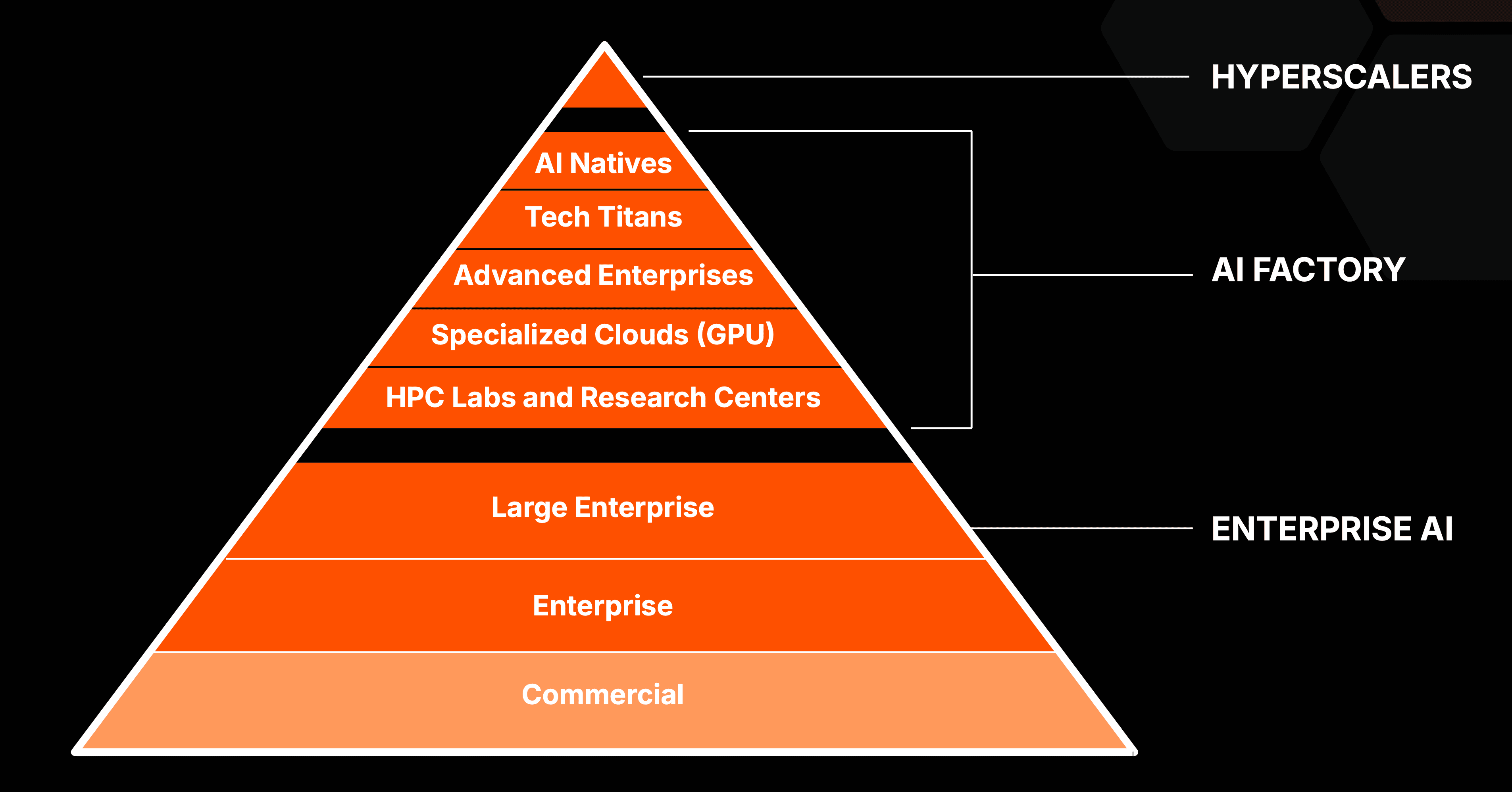
At the top of the pyramid, there are a small number of hyper-scalers with massive GPU and storage requirements. Typically, these solutions will be custom, or at least unique, designs built to the specific requirements of that business. We already know that Pure Storage is working with Meta to deliver the integration of Purity and DirectFlash Modules into Meta OCP servers (see this blog post). Presumably, this part of the business will expand as the results of the partnership become clearer.
At the bottom end of the pyramid, enterprise and commercial customers are using FlashBlade//S solutions from Pure Storage as their default platform. Those customers prefer a turnkey solution that can be simply plugged in and start working.
In between the two extremes is a set of customers that Pure Storage identifies as the “AI Factory”, including AI-specific businesses, smaller service providers and advanced enterprises. We could imagine one of those companies being CoreWeave, in which Pure Storage made a strategic investment in November 2024. These companies want more flexibility than the standard hardware delivers, without the need to build an entirely custom solution.
Flashblade//EXA has been built for this customer segment – those businesses typically looking for between 1TB-50TB/second of throughput and deploying thousands or tens of thousands of GPUs. Storage requirements are typically expected to be in the 100PB to multiple exabyte range.
FlashBlade//EXA
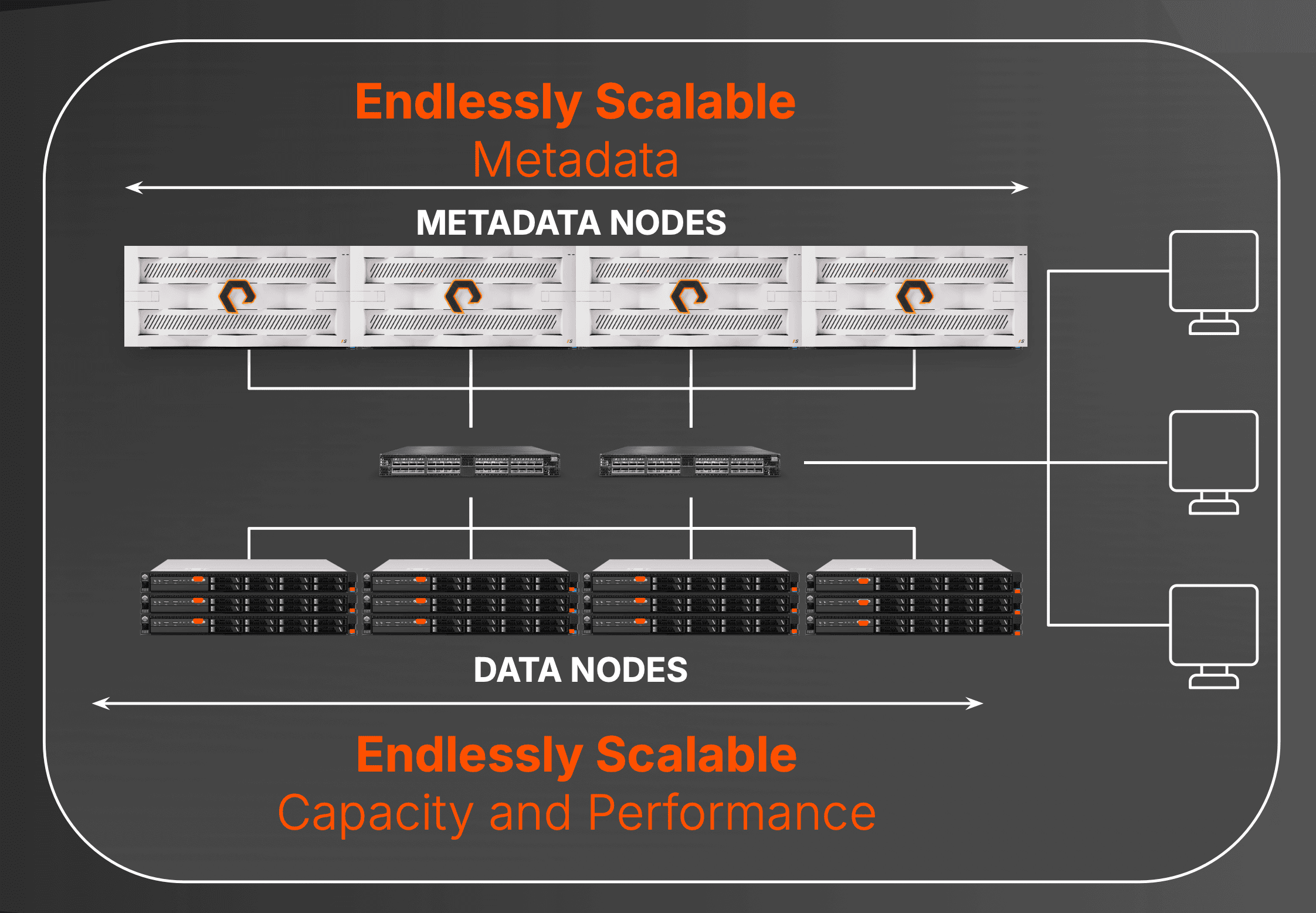
So, what is FlashBlade//EXA, and how does it differ from the FlashBlade//S and FlashBlade//E systems already in operation with customers? Pure Storage has chosen to move to a disaggregated architecture that separates storage capacity from performance, specifically in terms of the demands on metadata.
In AI solutions, metadata is used extensively, so overall system performance is dictated by the efficiency of metadata queries. The efficient management of metadata is a problem we’ve discussed before, in our coverage of object storage back in 2018 (see this post), but also in discussions on vendors including Weka, Qumulo and the now defunct InfiniteIO.
As shown in Figure 2, FlashBlade//EXA implements a disaggregated architecture that deploys “traditional” FlashBlade systems as metadata nodes and industry-standard servers with DirectFlash Modules as the storage layer. Each of the components can be scaled independently, up to exabyte scale and operating within a single namespace.
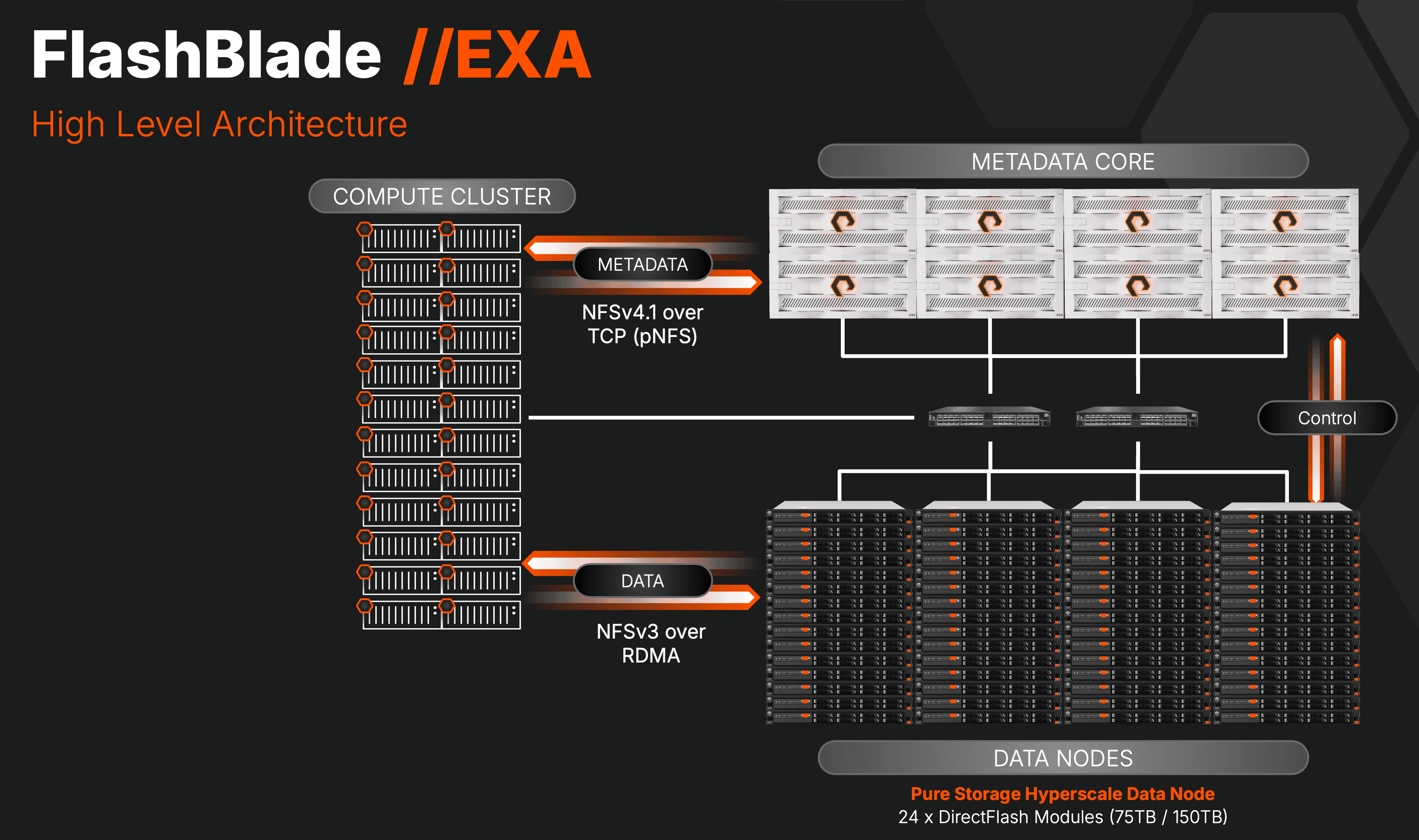
As Figure 3 shows, a typical deployment will connect a customer’s compute cluster to FlashBlade metadata servers running NFSv4.1 over TCP (pNFS) and to data using NFSv3 over RDMA. The initial customer implementations will use standard servers for data nodes. However, Pure Storage expects to transition to custom shelves later this year.
Scalability
The scalability of storage systems has been a challenge since centralised storage arrays were first deployed. When many mixed workload profiles are consolidated onto a small set of storage hardware, the growth profile varies considerably between implementations and over time.
In my career deploying storage systems, I typically designed to enable scaling of either performance or capacity (or both) with as much flexibility as possible. However, this process wasn’t simple, even with a few hundred terabytes of capacity.
Imagine scaling to multiple exabytes, and we see the challenge of operating a single system in which metadata and storage performance/capacity are deployed in fixed ratios. Disaggregation provides much greater flexibility to scale along any axis while keeping the data under a single namespace.
Intellectual Property
One of the more interesting aspects of FlashBlade//EXA is the reuse of existing IP from the FlashBlade hardware and Purity software. Although it is clear that the EXA architecture is more “custom” than simply deploying a FlashBlade//S system, for example, we can see that reusing existing technology has enabled Pure Storage to deliver a new solution within a known set of capabilities (and presumably relatively quickly).
What this means is FlashBlade//EXA can be integrated into the management ecosystem of Pure1 and Fusion, while customers can choose to move data in and out of a FlashBlade//EXA solution using existing tools. Components such as DFMs are also interchangeable between clusters, for example. This should enable Pure Storage to deliver FlashBlade//EXA using the Evergreen storage-as-a-service model.
The Architect’s View®
Obviously the FlashBlade//EXA system has only just been announced and we need to judge how adoption in the market proceeds. What we can see is yet another expansion in the target market for Pure Storage, creating a solution that addresses the needs of a wider range of customers that might otherwise have chosen a custom solution.
We can see some immediate differentiators compared to solutions in the market from (for example) VAST Data or Weka. Firstly, all these solutions are commodity server deployments with shelves of NAND flash storage. However, Pure Storage has the highest density available, with 150TB drives today and 300TB capacities in the near future.
We also should consider that the ability to manage petabyte or exabyte-scale flash as a single layer via Purity. Time will tell, but we should expect that FlashBlade//EXA will deliver more consistent I/O performance and resiliency, compared to JBOF deployments. While this is speculation on our part, we look forward to seeing how exabyte scale deployments play out in reality.
Finally, does the announcement of FlashBlade//EXA give us any clues as to where the Pure Storage business is heading? Although DFMs aren’t sold as a “retail” item that can be purchased individually, we are starting to see the DFM technology being offered as a standalone product in conjunction with Purity software. To a degree, Pure Storage is unbundling the IP developed in the hardware platform. This is something that competing vendors cannot offer.
Possibly the most significant observation from the announcement of FlashBlade//EXA is the capability for Pure Storage to extend further into the hyper-scaler market. NetApp is currently the only vendor selling a branded solution across the public cloud (ONTAP in various flavours). Pure Storage could achieve a similar position, not just for branded deployments, but also as the basis of the core infrastructure of the cloud. This, arguably, is a much bigger prize to win.
Copyright (c) 2007-2025 – Post #3ee3 – Brookend Ltd, first published on https://www.architecting.it/blog, do not reproduce without permission. Pure Storage, Inc. is a tracked vendor for data storage solutions and a client of Brookend Ltd.