

This is the first of a multi-part series looking at technology infrastructure predictions for 2024 and beyond. It builds on discussions from previous posts to predict what we might expect in persistent data storage media from both a micro and macro view.
Background
At the heart of all IT systems is the need to persistently store data, either for active or long-term archiving use. Figure 1 shows a hierarchy of storage media types, where latency and capacity are generally inverses of each other. The storage media hierarchy exists because technology economics determines that a blend of media types is the most affordable way to deliver large-scale computing environments.
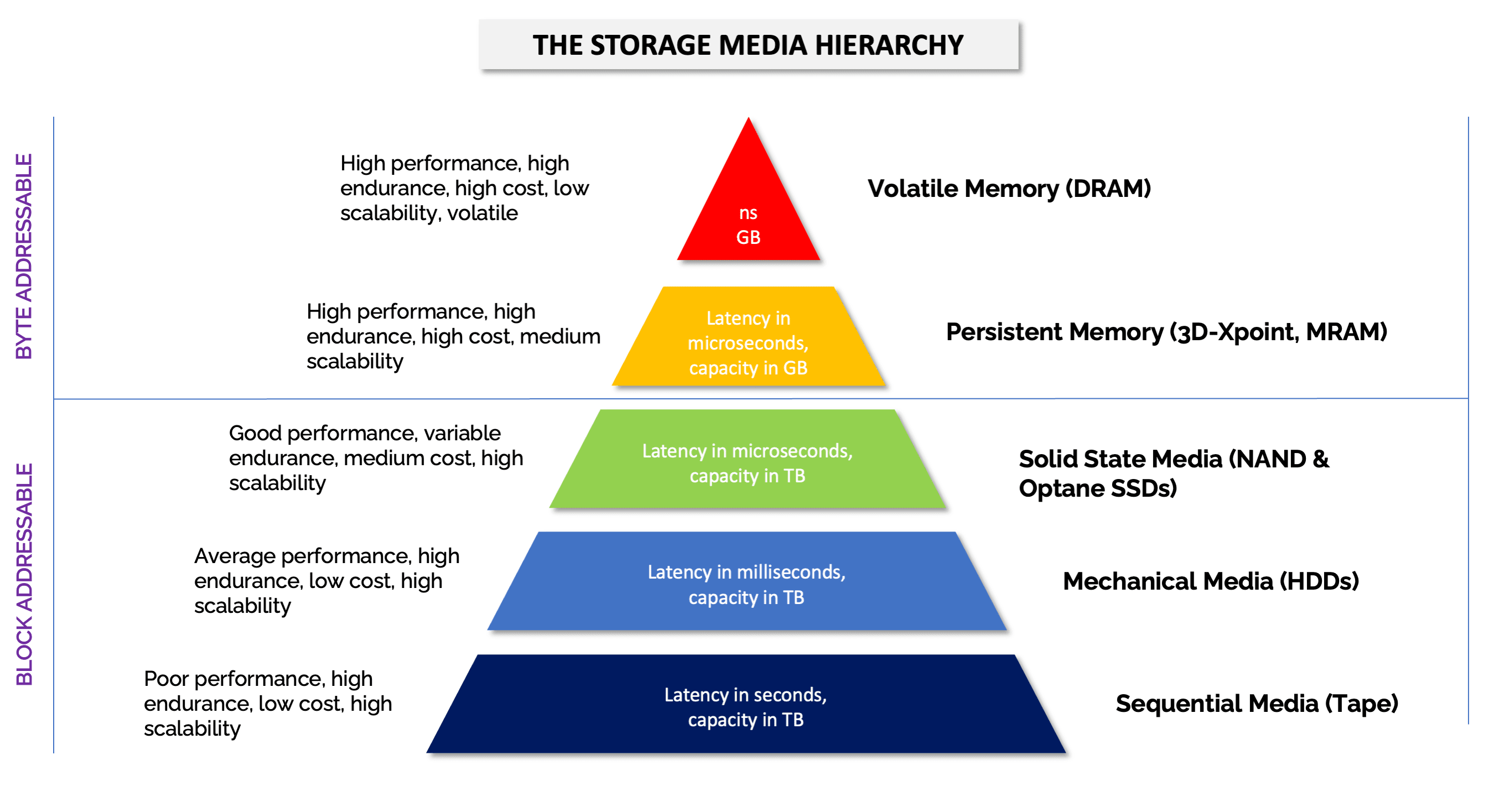
Over the past 12 months, we have seen the market for persistent memory products decline as Intel Optane stocks are sold off. The emerging CXL technology is likely to occupy the vacuum left by persistent memory as products are launched using the latest standards (more on this in a separate post).
Macro
At the macro level, cost per terabyte of storage continues to dominate the product development cycle. At the start of 2023, we discussed the emergence of 26GB HDDs, which have now been superseded by 28TB from the two leading manufacturers (Western Digital and Seagate). Drive capacity improvements are seeing increasingly smaller percentage increases as the vendors focus on absolute additions to capacity (typically 2TB at a time). The latest move from 26TB to 28TB represents only a 7.7% improvement. HAMR technology may change this.
In July 2023, Solidigm announced the D5-P5336 PCIe SSD, with a maximum capacity of 61.44TB, using the E1.L form factor. This is the first mainstream drive we’ve seen that breaks the 32TB barrier, a capacity that we highlighted as the “new normal” back in 2018 (six years ago).
The SSD industry has peaked at 32TB, partially because individual die density restricts the capacity of drives within traditional form factors (like U.2) but also because the internal metadata mapping of drive capacity requires increasingly more DRAM (as we explained in this post from September 2023). Solidigm solves the DRAM problem by using a separate device for caching, which will work but introduces additional challenges for system vendors (we will discuss this in the systems post later in this series).
Across all the major system vendors, only Pure Storage has a published roadmap for the use of larger-capacity drives, although these are bespoke and not for direct sale. IBM has also taken a similar approach with FlashSystem and now offers FlashCore Module 3.0 drives with up to 115.2TB of effective capacity (using internal compression).
Tape media continues to gain momentum. As we highlighted last year, the roadmap for LTO now extends to generation 14, with 1440TB (compressed) per cartridge. We think that the scourge of ransomware, plus the desire to retain large quantities of data for the long term, will drive further increases in the growth of tape media, exceeding the shipment record set for 2022.
Micro
Looking at media device improvements at the “micro” level, Samsung and SK Hynix are moving towards 300+ layer NAND production, with Samsung rumoured to have 430-layer devices in development. These density improvements are achieved through stacking rather than tunnelling down all the layers into a single piece of silicon. However, the density improvement is all that matters (subject to maintaining efficient production yields and manufacturing costs).
NAND chip densities will continue to improve; however, the industry is expecting an increase in prices this year as manufacturers attempt to reach break-even points and stem previous losses. How this plays out in the market remains to be seen, especially as the lifetime of existing NAND flash storage is far superior to hard drive technology.
The HDD industry is pinning its hopes on HAMR as traditional recording (PMR and SMR reach the limits of scalability). At its Investor Day in 2022, Western Digital announced the sampling of a 26TB UltraSMR drive, with volume shipments of up to 28TB SMR HDDs announced in November 2023. These drives are not directly available for retail customers. However, we can anticipate the hyper-scale cloud platforms to use these new drives in significant quantities. The WD Ultrastar DC HC680 has three capacity options (26, 27 and 28TB), with 6Gb/s SATA and 7.2K RPM speed. The drives use OptiNAND (additional NAND to optimise read and write I/O) with SMR energy-assisted magnetic recording (EAMR).
It’s worth noting that the HC680 is rated for only 550TB/year, which is the exact figure we highlighted in a blog post from 2016. At the time, we calculated that 10TB Seagate enterprise drives had a DWPD of only 0.15. This now translates into a value of 0.05 for the 28TB drive, making this technology absolutely focused on the archive market.
Seagate has announced 28TB drives, but as yet, they are not generally available but expected in Q1 CY2024. You can read more about the current line-up of Seagate storage in our X-Ray (available here for customers with an Individual Subscription or higher). Toshiba, the third HDD vendor left standing, currently offers 22TB drives, some way behind Seagate and Western Digital.
Predictions
Here’s a list of predictions, building on those from last year. Ongoing predictions represent previous discussions we will continue for some time. Archive predictions will be removed from this point. New predictions (obviously) represent new observations on the industry.
HDD capacities continue to increase but at a slowing pace [ongoing]. We made this prediction last year, and as we have highlighted already, 28TB drives are here, with the next wave of HAMR devices expected to push areal density and capacity past 30TB. However, we’re not sure whether vendors (meaning Seagate and WD) will choose to use density increases to initially sell drives with fewer platters for the same capacity as PMR and, thus, reduce costs. With the relatively low DWPD for HDDs, we see the majority of HDD sales heading into hyper-scalers and distributed object storage vendors.
2Tb NAND die and 400+ layer flash pushes drive capacities past 32TB [ongoing]. The 61TB drive is here, albeit using a new form factor that accommodates a higher volume of NAND chips. We highlighted the issue of rebuilding 100TB drives in the event of a failure, but this is just one issue for the industry. Sustainability and repairability will be essential to make the 100TB drive commercially successful. The second issue is that of scalability and DRAM for metadata. A system with many high-capacity drives could have more DRAM than the server itself, an issue discussed in this blog post.
Flash storage products bifurcate into read and write orientated solutions [new]. The challenge of metadata management in flash drives will diverge the market into high-capacity archive or read-intensive solutions and write-intensive (but lower capacity) products. While Solidigm is solving the metadata problem through software, we see opportunities for hybrid drives using a mix of SLC/MLC/TLC/QLC dies in a single product. Alternatively, DRAM could be augmented with MRAM or another persistent memory solution to reduce power consumption and cost.
Penta-level Cell NAND emerges in the consumer space [new]. We expect to see some PLC products appear in the consumer market within the next few years. This is an early prediction that needs further evidence from the market to be made more definitive.
Tape achieves a renaissance [ongoing]. We think this prediction is holding up well and will continue to be reflected in demand for archiving and read-only media that can avert the risk of ransomware. However, tape will need front-end support that translates random access data into something that can be aligned to tape media’s sequential access, such as Spectra Logic Vail or even simply LTFS.
New technology kills off Optane [archive]. This prediction is a fait accompli as it is now done. However, look out for CXL devices using the latest 2.0 and 3.0 specifications, which we believe will deliver high-performance memory and storage solutions to the PCIe bus. We will discuss these products in a separate post.
Computational Storage is a busted flush [archive]. The demise of NGD Systems demonstrates that the on-device processing of data from a content perspective will ultimately be unsuccessful in its current form. As we highlighted in this blog post from 2022, processing at the data level is frustrated by technologies such as RAID and host-level encryption. Any future improvements in computational storage devices will focus on optimising the data storage aspects, with gains in performance and data optimisation (see our Intelligent Data Devices report for more details).
DNA Storage will continue to be a dream [ongoing]. While technically possible to achieve, the future value of DNA storage will probably only be for archiving data (see this Tech Field Day presentation from September 2023, which highlights many of the practical issues of the technology). While DNA storage may be many years away from being useful, ceramic storage and new forms of optical storage, such as Microsoft Project Silica, could provide long-term archiving options that compete with tape.
Three HDD vendors become two [new]. As a left-field prediction, we think it is possible that the split of Western Digital into two businesses will create an opportunity for merger or acquisition. The market for HDDs is declining, and consolidation is the obvious answer to maintaining revenue.
MRAM will remain a technology niche outside the enterprise data centre [new]. The capabilities of MRAM look good, but the scalability characteristics are not good enough to displace NAND at this point in time. We believe MRAM and similar technologies will be used in niche applications (such as automotive) or as part of mainstream enterprise storage.
The Architect’s View®
The SSD market is headed in the same direction as HDDs, with increases in capacity resulting in reduced write performance capabilities. CXL products will fill the void left by the disappearance of persistent memory solutions. Optical and ceramic media could have a place in the storage hierarchy (as we commented last year).
One clear observation is that the market is now driven by the direction of the hyper-scalers. Both Seagate and Western Digital have experienced revenue slumps caused by reduced demand for HDDs in the public cloud. Innovation in HDD technology is likely to stagnate as the remaining three vendors focus on extending the life of HAMR-based solutions for the next 10-15 years.
In Part II, we will return to the topic of storage systems and review how the changes in media are affecting the development of storage platforms.
The following related content covers vendors mentioned in this article.

X-Ray: Seagate Technology PLC
This Architecting IT report takes a deep dive into Seagate’s history, products, services, and future outlook. This report is only available for download via paid subscription.

Intelligent Data Devices 2023 Edition – A Pathfinder Report
This Architecting IT report looks at the developing market of SmartNICs, DPUs and computational storage devices, as data centres disaggregate data management processes, security and networking. Premium download – $295.00 (BRKWP0303-2023)
Copyright (c) 2007-2023 – Post #b442 – Brookend Limited, first published on https://www.architecting.it/blog, do not reproduce without permission.