

This is the first of a multi-part series looking at technology infrastructure predictions for 2023. In this article, we look at persistent data storage media and what we can expect from both a micro and macro view.
Background
Two years ago, we published a series of blog posts looking at the future of data storage media. At the time, we covered technology that is typically deployed as primary storage. In this discussion, we’ve extended the hierarchy and will consider media both above and below the traditional tiers of rotating and solid-state disks.
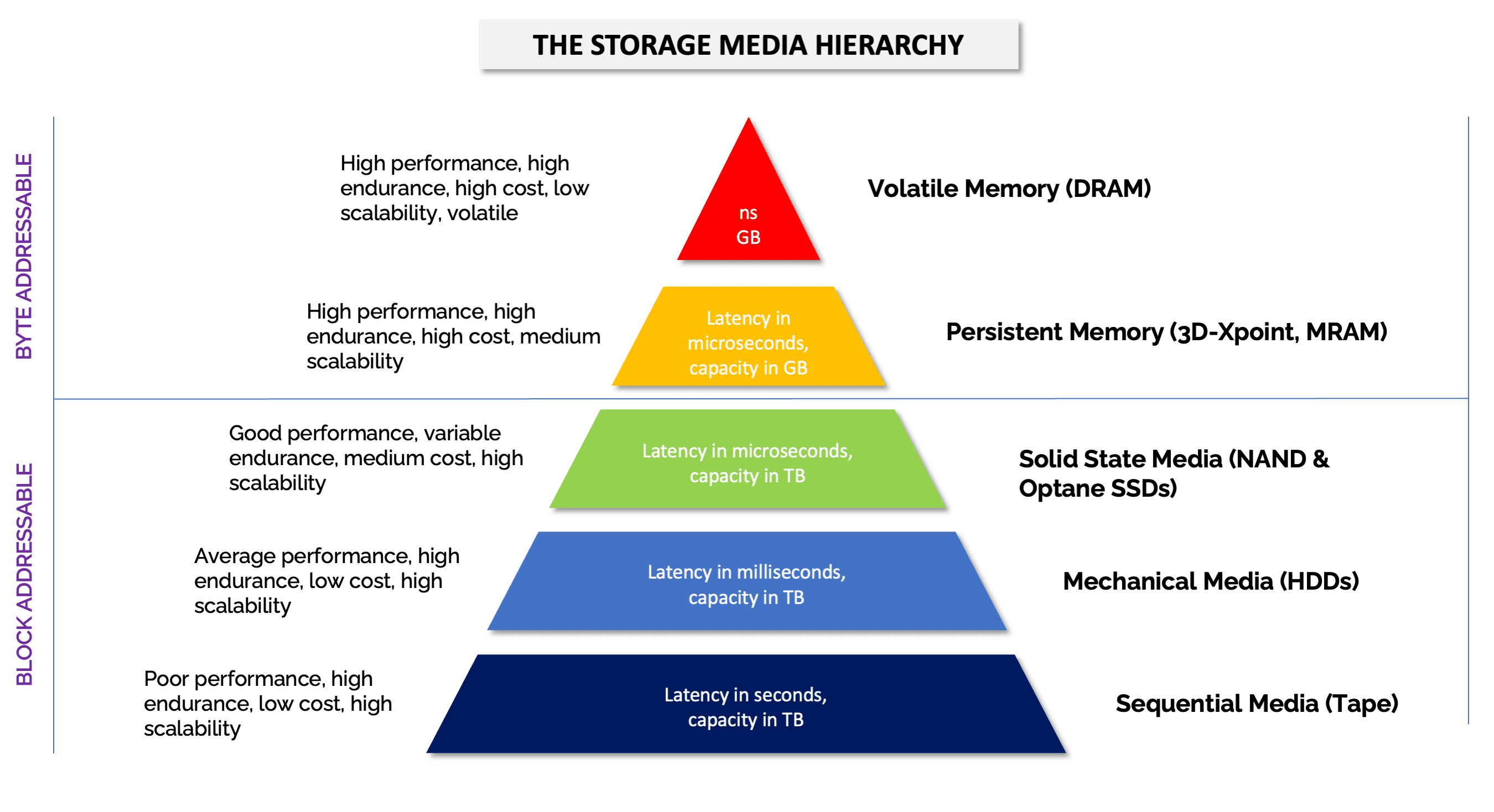
Figure 1 shows the traditional model of storage tiers. This representation has been used for decades, implying the greatest capacity of media sits at the bottom of the pyramid, while the most expensive, fastest technology sits at the top and generally is deployed in the smallest volume.
In practical terms, the pyramid metaphor may be incorrect in modern infrastructure, where SSDs are rapidly replacing spinning media. Many organisations may have little or no tape infrastructure but, instead, depend on the public cloud for long-term storage. However, the aim here is not to discuss individual strategies but to show that the traditional tiered structure still holds true.
Macro
At the macro level, cost per terabyte continues to be a factor in product development. For hard drives, this means pushing past the current 26TB mark, while SSDs have effectively stalled at 16/32TB, despite an increase in the number of layers supported by current technology.
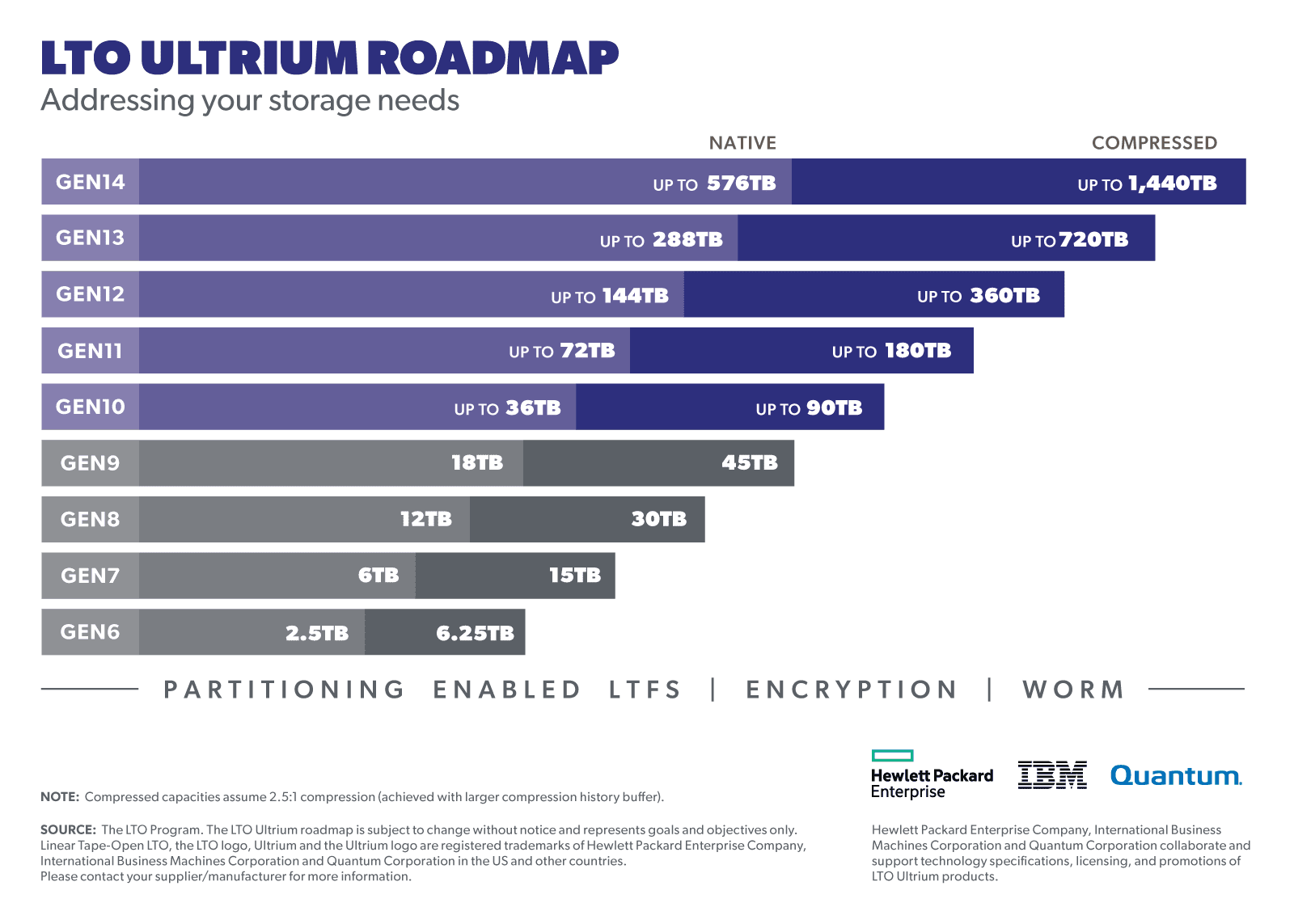
Tape is having a resurgence, with a record capacity shipment in 2021 and the availability of LTO-9 media supporting 18TB native and up to 45TB compressed per cartridge. The LTO roadmap has been extended to generation 14, with a predicted 576TB native and 1440TB compressed – per cartridge. These are astounding numbers and highlight an increasing challenge to ensure data can be written to and read from these media in a timely and secure fashion.
To put prices into context, HPE’s standard price for LTO-9 media is around £138, or £3/TB. High capacity 22TB HDDs retail for about £600 or £27/TB. In the UK, WD Gold NVMe 8TB SSDs are around £1700 or £212/TB. Remember that the cost of drives in systems will be more expensive, that tape costs quoted here don’t include the drives, and prices within a category will vary by performance.
Looking now at persistent memory, 3D-XPoint has transformed from being a future contender to replace flash (in specific use cases) to withdrawing from the market altogether. Intel has discontinued Optane, while Micron withdrew from 3D-XPoint development in March 2021 and is rumoured to be developing an alternative solution. What fills the gap left by Optane? Although Everspin has announced higher-density MRAM products, the solutions still don’t have the scalability for the enterprise (and may not have for years to come). Kioxia has recently announced the second generation of high-performance XL-FLASH, while Samsung has Z-NAND (see this post from a few years ago, where we discussed these technologies).
Perhaps we don’t need Optane after all. As CXL emerges to provide a cache coherent interface, the challenge of needing to use DDR-T is replaced by an industry standard. New products like Samsung’s memory-semantic SSD can exploit the benefits of CXL and optimise small-sized I/O. Start-ups like Neo Semiconductor are developing technology to vastly improve the performance of existing NAND solutions. The Optane void is being filled (if there ever was one).
Micro
At the micro level, vendors continue to innovate to increase performance and capacity while reducing costs. Micron has announced 232-layer NAND, with other vendors following closely behind. There’s no immediate reason to think that the layer count can’t be increased (as reported previously, a Toshiba representative indicated 500+ layers were practical). However, as we discussed in this podcast episode published in November 2022, some additional technology may be required, such as intermediate “floors”.
At Flash Memory Summit 2022, Solidigm demonstrated a PLC (penta-level cell) SSD. PLC offers a 25% capacity improvement over QLC by increasing the bit density per cell (5 bits, 32 voltage states). We think that PLC is an interesting side project, but the quickest and easiest capacity gains are still being made with improved layer counts. PLC is likely to come along later once the technology matures (and, of course, for more read-intensive devices).
Seagate continues to push forward with MACH.2, while Western Digital has also demonstrated dual actuator technology. The price of new model single actuator drives has typically been around $600, irrespective of capacity (due to the BOM cost). Dual actuator increases this baseline cost, and multi-actuator would increase it further. In this instance, the performance/price calculation must consider the benefit of the additional capabilities multiple actuators offer.
Hyper-scalers
It’s clear from our podcast discussions with Rick Kutcipal from the SCSI Trade Association that future protocol enhancements for HDDs are being driven by the requirements of the hyper-scalers. This continues the trend we first discussed back in 2018. As media becomes more complex to manage, the hyper-scalers want more control over drive operations. We discussed this previously in this blog post and podcast episode. You can listen to more on MACH.2 and dual actuator in this episode from 2020.
Predictions
OK, that’s enough background for now – time for some predictions.
HDD capacities continue to increase but at a slowing pace. The future for hard drives is the capacity market (and has been for some time). We think the biggest customers for these devices will continue to be hyper-scalers, including the new wave of cloud storage companies (like Wasabi and Backblaze). HDD innovation will slow as the number of units shipped continues to reduce. The big inflection point for the HDD market could come in 2025/26 if 2Tb NAND dies can match HDDs for price parity.
In the enterprise, HDDs continue a gradual decline, to be replaced by large-capacity SSDs targeting active workloads. NVMe HDDs will become more common and threaten to eliminate SAS and SATA protocols completely. We’ll discuss this area in a separate post.
2Tb NAND die and 400+ layer flash pushes drive capacities past 32TB. While there are some big SSDs out there, the current capacity “limit” will exceed 32TB, driven by higher die densities and better form factors. The biggest challenge for 32+TB drives is how the “blast radius” issue is managed. Drives need to be repairable or at least capable of operating in a reduced state until data can successfully be moved elsewhere. Fully rebuilding the data on a 100TB drive, for example, won’t be popular. We would hope to see some information on sustainability in the storage media market, including how vendors address the repair/replace issue.
Tape achieves a renaissance. On a purely price-based calculation, tape cannot be beaten for efficiency. We believe that 2023 onwards will see greater scrutiny on data retention and with it a need to justify the “retain forever” model. Tape has the opportunity to act as a repository for long-term retention if the data mobility issues can be addressed further. Technologies like Spectra Logic’s Vail could improve the use of tape in the enterprise, especially where the solution is delivered as a managed service.
New technology kills off Optane. The persistent memory market based around Optane is eventually replaced by solutions using CXL and accelerated NAND. With the introduction of PCIe 6.0 and 7.0 protocols, interoperability improves, and CXL becomes the de-facto method of connecting to persistent memory devices.
Computational Storage is a busted flush. The current use cases for computational storage narrow towards two scenarios. The first simply improves the performance and efficiency of existing drives (the ScaleFlux and IBM solutions), while the second sees computational storage devices used at the edge for IoT. However, the concept of mass deployment in the enterprise data centre will not occur until the price/performance benefit exceeds current storage devices. Edge use cases will be limited by the security and operational challenges of computational storage that have yet to be resolved.
DNA Storage will continue to be a dream. Developments in the use of DNA storage will undoubtedly continue, but we’re not going to be using the technology in this decade.
The Architect’s View®
At the lowest level, the storage industry doesn’t move at speed, but rather it continues to make incremental improvements. The promise of Optane, for example, looks to be replaced with CXL and better existing technologies. A revival in the use of tape makes a lot of sense in a world where efficiency and sustainability are about to be key tenets of 2023. We could even see new developments in optical media if the economics are right.
What’s clear about the future of storage media is that new features are being driven equally by a small number of hyper-scalers as they are by thousands of enterprise IT departments. In some cases (like HDDs), it could be argued that all the development is hyper-scaler focused. This development will be interesting to watch as we look at how the remaining on-premises vendors adapt their products to this changing world. Part II of this series will look at the future of storage systems and this scenario in particular.
Copyright (c) 2007-2023 Brookend Limited. No reproduction without permission in part or whole. Post #b3ba.