

Intel has released second quarter 2022 results, which show revenue down 22% year on year and a net loss. During the investor conference, Pat Gelsinger (Intel CEO) confirmed that Optane, the 3D-XPoint technology, will be discontinued. What does this mean now for persistent memory and Intel’s strategy in general?
Optane
Let’s look at Optane first. The Optane brand is based on 3D-XPoint, a phase change technology that is directly byte addressable. 3D-XPoint is persistent memory (retaining state over power cycles) and aimed to offer latency much lower than that of NAND flash. The technology was pitched to sit between DRAM and flash in the storage hierarchy while also offering the dual role as a memory technology. Compared to NAND, 3D-XPoint has much greater endurance, making it suitable as a memory replacement.
Intel pulled Optane out of the consumer market (see our disappointment at the H10), while development partner Micron dropped the technology in early 2021. Why has Optane not been a commercial success?
Split Personality
Optane sold in two markets. The first was as persistent memory DIMMs, which required specific Xeon Scalable hardware and BIOS support. The technology wasn’t a drop-in replacement. The second market is as a replacement for NAND flash. Here there are multiple issues in play, including poor scalability (a maximum of 1.5TB), cost and an overplayed performance boost that initially claimed 1000x improvements over NAND.
Of course, the performance improvements weren’t meant to be quoted verbatim, as the overhead of management, protocols and other encapsulation means the user experience is nothing like a 1000-fold increase, but perception and marketing stick.
We can look at the relative failure of Optane and say that the SSD format didn’t offer enough advantage over traditional SSDs (especially with the introduction of high-performance SSDs), while the DIMM format was “too proprietary” to gain widespread adoption. However, there are clear technical advantages of Optane over NAND flash and DRAM (including persistence) that made the technology suitable for new platform designs.
VAST Data, for example, uses Optane for metadata and as a landing zone for new data. The company has already implemented Optane alternatives. CEO Renen Hallak issued a statement indicating that VAST already has alternatives in place for customers, which will have zero impact on customer deployments.
“Intel helped create a market for this new category of storage class memory technology, which we applaud. It started a technology revolution that allowed us to introduce our game changing storage architecture, Universal Storage. Since that time, there are a lot more choices for storage class memory that we have qualified for VAST’s Universal Storage. While we understand Intel’s decision, this has no impact on our business model since we implemented a multi-vendor strategy more than a year ago. Nothing will change for our customers.”
Renen Hallak, Founder & CEO, VAST Data
In fact, the move away from Optane may improve the design of platforms such as VAST’s Ceres, which uses standard U.2 SSDs for metadata (mounted in SLEDS).
Goodbye (or Au Revoir?)
For now, it seems, Optane production is being discontinued. With the sale of the Intel storage business to SK Hynix in 2020, the company will be out of the storage business altogether. Pat Gelsinger seems to be placing more focus on CXL, which is presumably based on designs that won’t simply extend the addressable memory available within a server.
CXL
The emphasis on CXL seems to be at a tangent to the discussions on Optane. CXL is a memory pooling/sharing technology that, in the first instance, will enable add-in cards (AICs) to share processing and memory with core CPUs. The AIC doesn’t have to add memory but could be delivering services such as data compression or encryption, accessing system memory to do this. You can read more on how CXL works in a podcast we recorded last year with CXL Consortium Chair, Jim Pappas.
It’s interesting to note that CXL devices could make good use of Optane, removing the proprietary nature of the DIMM interface while gaining faster speeds than would be achieved with NVMe. So, for Intel to be both stepping away from Optane while talking up CXL seems more than a little confusing.
Remember also that CXL requires PCIe 5.0, which isn’t supported on any current Intel data centre CPUs but should arrive with the Sapphire Rapids processors (4th Generation Xeon) sometime later this year.
Intel Challenges
By winding up Optane development, Intel is moving back to much more focus on the core technology of processors (both CPUs and GPUs). The recent earnings announcement vaguely discussed a partnership with AWS and the IDM 2.0 strategy could conceivably see Intel offering SoC and x86 custom development services to AWS, Microsoft and others.
The Architect’s View®
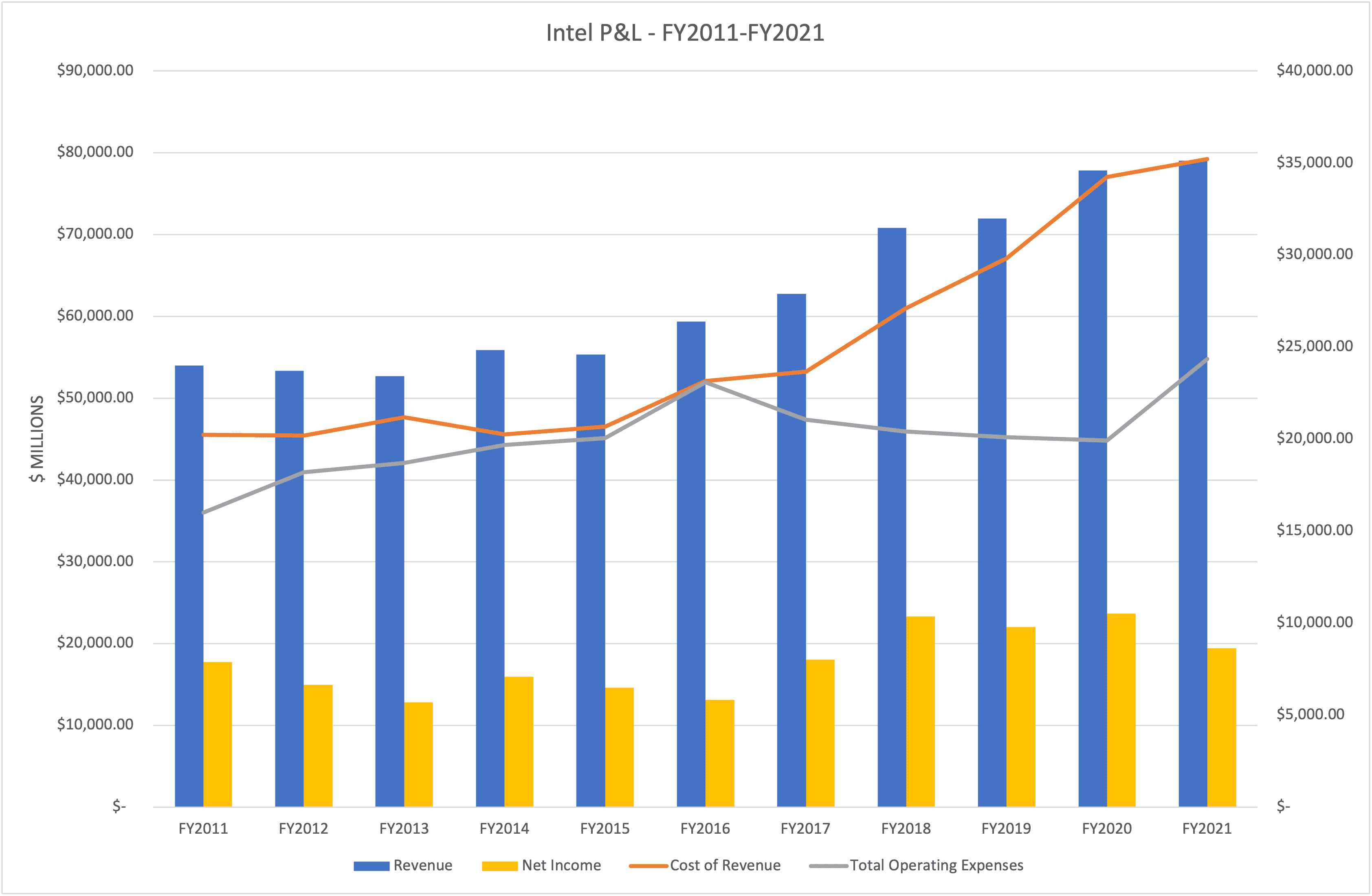
While we’re not digging into the detail of all Intel’s activities in this post, it’s clear that the core businesses aren’t doing well. AMD is newly resurgent, and there’s an increasing threat from Arm-based solutions in the public cloud. NVIDIA is a significant threat in the AI and analytics market. As the nature of computing changes, big, centralised processors aren’t the future. Instead, computing is diversifying, and there are greater opportunities than ever for new processor designs.
Intel needs a revolutionary rather than evolutionary approach to fix the business. We’re struggling to see where that will come from, based on the strategy presented to date.
Copyright (c) 2007-2022 – Post #ed3e – Brookend Ltd, first published on https://www.architecting.it/blog, do not reproduce without permission.