

Cohesity has announced that founder Mohit Aron will step sideways into a Chief Technology and Product Officer role, with ex-VMware COO Sanjay Poonen becoming President and CEO. What can we learn from this transition in terms of future direction for the company?
Background
Mohit Aron has been Cohesity’s CEO since the company was founded in 2013. Aron came from Nutanix, where he was also a co-founder. Cohesity’s initial solutions focused on data protection and have expanded into file services and some data management capabilities. Unsurprisingly, the core IP of the company is based on a distributed file system. Aron previously worked on the Google File System, while the core technology in Nutanix’s platform is also a distributed storage platform.
To date, Cohesity has raised $660 million in funding over six rounds. There was also a share tender offer in March 2021.
- Cohesity looks to exploit secondary data value with MarketPlace
- Rubrik, Cohesity and the battle for NoSQL Backup
- The Britpop Battle of Rubrik and Cohesity
Despite using the term data management to describe the Cohesity value proposition, the solutions offered by the company are essentially focused chiefly on data protection. In 2019, Cohesity launched a marketplace solution (similar to the idea of public cloud marketplaces) where vendors could write software solutions to interact with data on the Cohesity platform. At the time of publication, the marketplace website lists only 26 offerings, many of which have been developed by the company itself.
Data Management
To determine how Cohesity fits into the market landscape, it’s worth taking a moment to define what we mean by data management. The term is used widely across the industry to cover everything from backup to ransomware protection and disaster recovery. Some vendors look at data management as a process for migrating aged data between tiers – effectively old-school ILM.
In general, the different approaches for managing data refer to how data is stewarded over its lifetime. This can mean ensuring data is available, accessible and consistently accurate. In some scenarios, data management optimises the placement and accessibility of data on storage platforms.
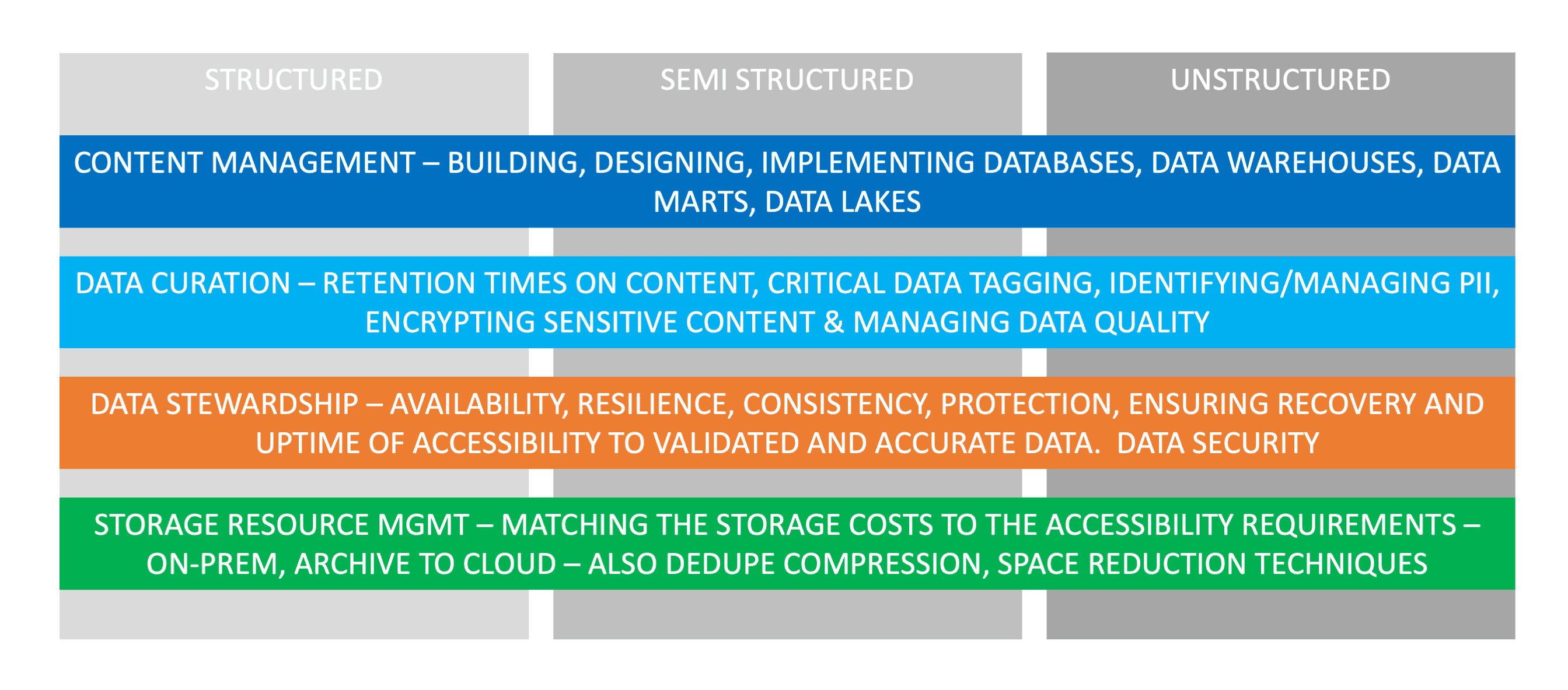
Figure 1 shows a rough approximation of how the data management “layers” fit together. At the bottom, Storage Resource Management or SRM looks to match storage costs to accessibility requirements (performance, availability) while optimising for cost.
Data Stewardship focuses on availability, resilience, and consistency, not necessarily at the hardware layer, but on data as an abstract entity. A good example here is the processes required to avoid the impact of ransomware.
Above that comes Data Curation. Here we’re looking at content to perhaps delete data over time, apply PII-specific encryption or other tagging requirements.
Finally, at the top layer is content management. This process is focused on how data is used by applications in structured, semi-structured and unstructured formats.
Cohesity
Looking at the product and solution offerings from Cohesity, we see the company delivering services mainly in the stewardship area, with some applications in the curation space. The majority of Cohesity’s solutions address secondary data (the copies of data taken for protection and resilience) rather than primary data. However, some data sits on Cohesity’s file platform, but we don’t believe this is petabyte-scale data lakes.
TAM
Although Cohesity claims to be a next-generation data management company, we see the current focus as data protection. The marketplace offerings are limited, and broader data management capabilities (those that map to our framework) just don’t seem to be there yet.
The Architect’s View®
The gap between aspiration and reality will be the greatest challenge for Sanjay Poonen as he takes the reins as CEO. Cohesity aspires to be a data management platform, but with most capabilities focused on backup/restore of traditional applications, there’s a lot of evolution needed to become a true data management behemoth.
Another way to look at this, of course, is to envisage a massive opportunity for Cohesity to expand into different data management markets and capabilities. By way of comparison, we can look at the way VMware (where Poonan was previously COO) grew from a desktop hypervisor to type 1 hypervisor and then built an entire ecosystem around infrastructure and application management. Can Cohesity do the same for data? We think the desire is there, but the market is already saturated with vendors, whereas VMware effectively created its own space.
This difference is perhaps the area where Cohesity is challenged. The company currently has 3000 customers and recurring revenue of approximately $300 million (self certified). Future growth needs new products, new market areas and potential acquisitions to achieve these goals. An IPO could help with this vision, although it’s not clear whether the confidential submission made in December 2021 will result in an IPO anytime soon.
Copyright (c) 2007-2022 – Post #8ed9 – Brookend Ltd, first published on https://www.architecting.it/blog, do not reproduce without permission.