

Seagate has announced a new platform, branded Mozaic 3+, that introduces new technologies enabling the arrival of HDDs with 30TB+ capacities. How has this been achieved, and where will these drives add value to the enterprise?
Background
Seagate has announced a new platform that will be the basis for the future development of hard disk drives using HAMR technology. HAMR or Heat-Assisted Magnetic Recording has been anticipated for many years, with the ASTC roadmap for hard disks implying that HAMR would be with us from 2017/2018 onwards. Seagate first announced HAMR drives in the lab in December 2018, with 16TB test units.
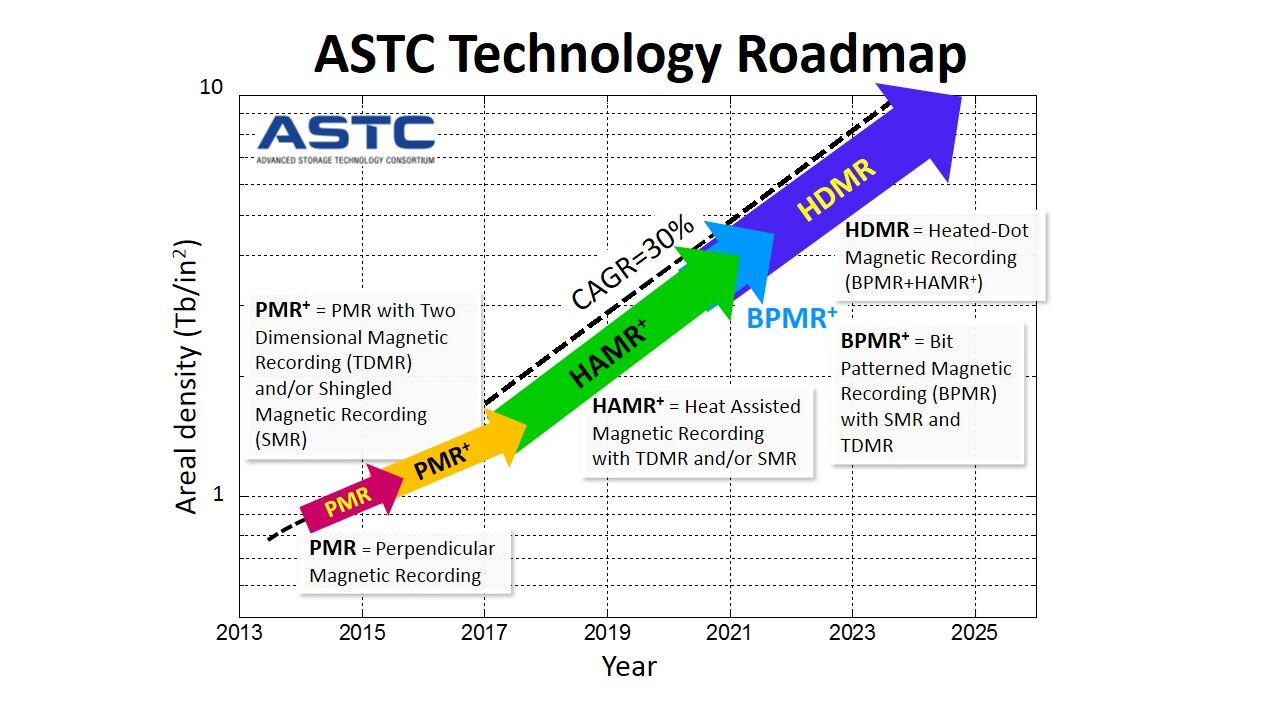
Finally, at the start of 2024, Seagate has announced shipping of the first HAMR HDDs, with capacities of 32TB using SMR and 30TB with traditional bit pattern layout (PMR).
Technology
The Mozaic 3+ platform uses four new technologies, which together enable the first phase of HDDs to achieve 3TB+ per platter. Further improvements are expected to deliver 4TB+ and 5TB+ per platter in the future. Typically, the highest capacity drives have ten platters, although Seagate could use the HAMR density capabilities to deliver drives with fewer platters, resulting in lighter and cheaper devices.
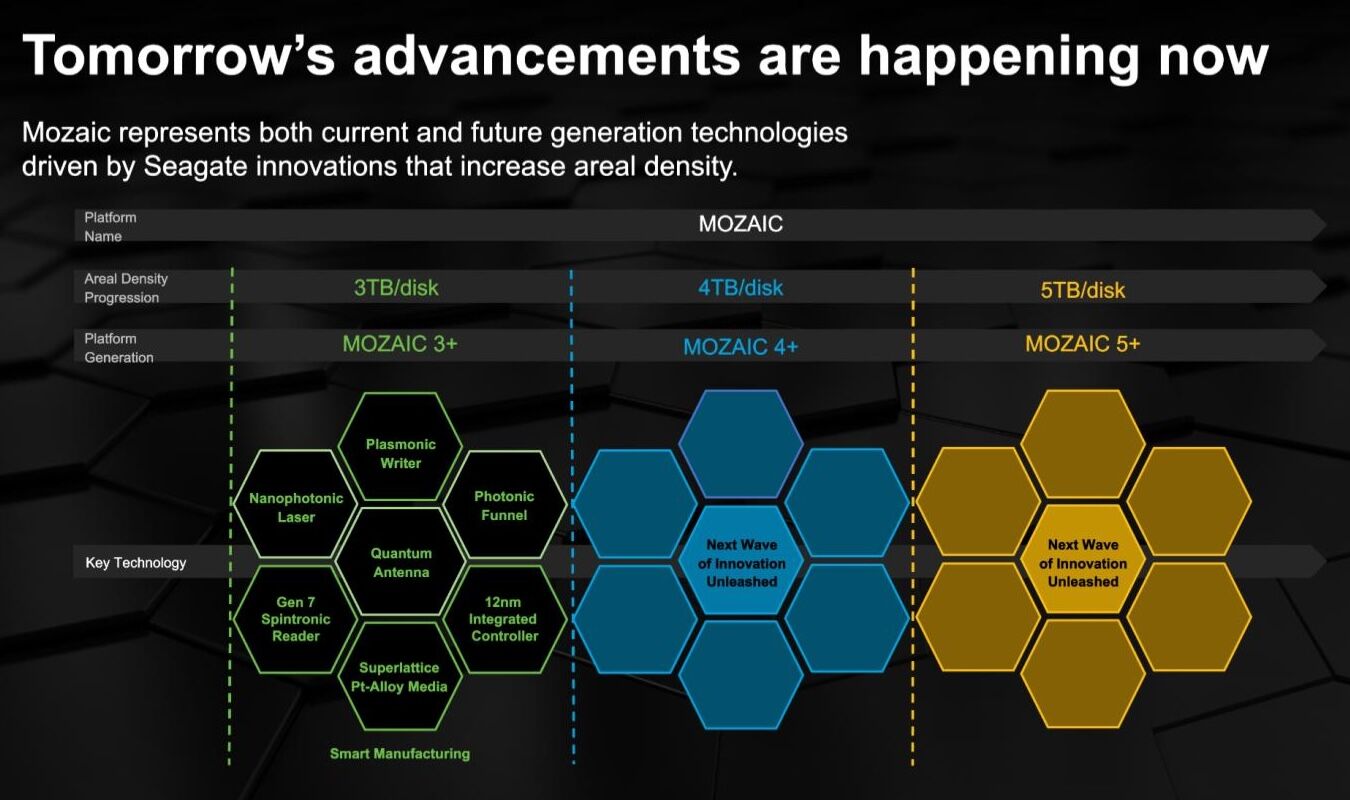
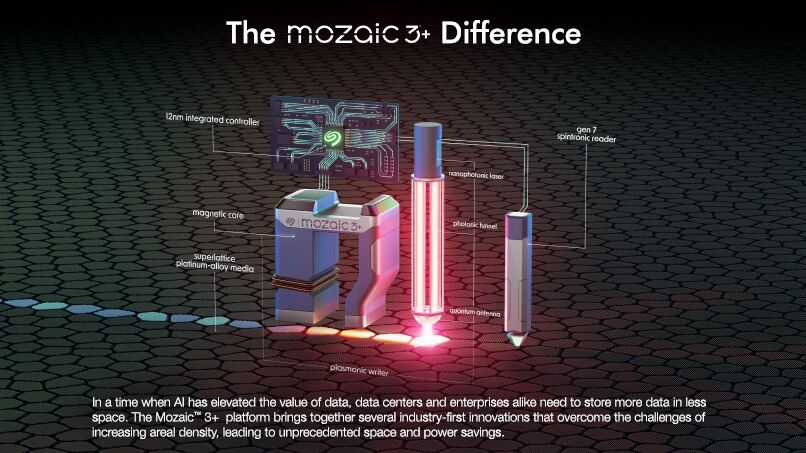
Platter capacity is driven by areal density, which is a measure of the bits per square inch that can be stored on the recording medium. Seagate has developed a smaller grain size for the recording medium using a new iron-platinum superlattice structure. As we previously discussed in this blog post, reducing the grain size is problematic from a magnetic stability perspective. The new nanoparticle-sized grains provide high magnetic stability over time, even at smaller resolutions.
The highly stable magnetic substrate required Seagate to develop a new writer to store data on the platter. The plasmonic writer uses a nanophotonic laser to heat the recording particles to around 430o Celsius, which then cool again within two nanoseconds. This is the “heat-assisted” component of the technology, using energy to change the magnetic coercivity of the particles on the platter.
With smaller grains of magnetic material, Seagate needed a new reader to ensure data was accurately read from the media. The Gen 7 spintronic reader uses quantum effects to read data from the platter. Orchestrating the operation of the drive is a new controller built on 12nm technology. This custom ASIC is claimed to have three times the performance of previous HDD controllers used by Seagate.
Achievements
The level of new technology in the Mozaic 3+ architecture provides Seagate with an impressive leap past its competitors. The company claims that Exos 30TB Mozaic 3+ drives will offer a 40% improvement in watts per TB power consumption and a 55% reduction in embodied carbon per terabyte compared to existing 16TB drives.
Why compare to 16TB drives when the latest Exos drives already offer 24TB in conventional recording and 28TB with SMR? Well, 16TB drives were first shipped in June 2019, almost five years ago. This means those HDDs will be reaching the end of warranty, and hyper-scalers (the main recipient of the new 30TB drives) will be looking to replace this hardware.
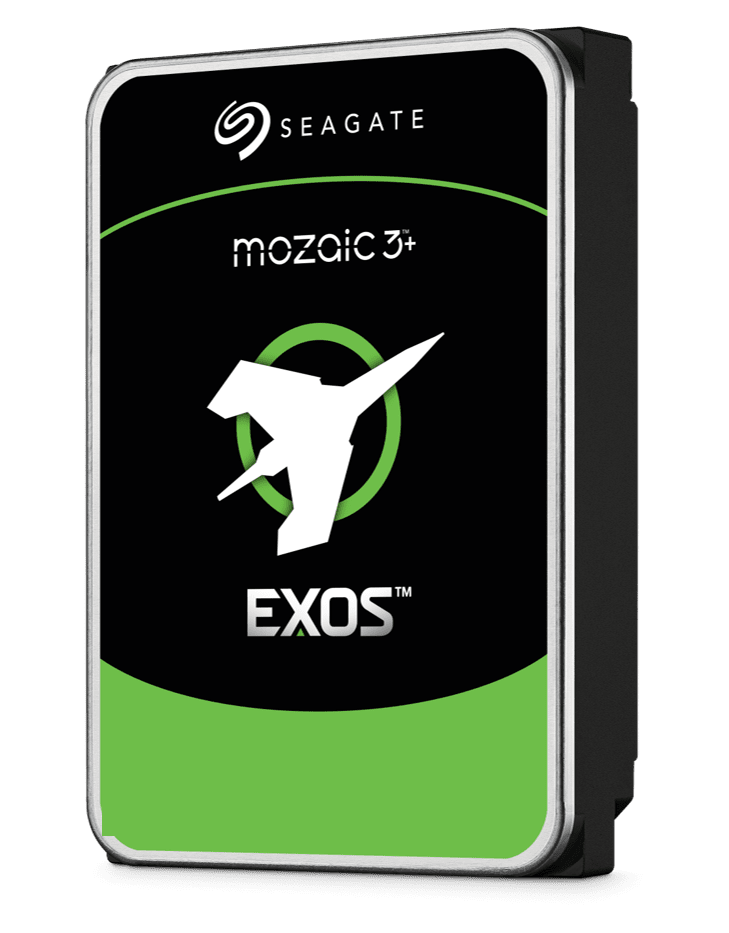
Naturally, Seagate wants to make like-for-like comparisons with older technology as it makes the numbers look good. Hyper-scalers will see almost double the capacity of storage within the same footprint for only a marginal increase in overall power consumption (the HAMR drives consume around 10W each, compared to 8-9W for previous HDDs).
Unknowns
While Seagate is providing lots of good information on the new Exos Mozaic 3+ drives (such as 2.5 million hours MTBF and a 5-year warranty), there is a lot the company is not saying. There is currently no datasheet or manual online, making it hard to compare these drives with previous models or those from competitors. Here’s what we would like to know.
Performance. How fast are these drives compared to existing models? I/O latency is determined by spin speed (rotational delay) and head movement (seek time), so unlikely to be any different to previous 7.2K HDDs. Throughput is determined by rotational speed (which is fixed) and the density of magnetic recording particles on the drive. As the reader reads data linearly (albeit in a curve), performance increases are, at best, proportional to the inverse square of the improvement in density. Therefore, we don’t think the new Mozaic 3+ drives will see any great improvement in throughput. The Exos X24 drives achieved around 285MB/s as a comparison.
I/O Density. We’ve discussed the issue of I/O density for at least the last two decades, as the performance of drives measured in IOPS/GB and Throughput/GB have declined continuously with each generation of new products. I/O latency is a factor of the mechanics of the drive (as described above) and is impossible to alter without increased rotational speed. Seagate could add MACH.2 technology to the Mozaic 3+ platform and improve throughput, but IOPS capability would still be a problem.
Endurance. Back in 2016, we noticed that hard drive specifications had started to add workload rate limits. Seagate has removed the workload limit data for the latest Exos drives in the datasheets, but it can still be found in the product manual (section 5.2.1). For 24TB drives, a 550TB/year limit is approximately 0.06 DWPD (device writes per day). For 32TB drives, this figure drops slightly below 0.05 DWPD. We have noticed that some Seagate SMR drives have much lower workload rate limits, which could place serious restrictions on the active nature of data on these drives.
The Architect’s View®
There is some pretty impressive technology under the hood of the new Mozaic 3+ HDDs. Reaching 32TB is a milestone not seen before in the industry, and Seagate believes the technology can go further. In hyper-scale environments, such as those storing petabytes of unstructured data, these new HDDs offer a refresh capability that could double capacity in the equivalent footprint of systems that were deployed only five years ago.
However, with every additional capacity bump, the usefulness of hard drives for active data storage reduces. With such a low DWPD figure, Mozaic 3+ and its successors will need active management, especially those drives based on SMR.
In comparison, 30TB SSDs were already available five years ago (albeit at a high premium), and 60TB drives are starting to emerge. For any moderately active workloads, SSDs represent the best choice, with long-term price erosion that matches HDDs. The use cases for HDDs in the enterprise continue to diminish. As a result we don’t see much of a market in the traditional enterprise for these drives, unless businesses are building out large on-premises archives.
We believe that the HDD market (which is now an archive medium) will not be challenged by solid-state disks. That battle is already over, and SSDs won. Instead, HDDs face being outflanked by tape. LTO-9 drives and media, for example, currently offer compressed capacities of 45TB per cartridge and throughput of 400MB/s. The LTO roadmap doubles capacity every generation, which currently has a frequency of 3-4 years (compared to HDDs at five years).
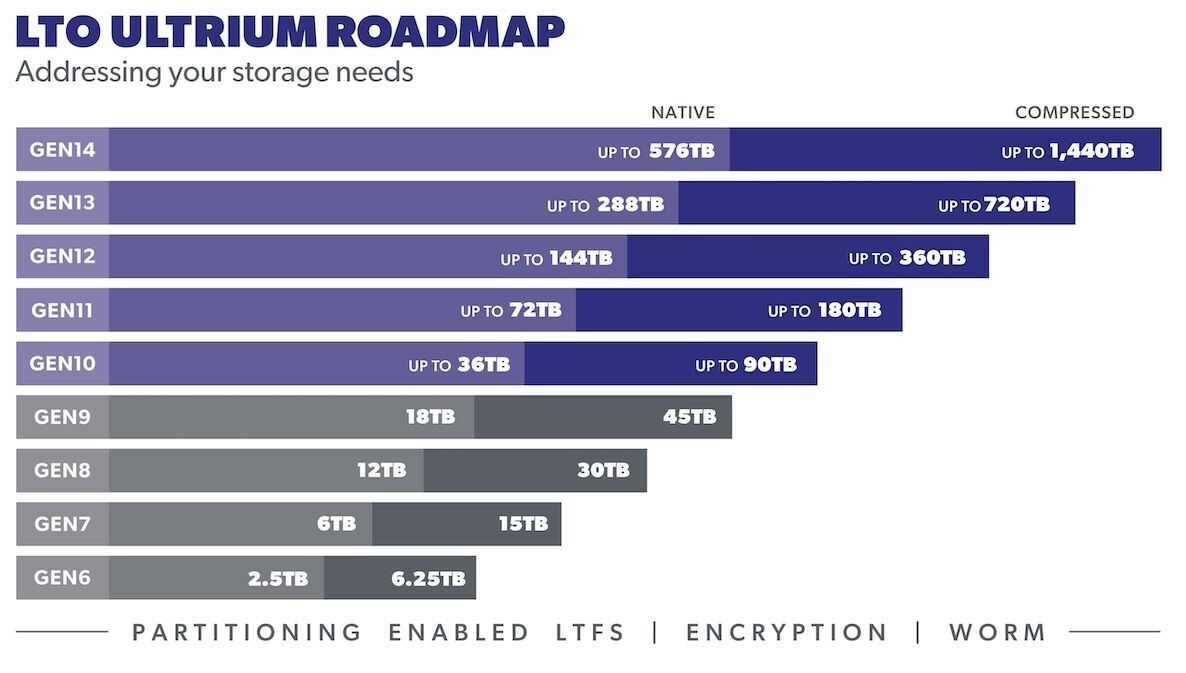
As more data is retained for long-term usage, the sustainability of hard drives must be questioned. There is nothing to be gained by keeping HDDs for passive data storage, where active data must be moved to flash-based systems to become useful. Tape could be used just as easily.
Seagate, Western Digital and Toshiba need to think about how the drive performance issue will be resolved rather than focusing solely on capacity gains. Otherwise, HDDs will cease to be relevant and have no long-term future, except perhaps in the public cloud, where hyper-scalers will continue to price their storage offerings to cover the cost of the media.

X-Ray: Seagate Technology Holdings PLC
This Architecting IT report takes a deep dive into Seagate’s history, products, services, and future outlook. This report is only available for download via paid subscription.
Copyright (c) 2007-2024 – Post #25db – Brookend Limited, first published on https://www.architecting.it/blog, do not reproduce without permission.