

Seagate Technology has published disappointing full-year results for the financial year ended 2023, which show the company made a loss and saw revenue fall by 37%, year-on-year. Is 2023 a blip or the harbinger of the long-term decline in the hard drive business?
Background
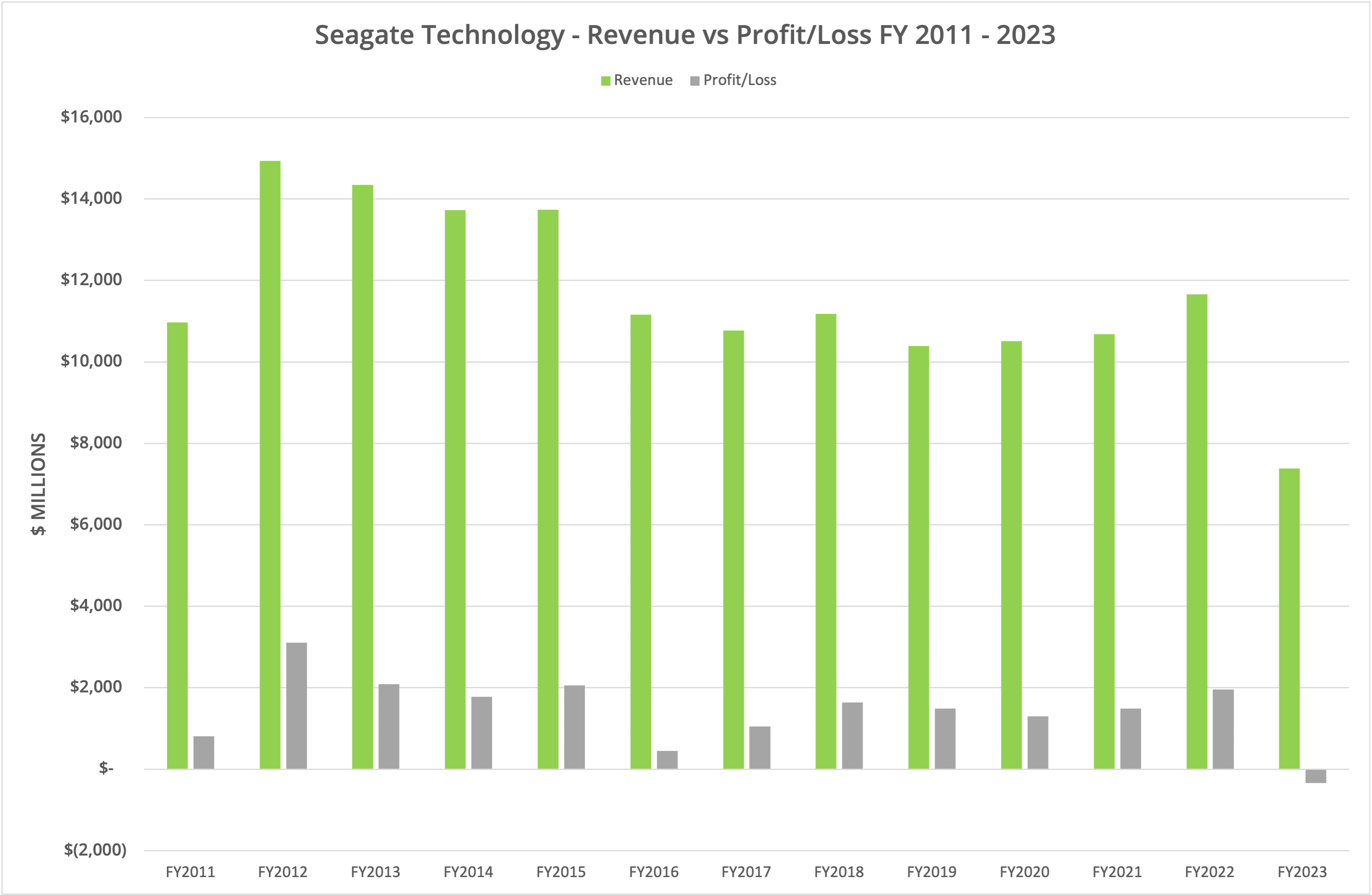
Seagate published financial data showing revenue of $7.4 billion for FY2023, with a loss of $342 million. This compares to $11.7 billion in FY2022, with a profit of just under $2 billion. In Q3 FY2023, Seagate was fined $300 million for illegally shipping hard drives to Huawei in contravention of US regulations. Taking that penalty into account, the year would have been close to break-even.
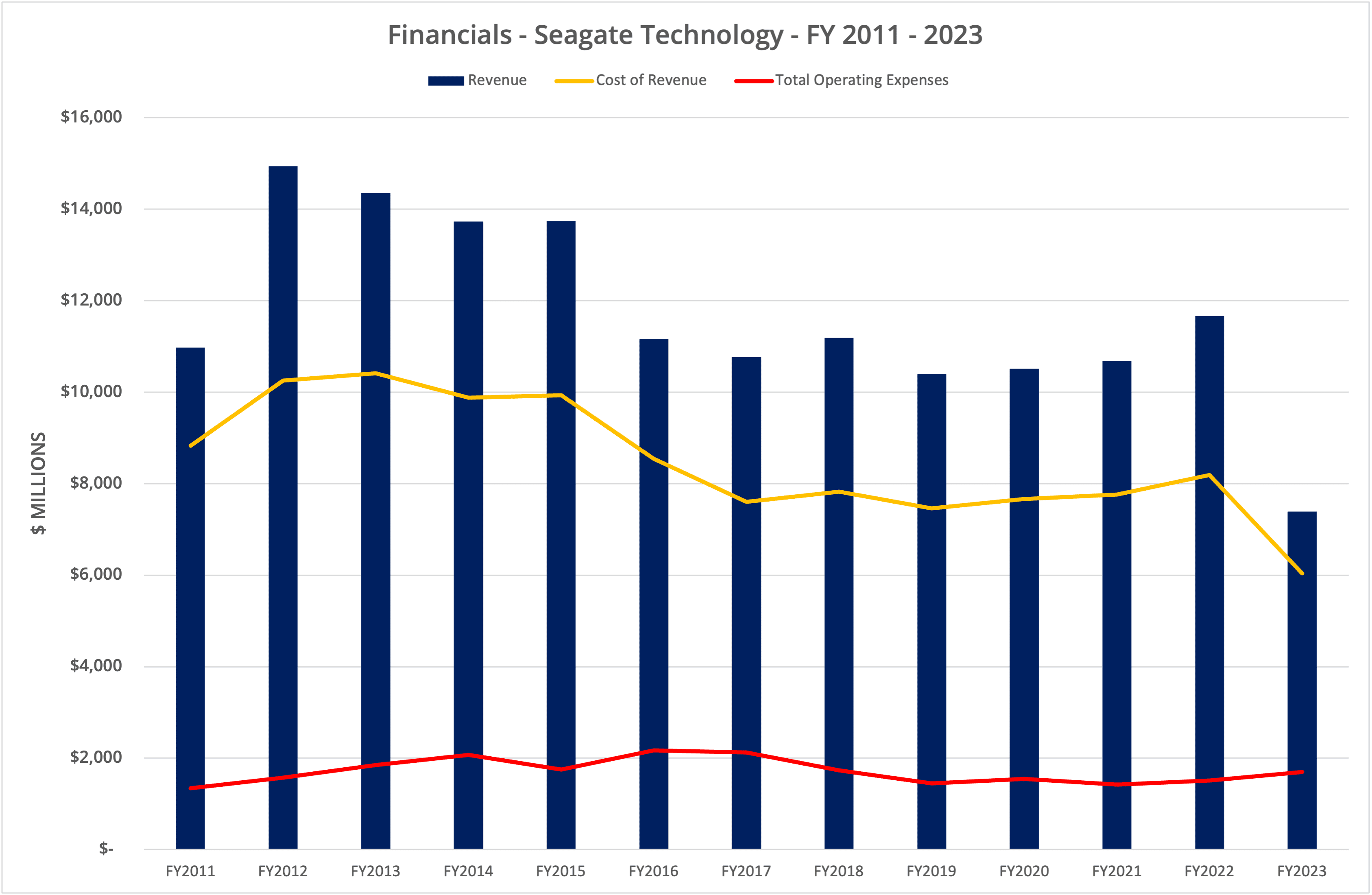
As our data shows (see Figure 1), revenue has been relatively flat for the last 5-6 years, although the company has been making a profit (see Figure 2).
HDD vs SSD
Seagate has a long history in the hard drive business. The company was initially founded as Shugart Technology in 1978 and released the first 5.25” hard drive (the ST-506) in 1980. Over the last four decades, Seagate has brought many innovations and firsts to the industry, including leading the push to increased capacities, being first to ship SMR drives and the first to multi-actuator drives.
In 2015, Seagate formed a strategic alliance with Micron to develop SAS solid-state drives, having acquired the LSI flash business from Avago in May 2014. However, Seagate SSDs haven’t made much of an impact on the market. Although the company doesn’t report HDD vs non-HDD sales directly, the data is in the earnings transcript notes. In Q4 FY2023, for example, $1.4 billion of the $1.6 billion revenue was from HDDs (87.5%), while $1 billion of the $1.4 billion came from “mass capacity” shipments – large capacity HDDs. The non-HDD business (SSDs and appliances) was down 15%.
Seagate’s business is very much tied to the HDD market and to the capacity drive category specifically.
HAMR Time
With everything depending on the future success of the hard drive, what can we expect from Seagate? We learned this week that 30+TB HAMR drives are now shipping in the Exos CORVAULT platform (the rebranded technology from the acquisition of Dot Hill Systems in October 2015).
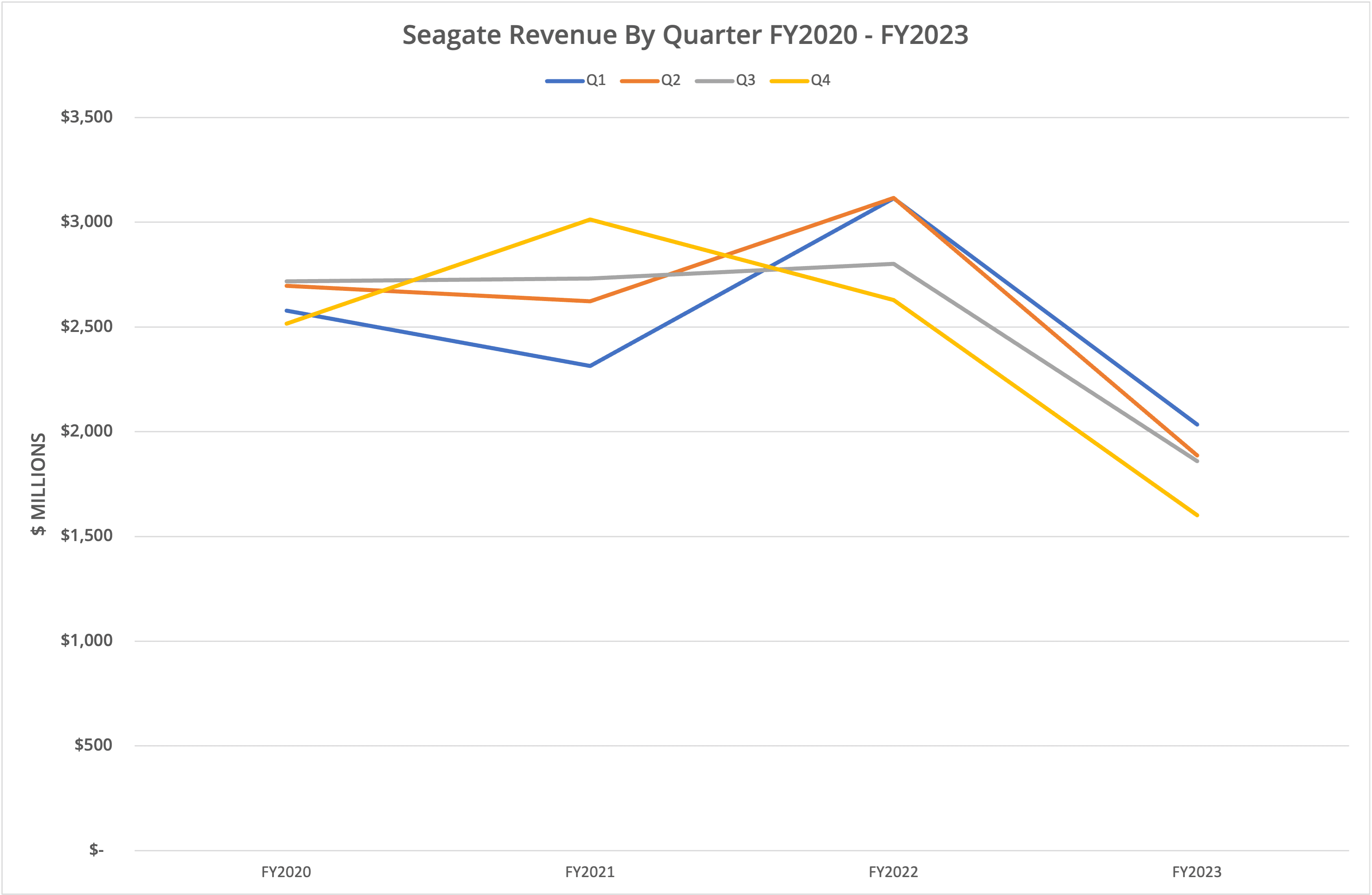
Elsewhere though (as reported by Seagate), hyper-scaler demand is down and expected to say that way for another couple of quarters. It’s worth noting that for the 91 exabytes of capacity shipped by Seagate in Q4 FY2023, 55 exabytes (60%) were to cloud service providers, making this part of the business critical to success.
- The Sustainability Characteristics of Hard Drives
- Pure Storage: No New Hard Drives Will be Sold by 2028 – Really?
- #54 – Are we at All-flash and HDD Array Price Parity?
- Storage Unpacked 240 – Predicting the HDD to SSD Transition Timeline
- #230 – Seagate NVMe Hard Drives
HAMR technology is expected to push the boundaries of capacity past 40TB, after which Seagate has plans to combine HAMR with bit patterned media in a technology called Heated Dot Magnetic Recording (HDMR). HDMR is expected to deliver drives of 100TB capacity at some time in the future.
Cloudy Data
As we reported in our weekly newsletter last week, the public cloud grew almost 30% in 2022, as annual spending reached $120 billion. Why is the demand for HDD storage from the hyper-scalers going in the opposite direction? We believe there are two factors. First, the demand for active storage is targeted at flash. Technologies such as AI are driving that demand. As the flash market continues to expand, the $/GB cost is declining. Simply put, we believe that public cloud customers are putting more data onto flash by default, in a similar transition to that seen in private data centres.
Second, the cost of the public cloud is operational, so for every terabyte of data stored, the monthly charges accrue. With a focus on cost management, we believe that businesses are evaluating whether data needs to be retained or can be deleted. It’s possible that some data is being archived to tape as part of a cost reduction plan.
Another factor in the data reduction cycle is the need to reduce exposure to malware attacks. Data loss prevention may be driving businesses to move more data offline and air-gapped from capture.
The Architect’s View®
Vendors such as Pure Storage and VAST Data are predicting and hoping for the demise of the hard drive to be replaced by all-flash systems. Undoubtedly there will continue to be demand for HDDs for many years to come. However, HDD sales are on a long-term decline, and every year that passes makes flash more attractive financially.
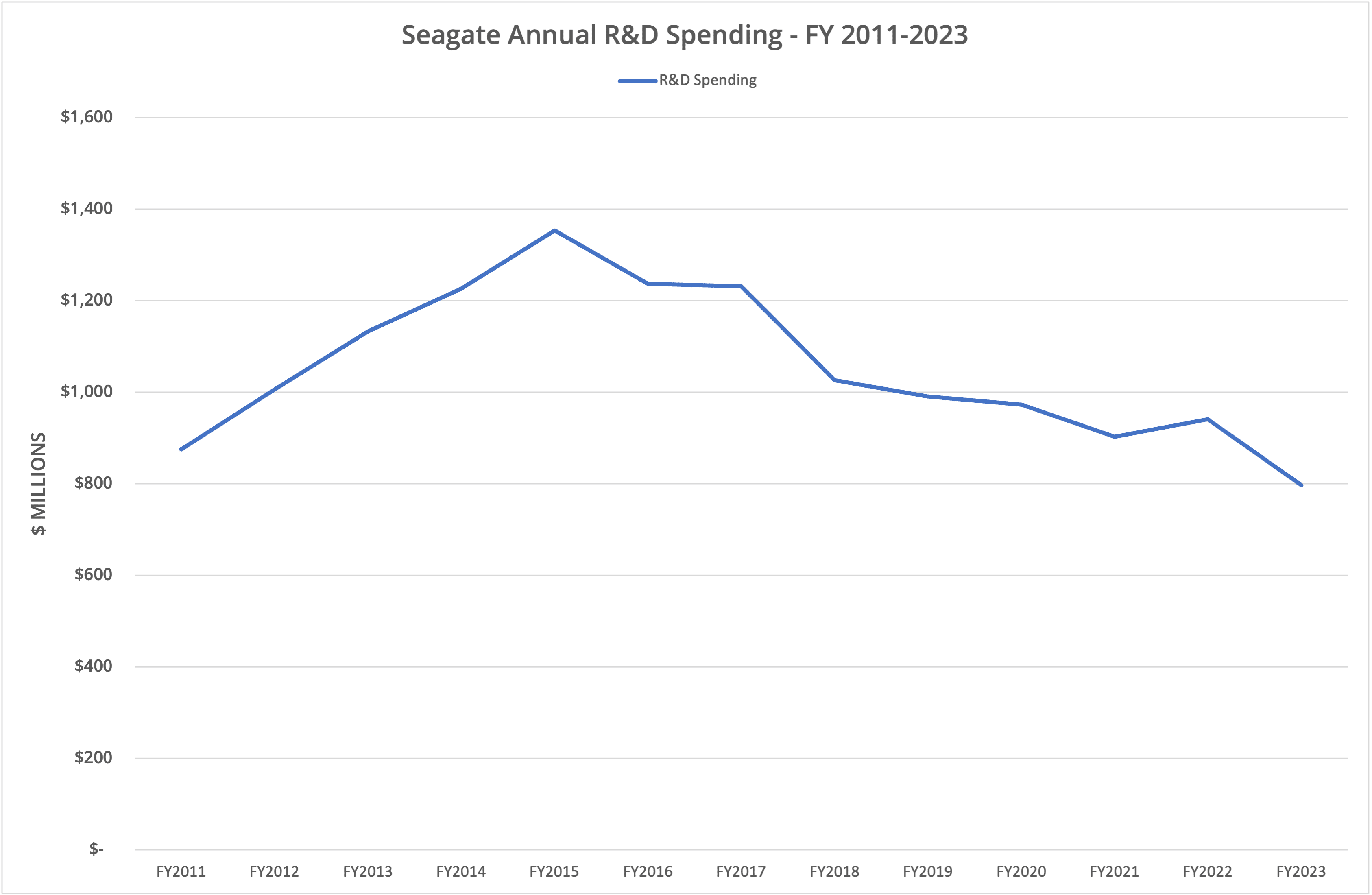
What is Seagate to do? We might see more vendor consolidation; Western Digital could spin off its HDD business, and Seagate could become one of two vendors (subject to regulatory approvals). However, that’s surely deferring the inevitable. It seems that Seagate needs a new strategy, focusing on new media. Unfortunately, in nearly ten years since the LSI flash business was acquired, that approach has failed to work.
There are tough times ahead for Seagate, of that, there’s no doubt.
Copyright (c) 2007-2023 – Post #13da – Brookend Ltd, first published on https://www.architecting.it/blog, do not reproduce without permission.
This post is only available to Individual, Vendor or Enterprise subscribers. Restrictions on distribution are based on those licensing terms. Check our Terms of Service for details.