

NetApp has announced financial results for the fourth quarter FY2023 and data for FY2023. The highlights show a business that barely grew revenue (0.6%) over the year and achieved only marginal gains in Public Cloud ARR (2.4%). So, what’s working and what’s not?
Background
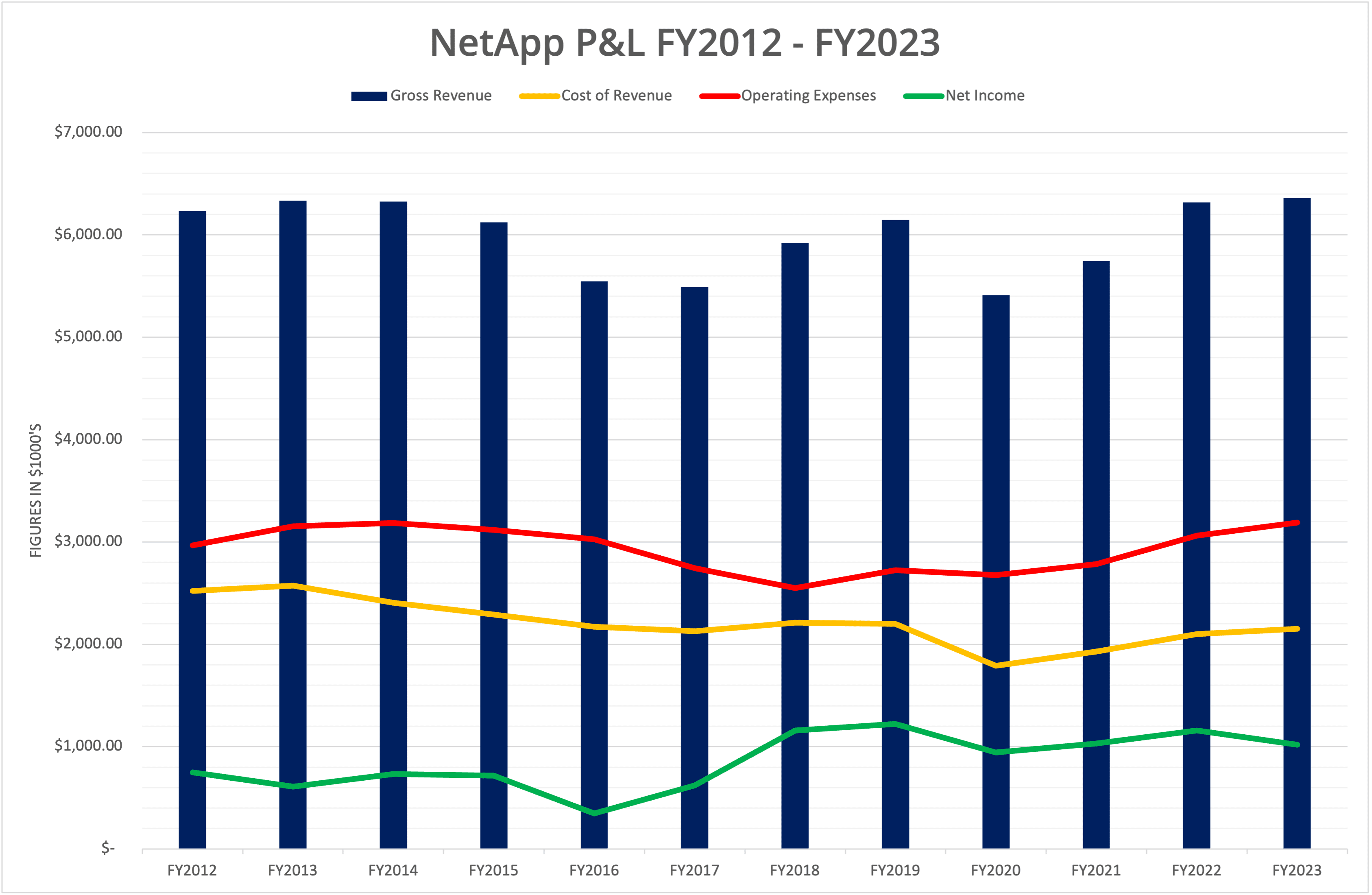
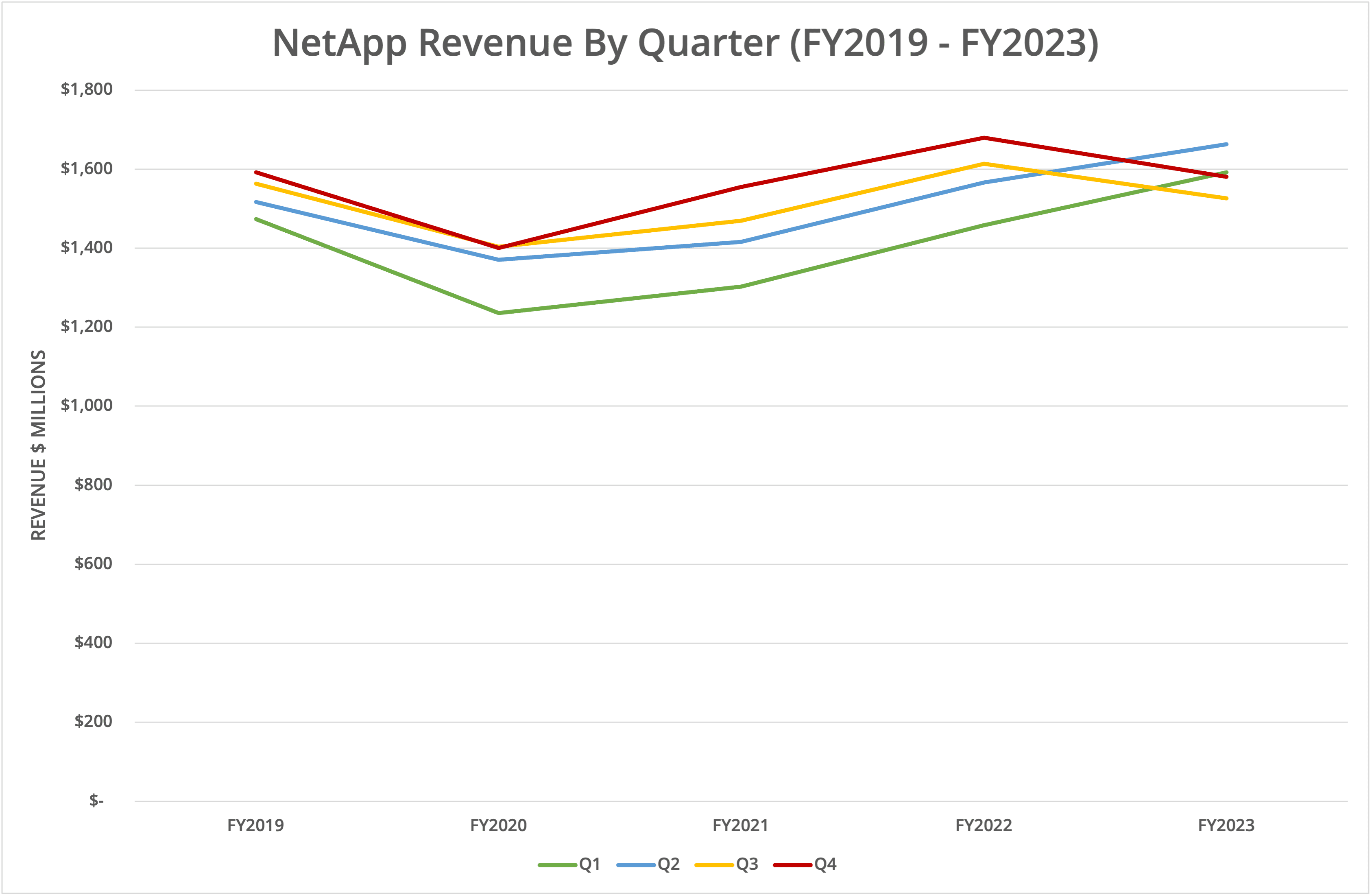
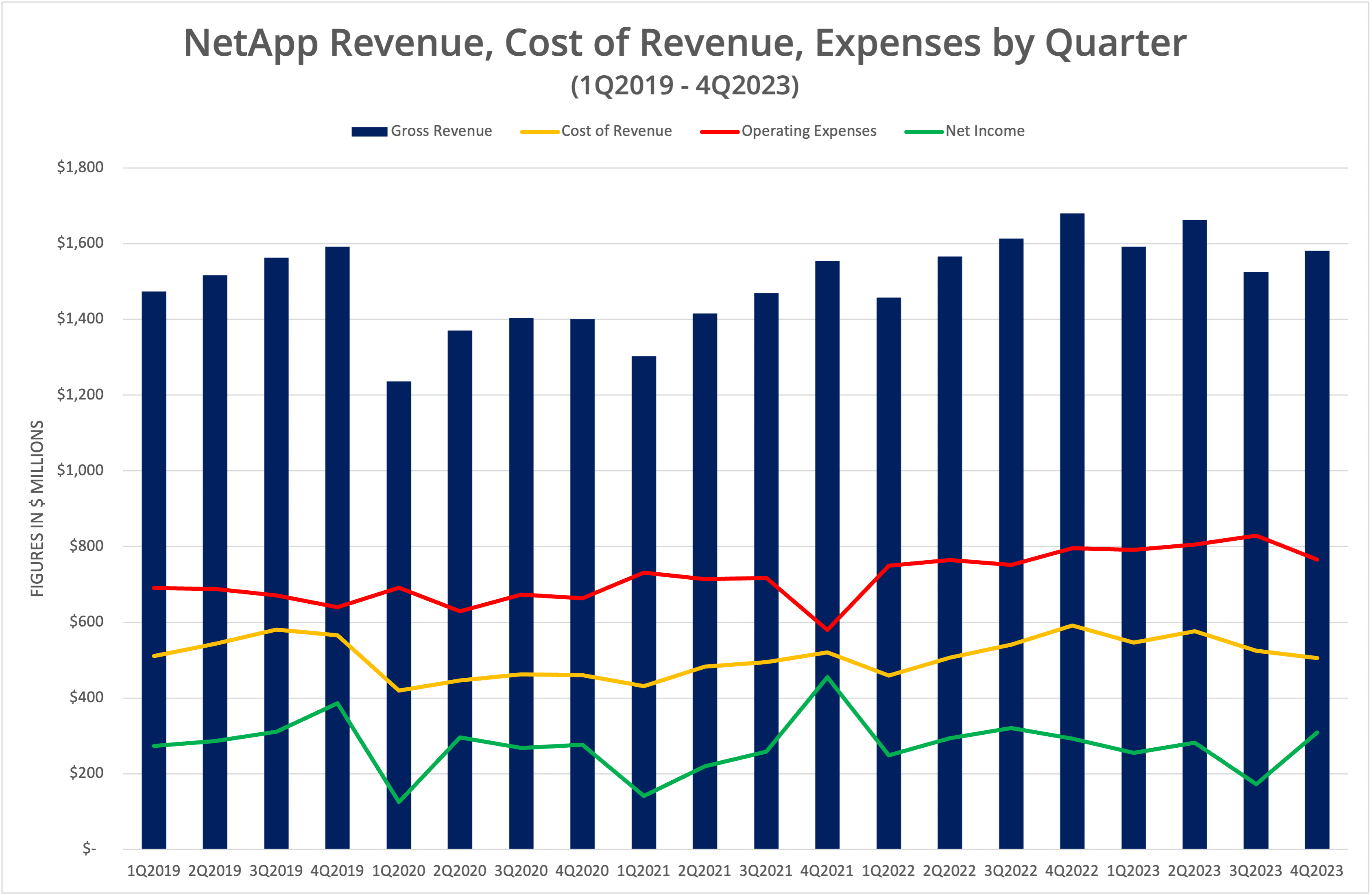
Figures 1 and 2 show revenue data from financial years 2012 to 2023. Over that period, NetApp’s business has barely grown, with revenue only fractionally higher than a decade earlier. The last two quarters have seen lower revenue than the equivalent quarters 12 months before (figure 3).
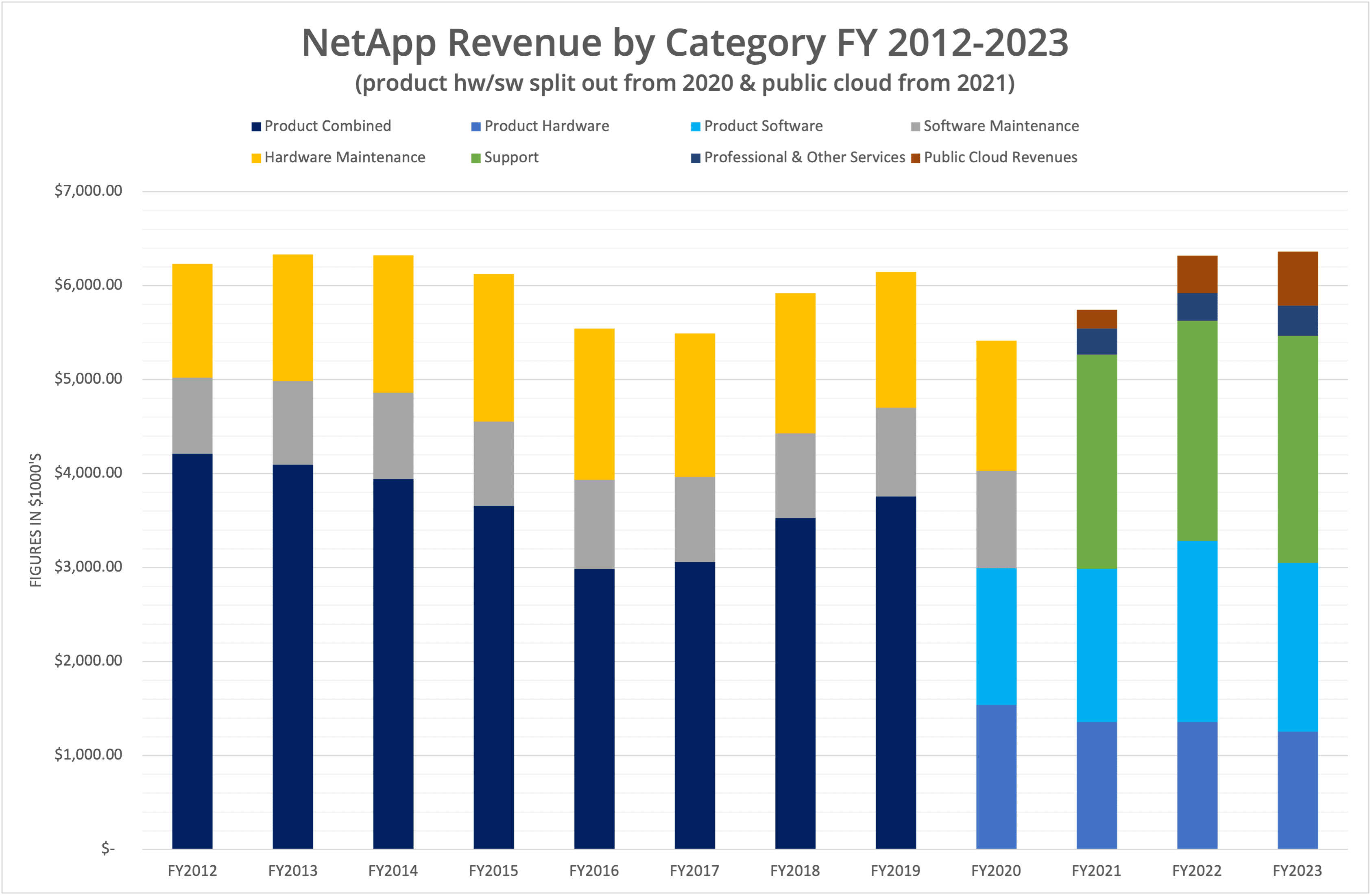
In fairness, compared to the rest of the market, NetApp has managed to maintain a relatively steady business (so far), while other competing vendors have experienced significant reductions in revenue.
ARR
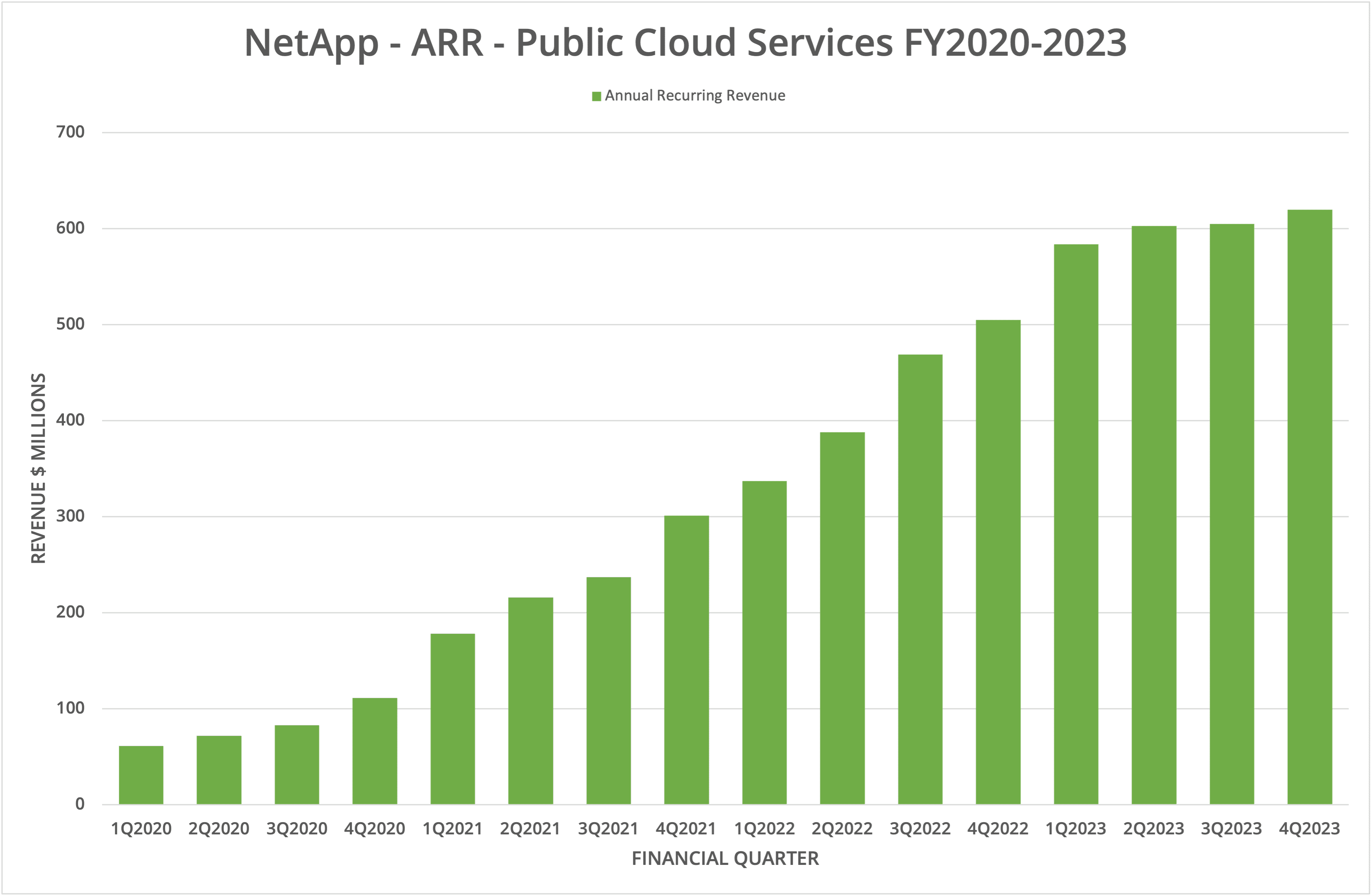
Probably the most disappointing data is the annual recurring revenue from public cloud. While the year-on-year data shows an increase of 23% ($620 million compared to $505 million), figure 4 shows a different story with a marked slowing down in demand. Having a public cloud business is not a panacea for anaemic growth with on-premises deployments, as a global slow-down affects all areas. However, sitting in both the public and private cloud businesses does provide the ability to capture revenue as businesses shift their focus away from on-premises deployments.
Strategy
So, what’s working and what’s not? In the last 12 months, NetApp has released a new version of the All-SAN Array, announced a new cost-optimised all-flash array, restructured its cloud management portfolio with the addition of BlueXP and ONTAP One, and delivered enhancements to the purchasing models for customers with the launch of NetApp Advance.
Although there have been enhancements to the Spot portfolio, it doesn’t appear that this part of the business is gaining enough traction to have any real impact on revenue. Back in February 2023 we suggested more work was needed to develop the “right-side” of the NetApp brain, focused on optimisation and efficiency. We still haven’t seen evidence that these acquisitions have a strategy to drive significant future growth.
The Architect’s View®
Looking back over the last decade, what can we forecast for NetApp’s next ten years? There are relatively few new innovations in the storage industry these days, with most new products and solutions covering niche parts of the market. So it’s unlikely that NetApp can create an entirely new product genre. Existing storage platforms are running to stand still, with most innovations focused on reducing cost and improving efficiency to keep up with vendors in a mature and tight market.
The Spot portfolio needs a little reimagining, to use a Hollywood euphemism. This part of the business just doesn’t have the spark of creativity and obvious roadmap seen with the first NetApp solutions in the public cloud. Perhaps Spot needs more flexibility to operate and be marketed as a separate business, almost building a persona that doesn’t have the NetApp legacy association.
Another option is to acquire or develop solutions competing directly with existing vendors – perhaps focusing on data and analytics. Unfortunately, most of the most successful companies in this area already have a market cap much higher than NetApp, making that avenue difficult, or impossible.
If nothing changes, we’re likely to be discussing the same issues and the same flat revenue story in another ten years time. Let’s hope that’s not the case.
Related Posts
- NetApp Announces Q1 FY2023 Results
- NetApp delivers solid FY2022 growth, but there’s work to do in public cloud messaging
- NetApp – Transformation, Bifurcation or Re-invention?
- Can NetApp Reach Escape Velocity to the Public Cloud?
Copyright (c) 2007-2023 Brookend Limited. No reproduction without permission in part or whole. Post #93ed.
This post is only available to Individual, Vendor or Enterprise subscribers. Restrictions on distribution are based on those licensing terms. Check our Terms of Service for details.