
PCI-SIG, the standards body that develops the PCI Express specification, has announced that PCIe 8.0 is now under development and targeted for release in 2028. The 8.0 specification will again double the throughput of the protocol, reaching a maximum 1TB/s of bandwidth.
Background
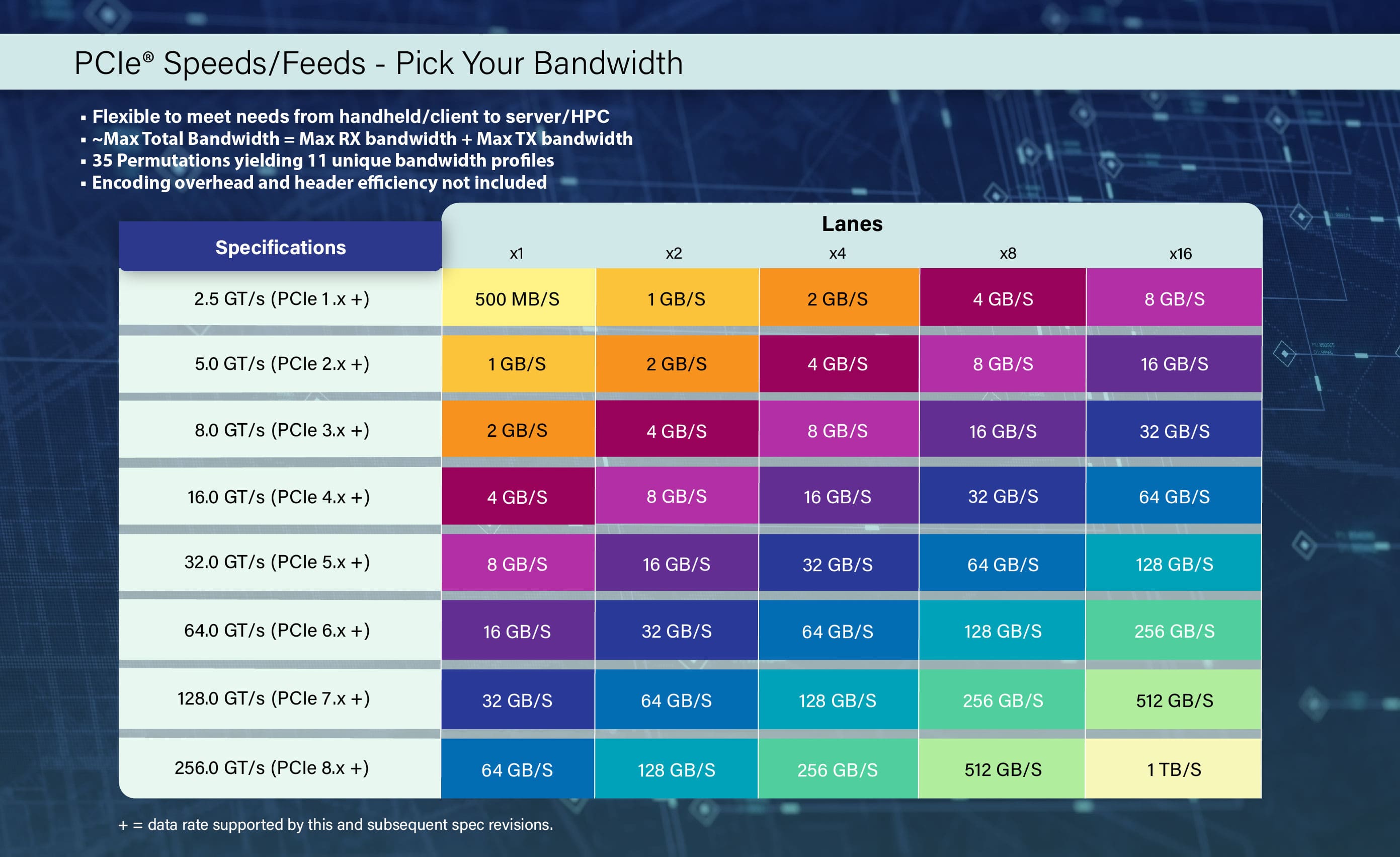
PCI-SIG, the standards body responsible for the PCI Express specification, has announced the development of PCIe 8.0. In keeping with recent improvements, the expected performance of PCIe 8.0 will be 256GT/s, doubling the 128GT/s specification of PCIe 7.0. This translates to around 64GB/s per lane, or a maximum of 1TB/s on a 16-lane bus. The diagram in Figure 1 shows how the PCI Express standard has evolved and how, depending on the protocol version in place, the bandwidth scales by the number of lanes used with a device.
Integral
The importance of the PCI Express standard may not be immediately apparent in a world that’s generally dominated by discussions on software and platforms such as AI. However, we need to remember that PCI Express is the basis of the interface used for the NVMe protocol and all modern high-performance SSDs (Side Note: there’s even a proof-of-concept NVMe HDD from Seagate).
As we’ve seen recently with SSD vendors initially moving to PCIe 5.0 and now PCIe 6.0 (Micron), the throughput capability of solid-state disks doubles with each iteration of PCI Express. PCIe 5.0 SSD devices typically deliver around 14GB/s of sequential read I/O, while the Micron 9650 with PCIe 6.0 can reach a theoretical capability of 28GB/s. There is a similar improvement for random I/O performance.
PCI Networks
While it is unlikely we will see any PCIe 8.0 SSDs any time soon, PCI Express is also used as the underlying interface for CXL, or Compute Express Link, a technology for connecting processors and accelerator devices. To date, CXL has been used as a memory extension solution, providing coherence on an I/O bus.
New Architectures
We need to see a constant improvement in I/O performance to ensure that this part of the Von Neumann architecture of modern computing doesn’t become a bottleneck to the overall performance of computing systems. With the introduction of CXL and the potential for optical PCIe interconnects, there is an opportunity to create new server designs and share resources in ways that haven’t been possible before.
We discussed some of these ideas on a podcast recorded in 2021 that introduced the concept of CXL (embedded here).
The Architect’s View®
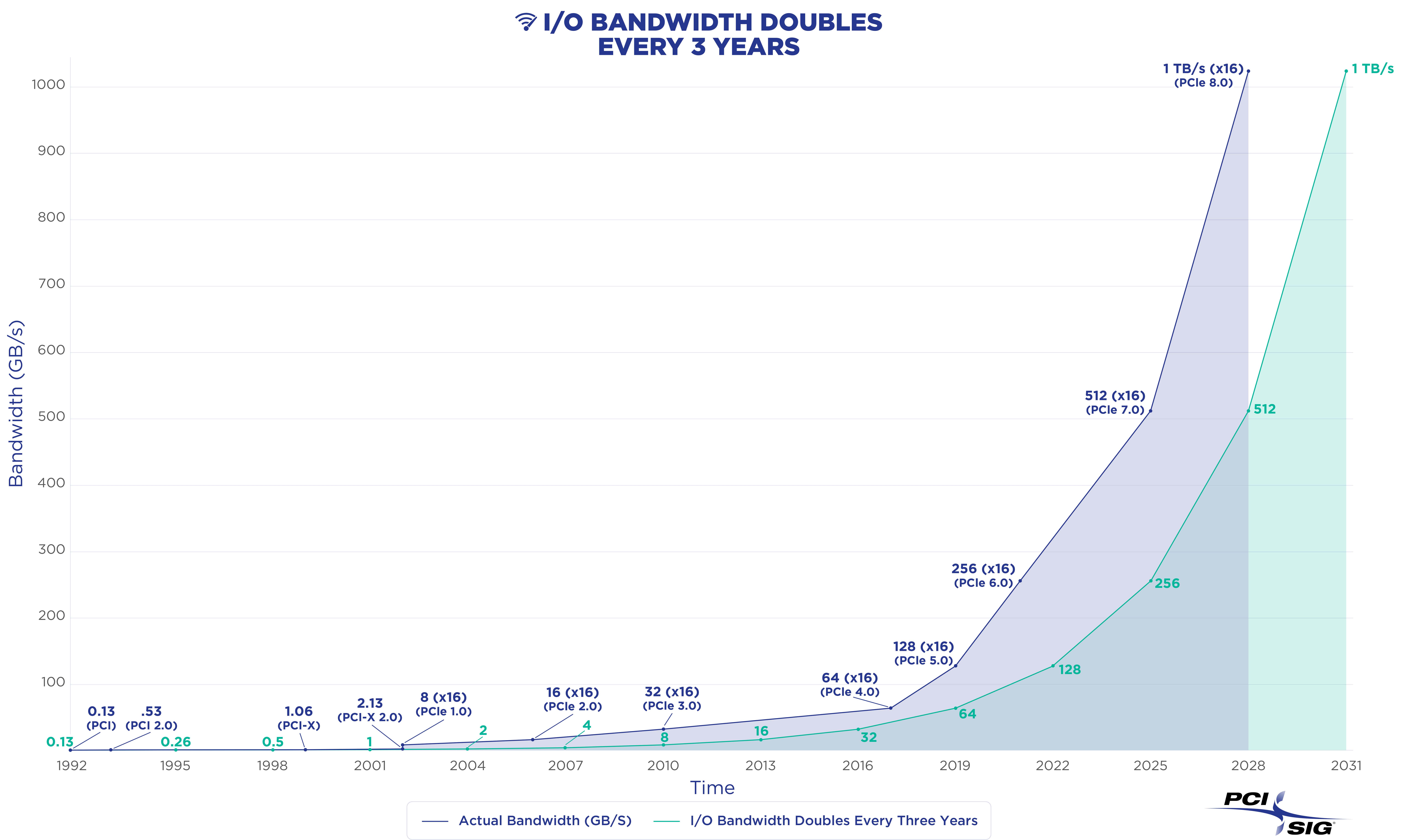
As we discussed on podcasts covering PCIe 6.0 and 7.0 (links below), the PCI-SIG has aligned to a three-year cadence when releasing the next evolution of PCI Express. At the same time, each iteration has managed to double throughput performance while maintaining backwards and forwards compatibility. This is an incredible feat. See Figure 2 that puts these achievements into context.
- Podcast #229 – Exploring PCIe 6.0 Specification with Al Yanes
- Podcast #239 – Unpacking the details of PCI Express 7.0 with Al Yanes
Optical connectivity may provide the option to build rack-scale architectures similar to the original mainframes, but with much greater power. In an age where the efficient use of GPUs is paramount, sharing resources over PCI Express and/or CXL could give a much-needed boost to the cost and efficiency of GPU farms.
It is possible that storage devices (specifically NVMe SSDs) could also be connected across massive optical networks in the same way Fibre Channel centralised storage in the early 2000s. Currently, NVMe over Fabrics delivers this capability, so implementing direct PCI Express connectivity may be irrelevant. Don’t forget, though, that NVMe over Fabrics is a storage protocol, whereas PCI Express used with CXL implements memory coherence, which could be helpful in extending system memory into storage solutions.
As usual, we will be watching to see how PCI Express develops. We encourage readers to review the podcast material in this post, which, although a few years old, still has relevance in today’s market. Don’t dismiss the benefits and dependency we have on technologies such as PCI Express to deliver the underlying growth we need in the industry. Without it and similar standards, we would make no progress elsewhere.
Copyright (c) 2007-2025 – Post #3a1b – Brookend Ltd, first published on https://www.architecting.it/blog, do not reproduce without permission.