

Nutanix, Inc. has announced financial results for the first quarter of FY2025, which show revenue up 15.6% at $591 million. Annual recurring revenue is close to $2 billion, with gross margin of 86% and a small profit of $37 million. The company has turned itself around and appears to be thriving in the wake of the VMware takeover.
Background
Nutanix, Inc. has published financial results for Q1 FY2025 that show an increase in revenue of 15.9% to $591 million compared to Q1 FY2024. The increase, which was above the guidance figures, was driven by product sales, which rose 22.3% over the comparable period in FY2024. Gross margin increased slightly to 86%, while the company declared a small profit of $36.8 million (GAAP). Nutanix now has 27,160 customers, a gain of 630 in the reported period.
We present the financial data as four graphs, labelled Figures 1 to 4.
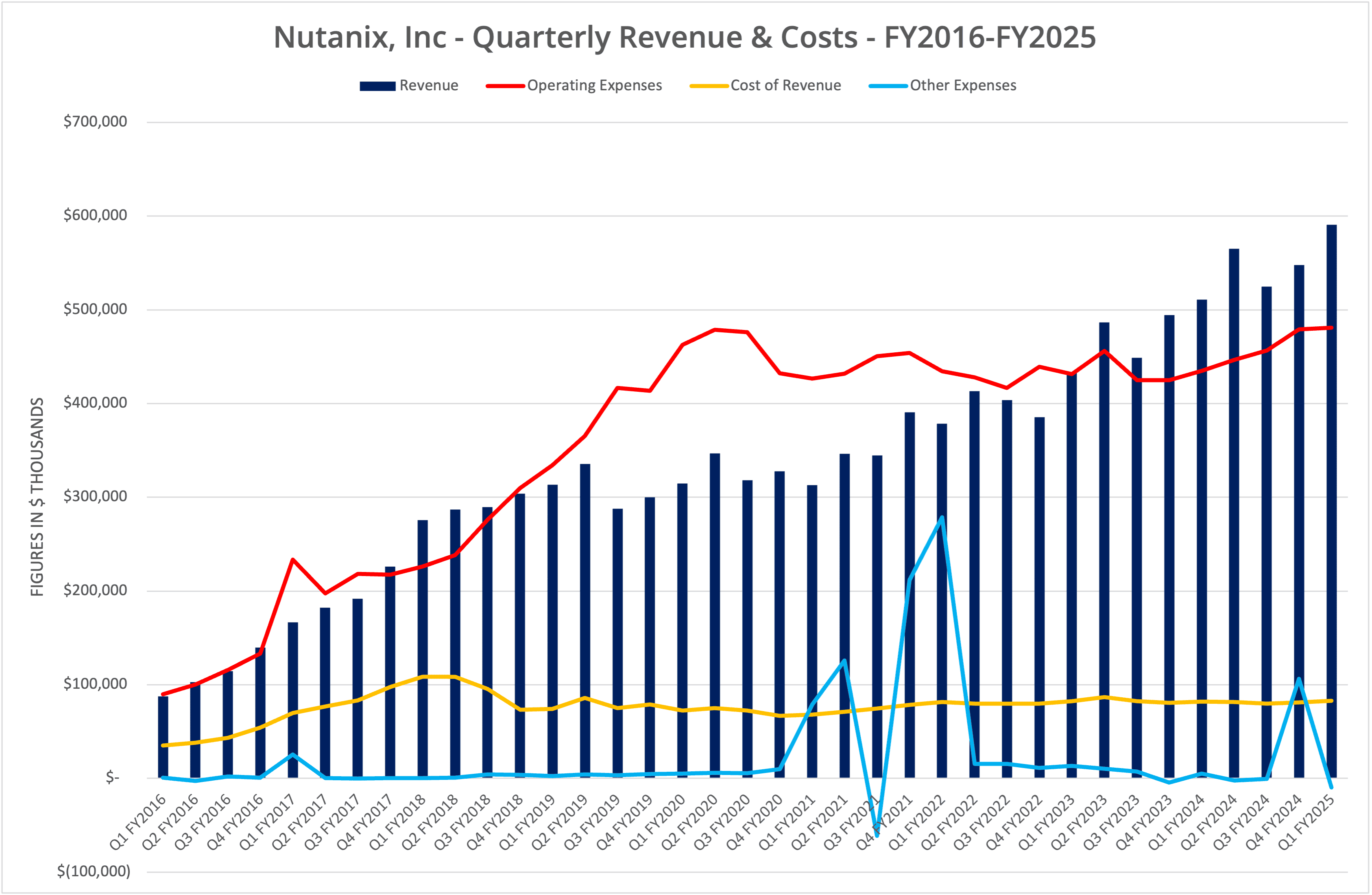
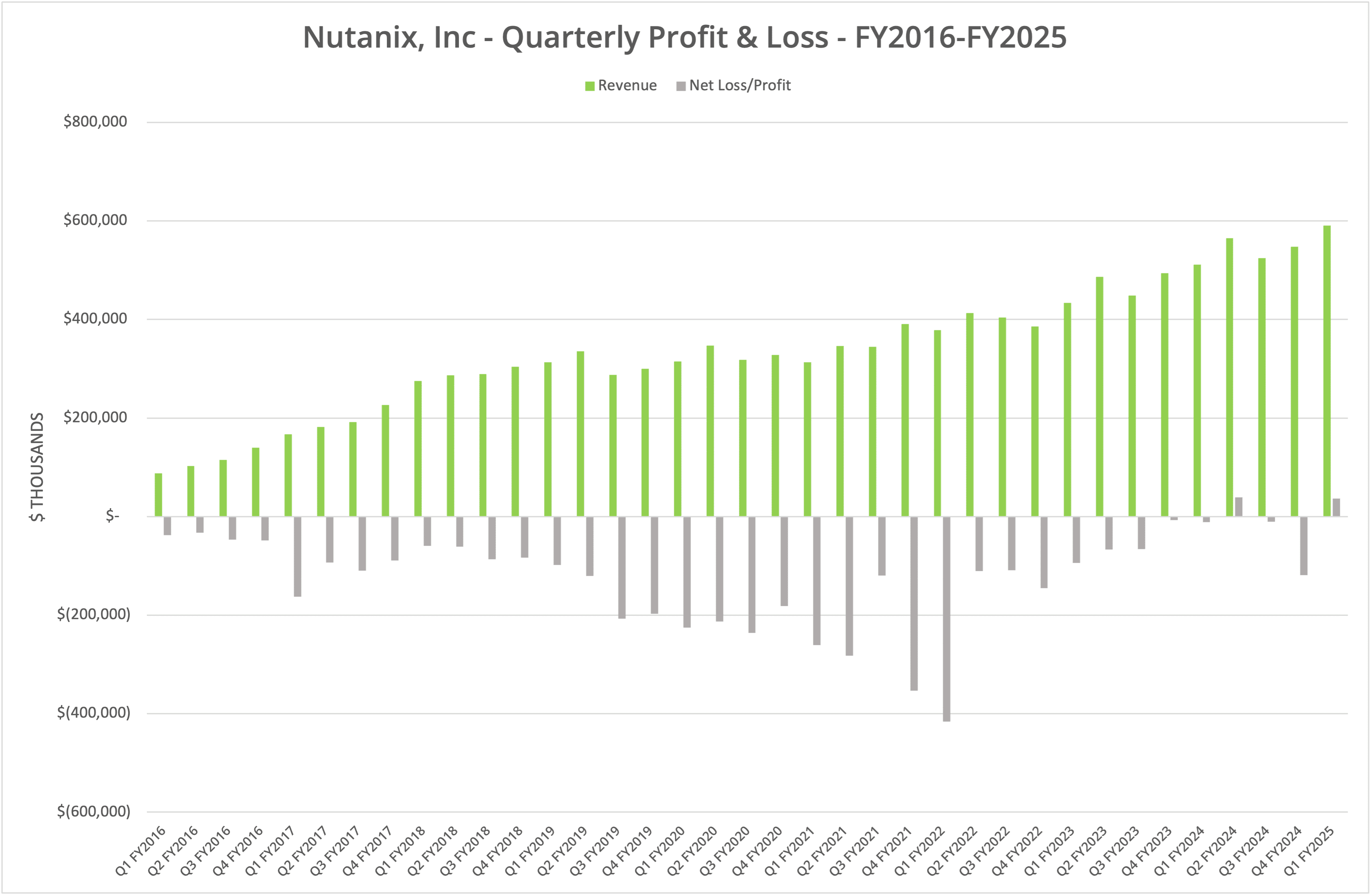
Expenses
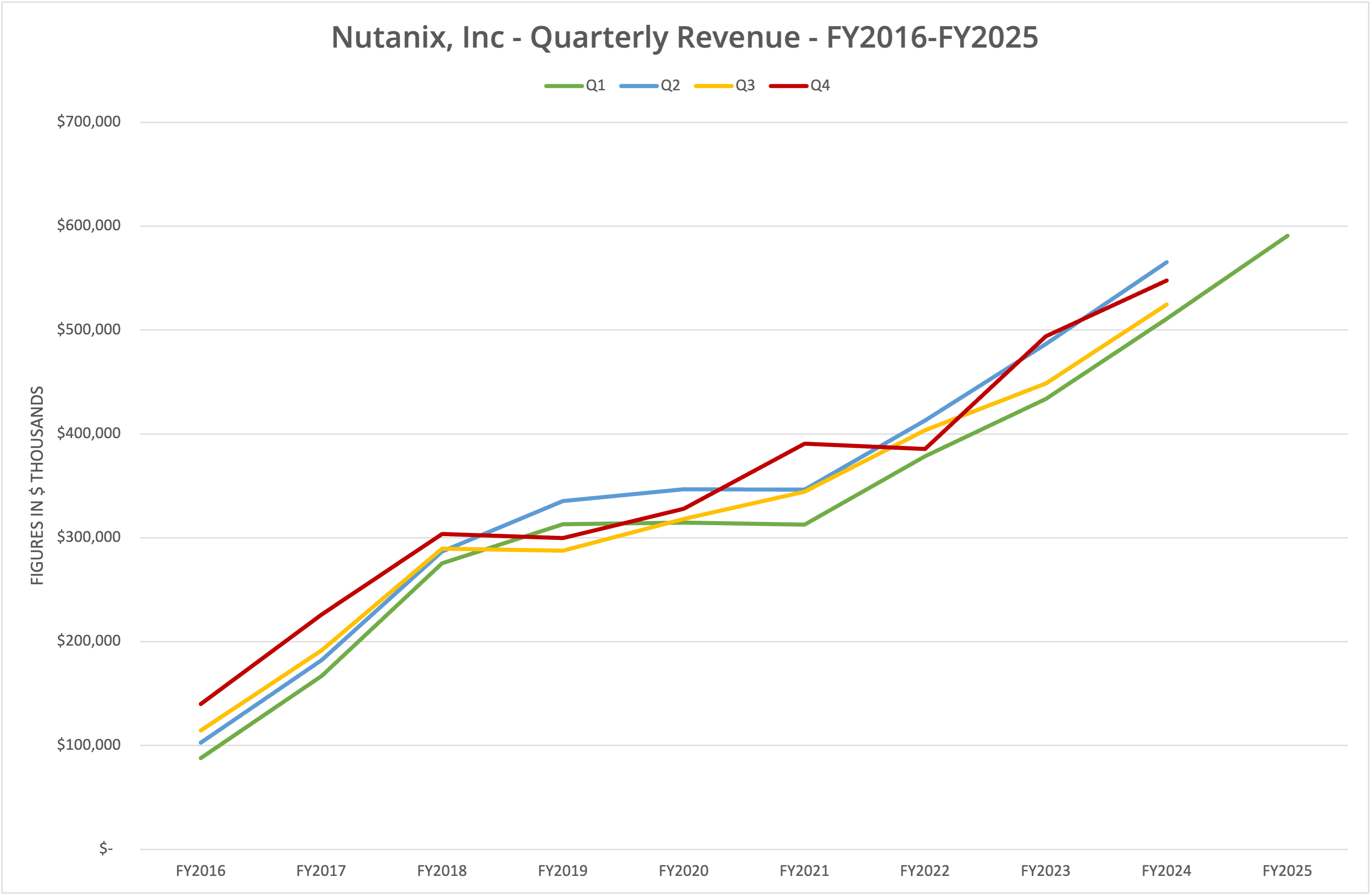
The Nutanix financial data can be represented by two threads. In the first, as shown in Figure 3, revenue has increased steadily from FY2021 onwards, following a slowing of momentum in financial years 2018 and 2019. It is fair to say that none of this growth can be attributed to the turbulence at VMware, which was first announced in May 2022.
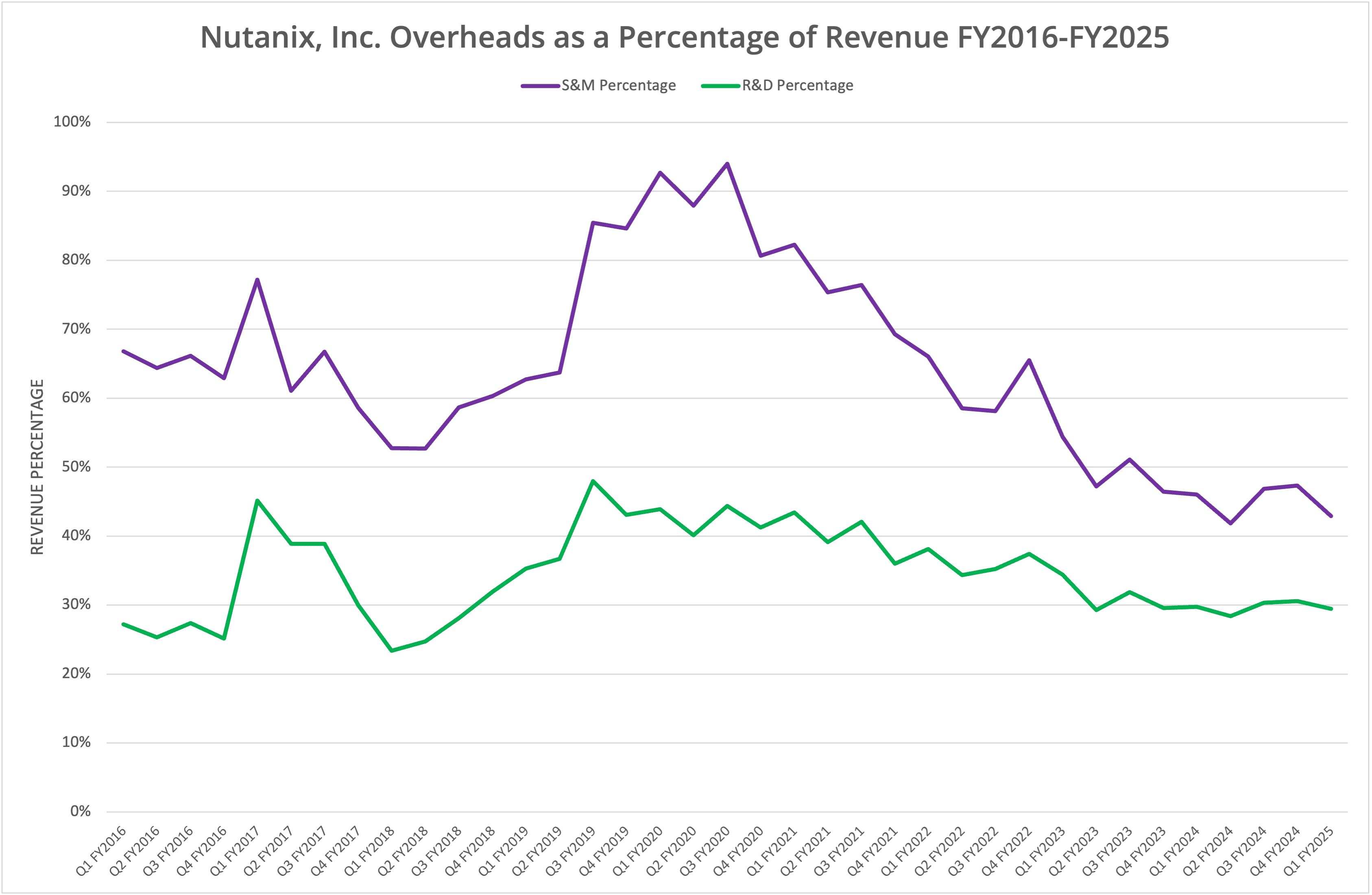
The second thread, represented by Figure 4, shows the trend in overheads, expressed as a percentage of revenue. We can see that following the change of CEO in late 2020, expenses have been curtailed and trended downwards ever since (although some of this percentage change is due to increased revenue). Sales & Marketing expenses peaked in Q3 FY2020 at 94%, with the figure even worse when expressed as a percentage of net revenue. In this instance, S&M overheads were more than 100% of the net revenue between Q3 FY2019 and Q1 FY2021.
Now, not all of this expense is real money or a direct impact on cash flow, but it did highlight the fiscal challenges of bringing the business in line for long-term growth and profitability. Rajiv Ramaswami has done an incredible job improving the financial footing of Nutanix (even with an 86% gross margin on sales).
AHV
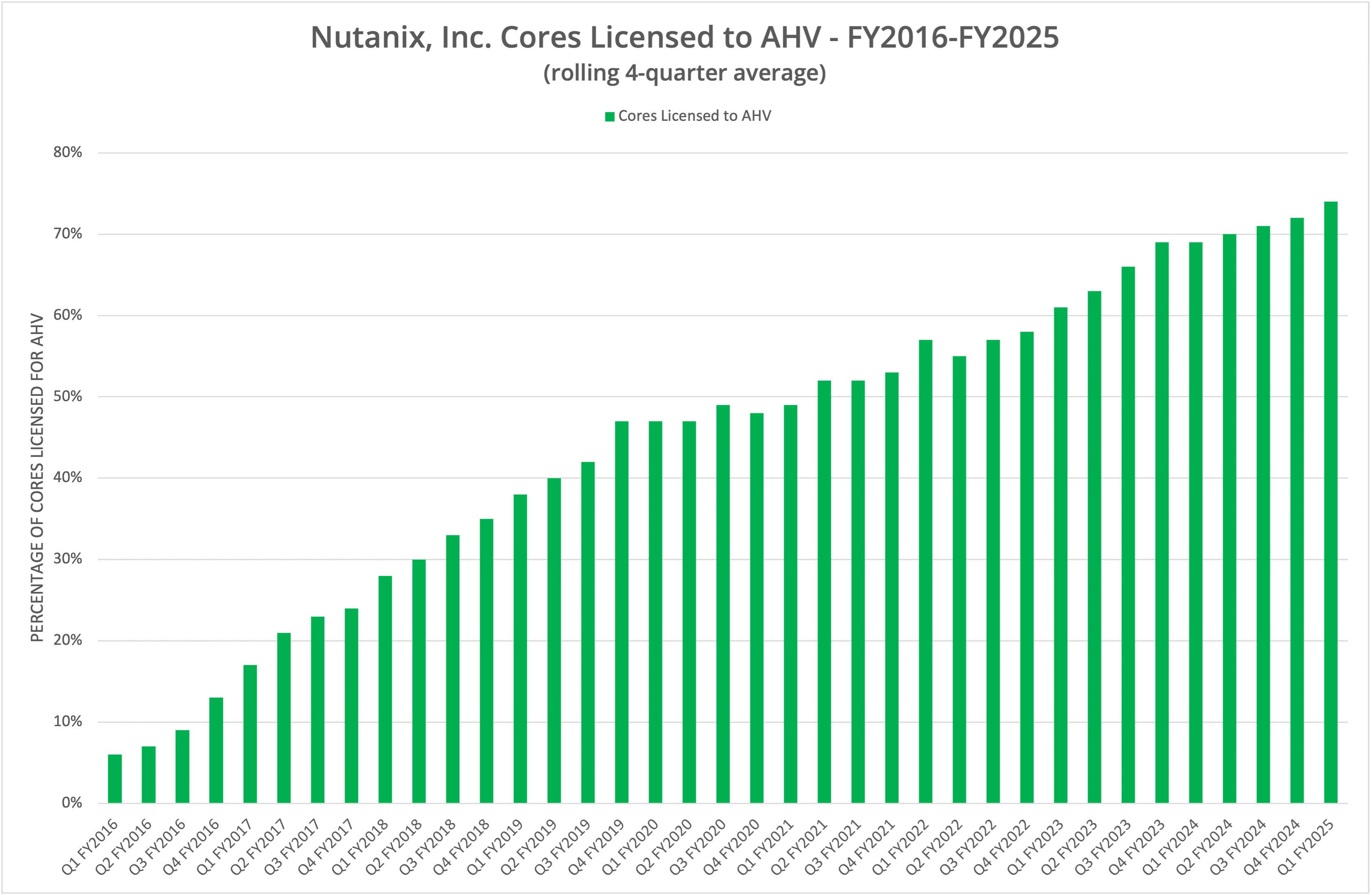
It is worth noting a small piece of data provided on the announcement infographic that indicates on a rolling four-quarter average, AHV is used on 74% of total licensed CPU cores. We have taken all the data since Q1 FY2016 and produced a graph showing the trend of AHV adoption to the current reporting period (see Figure 5). As we can see, AHV adoption has grown steadily, resulting in fewer VMware licences being either resold or used by customers.
Of course, within that data, we don’t know how many new customers are deploying 100% of their infrastructure on AHV. This is a rolling number over the period of one year, but it does indicate a clear trend away from VMware and onto Nutanix’s own platform.
The Architect’s View®
Nutanix is continuing to gain momentum, add customers and increase revenue. As we can see, those customers are increasingly moving to AHV and dropping the VMware ecosystem. VMware claims to have 500,000 customers, the vast majority of which will be using vSphere. In comparison, Nutanix has just over 5% of that number, although we don’t know the breakdown of the individual software solutions in the VMware number.
By comparison, Nutanix is still a minnow on customer numbers but is gradually catching up in terms of revenue (although currently around 15% of VMware under Broadcom).
From a product perspective, we highlighted that Nutanix should move away from the HCI model and enable the use of centralised storage, specifically for customers where there is already an investment in hardware and for whom the centralised model will remain a core piece of infrastructure.
We still see this as a future measure of increased success for Nutanix, especially with larger customers. We also believe Nutanix has an opportunity to increase its revenue through more SaaS-enabled capabilities. This is a route VMware has chosen to discontinue, but could be more beneficial for customers looking for an integrated cloud experience. We will discuss this further in our review of the server virtualisation software market.
For now, it appears Nutanix has found the formula for growth that doesn’t show any signs of stopping soon.
Related Content
- X-Ray: Nutanix, Inc (Second Edition)
- Analysis: Nutanix. Inc. announces Q4 FY2024 and Full Year financial results
- Alternatives to VMware: Nutanix
- Nutanix Announces Q1 Fy2024 Results
Copyright (c) 2007-2024 – Post #d3ca – Brookend Ltd, first published on https://www.architecting.it/blog, do not reproduce without permission.