

Dell Technologies, Inc. has announced Q3 FY2025 financial results, which show a 9.5% increase in revenue year-on-year of $24.4 billion (a slight revenue miss) compared to Q3 FY2024. By business group, ISG revenue increased 33.8%, while CSG declined 1.2%. It appears Dell is becoming increasingly dependent on the income generated by AI infrastructure.
Background
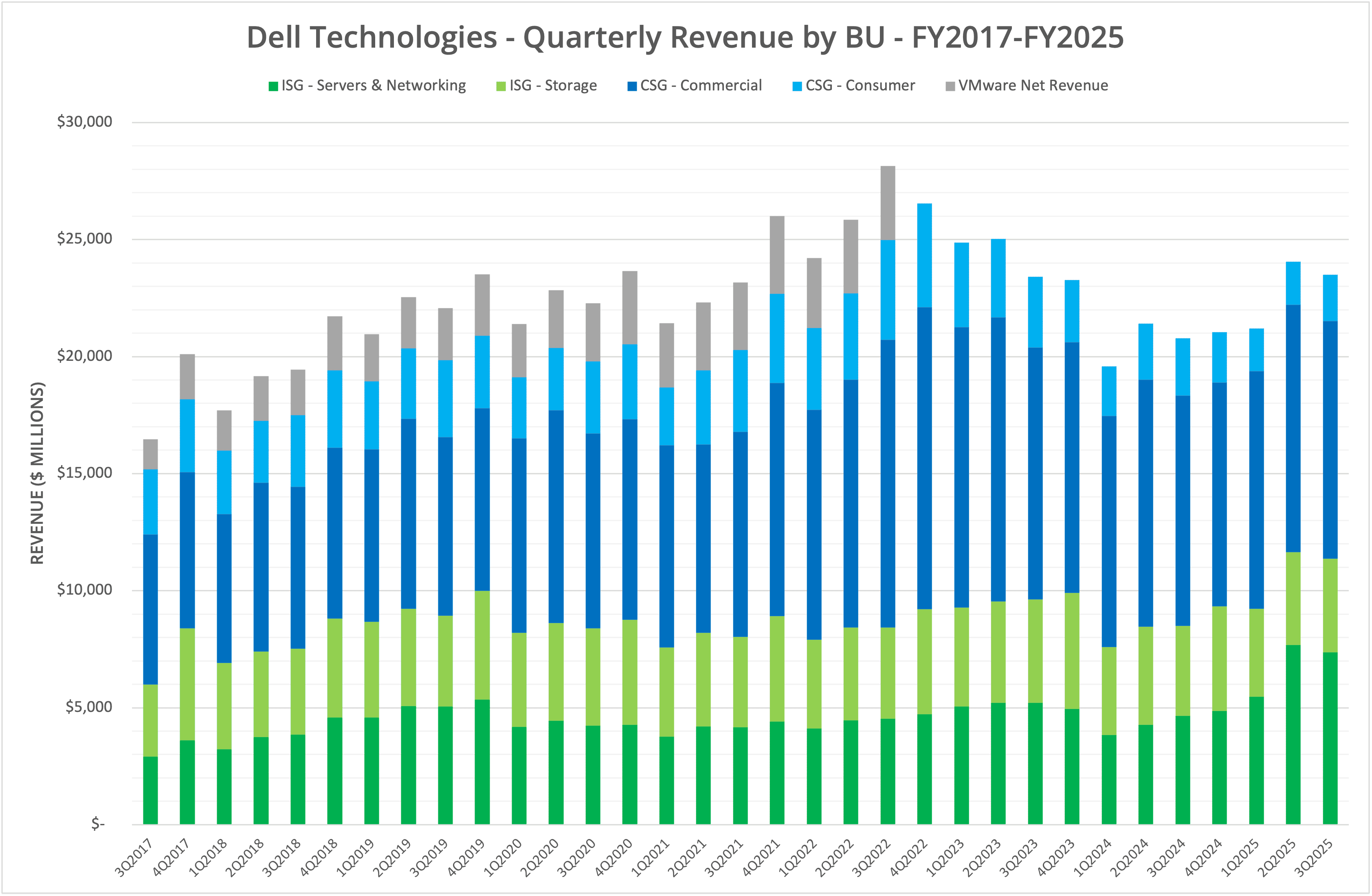
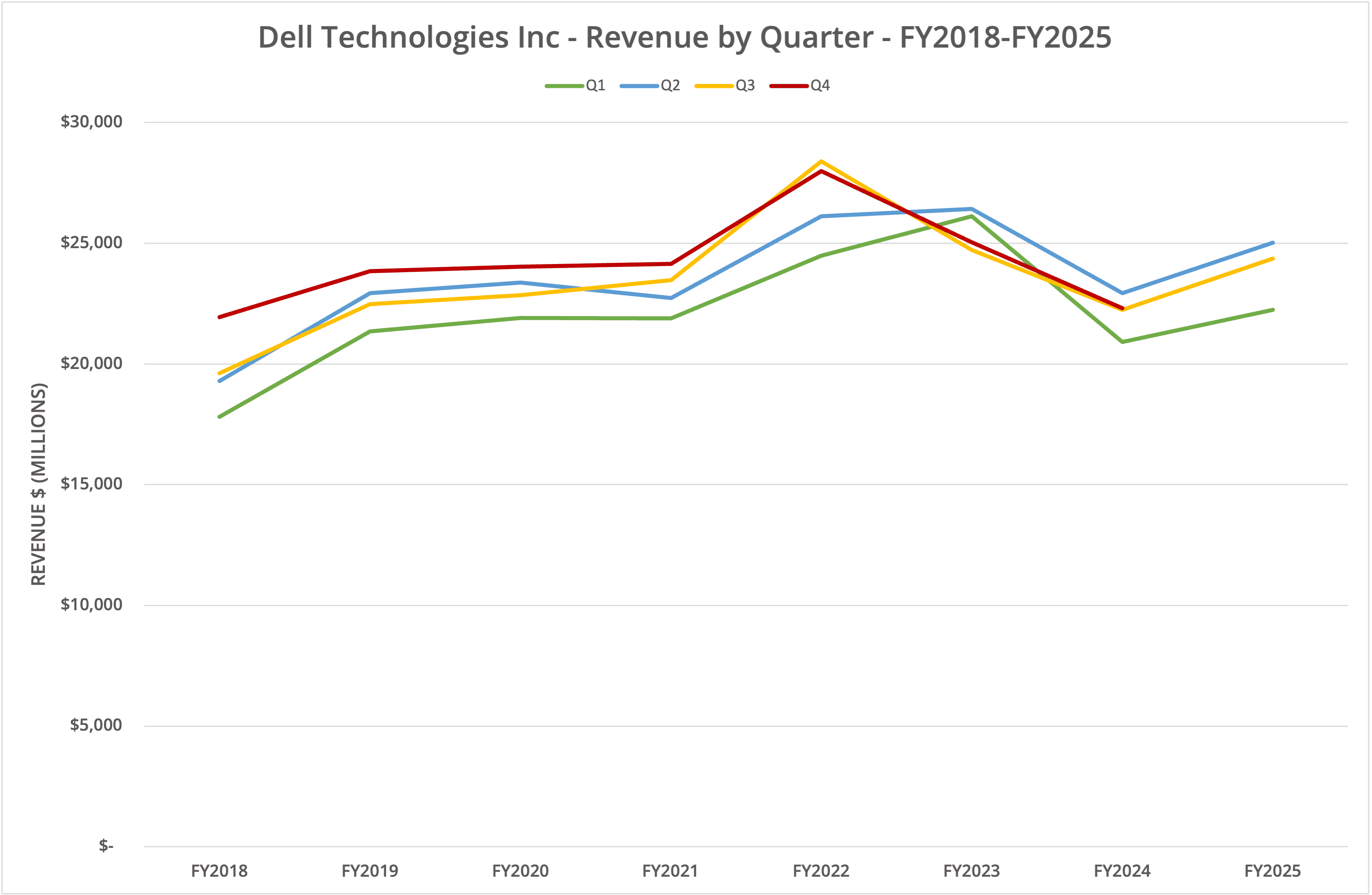
Dell Technologies, Inc. has posted financial results that show Q3 FY2025 revenue of $24.4 billion, which is up 9.5% on the same quarter in FY2024. The reported numbers missed the target of $24.5 billion. By category, Product sales increased 12.7%, while Services increased only 1.0% on Q3 FY2024. By business group, ISG increased sales by 33.8%, of which Servers & Networking increased 58.2% and Storage 4.2%.
CSG (Client Solutions Group) revenue declined by 1.2%, of which CSG Commercial increased by 3.1% and CSG Consumer declined by 18.4%. Compared to the historical trend that has seen ISG account for around one-third of Dell’s business, ISG and CSG are now 50/50 in the income they generate, although ISG delivers double the margin of CSG.
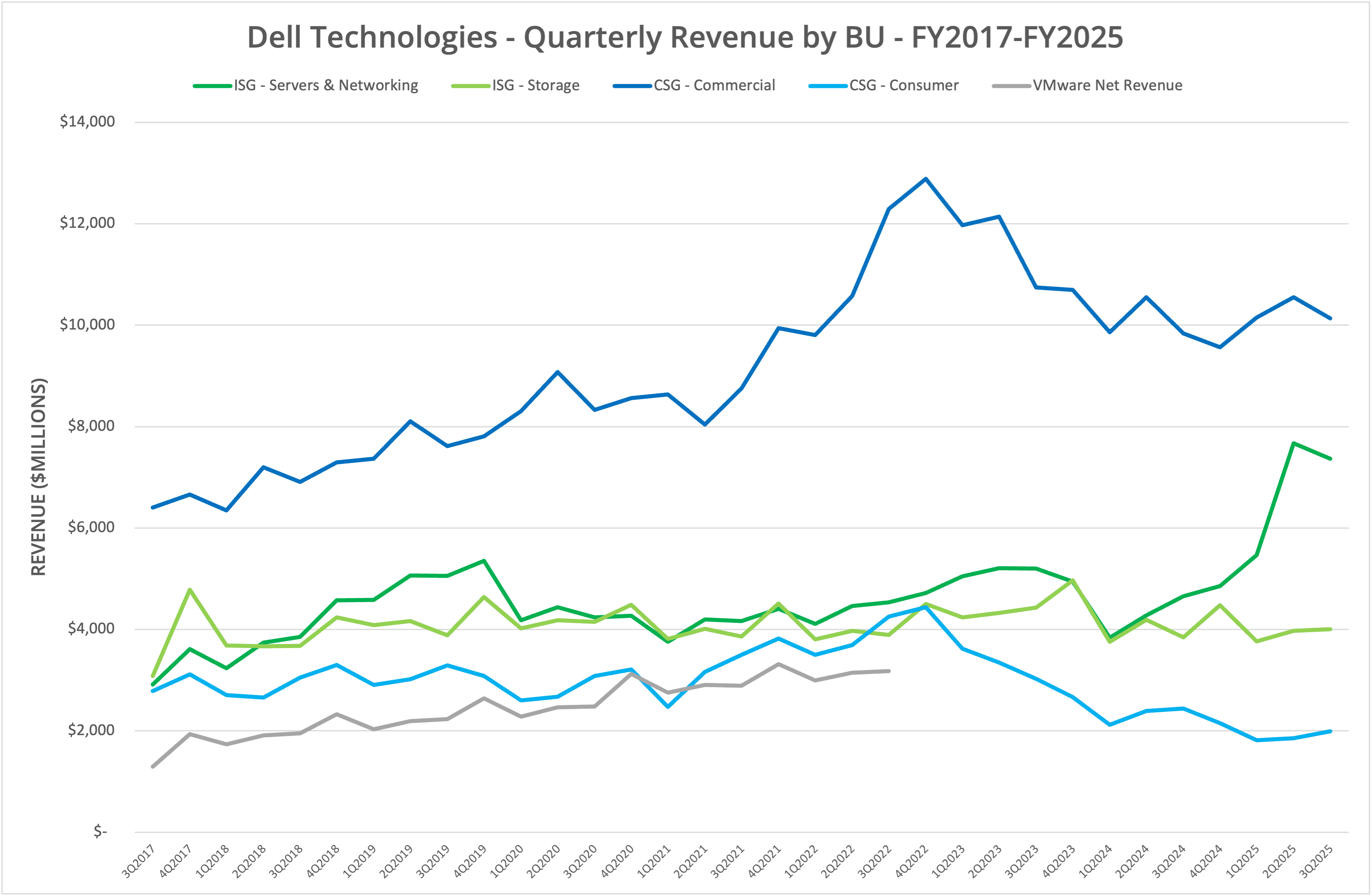
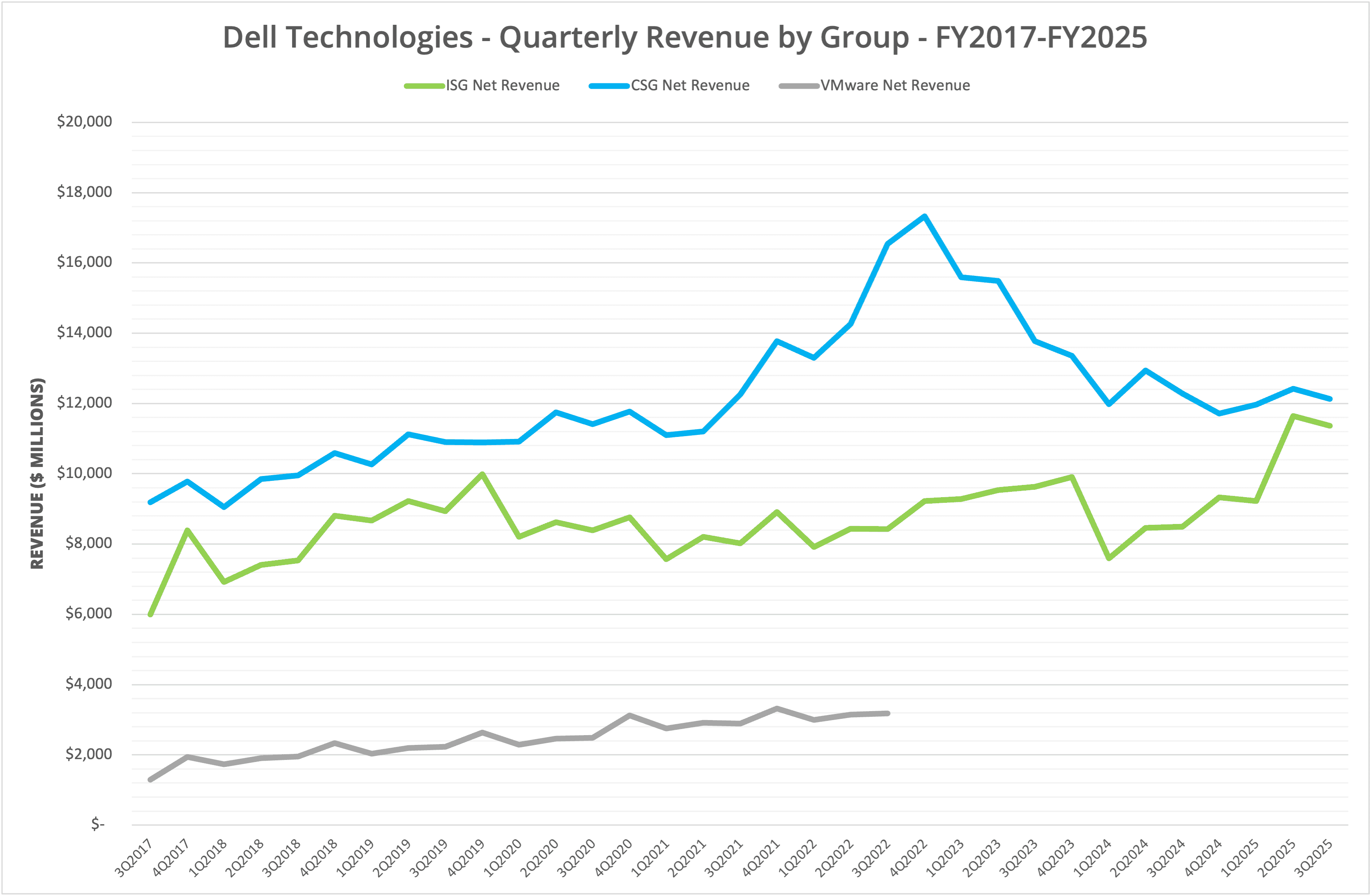
We present the data in four graphs, labelled Figures 1 to 4.
AI
Undoubtedly, Dell’s revenue growth can be attributed to physical server infrastructure sales for AI workloads. In the post-earnings announcement financial call, COO Jeff Clarke highlighted the increase in AI server pipeline, particularly the XE9680, which shipped $2.9 billion in Q3. The company still has an AI server backlog of $4.5 billion.
Dell Technologies is going “all in” on AI hardware, with the announcement in October 2024 of the XE9712, rack-scale deployment of NVIDIA GB200 NVL72 super-chips. Further products are in the wings (and announced at Supercomputing 2024) as part of the Dell “AI Factory”, including rack-scale deployments of the NVL4, which will support 144 GPUs per rack.
AI PC
Diverting away from enterprise hardware for a moment, the expected demand for AI PCs has failed to materialise. Dell (the company) now believes demand for AI PCs will appear in the first half of 2025. Interestingly, this transition will align with the sunset of Windows 10, so significant volumes of new PC purchases could be due to the additional compute requirements of Windows 11.
In reality, though, the majority of end users are not “creatives” and so will not benefit from the most frequently demonstrated features of AI PCs, namely video and image editing. As Microsoft continues to push AI Copilot, including into Microsoft 365 subscriptions, the AI capabilities of desktops and laptops will become “de facto”, justifying the claim that the market is clamouring for AI PCs rather than it being the only option available.
Storage
Turning to areas we cover in detail, Dell reported a 4.2% increase year-on-year in storage revenue. Jeff Clarke highlighted increased demand for PowerFlex and PowerScale (Isilon) systems, specifically F710 and F910 systems. However, no details were provided on any other part of the Storage business. Looking at Figure 3, we can see that Dell’s Storage business has been flat for the last eight years, hovering around the $4 billion per quarter mark, not taking into account inflation over that period.
During the post-announcement financial call, one analyst asked why Dell had not seen any pull-through on storage sales in conjunction with the AI server revenue. COO Jeff Clarke fluffed around the topic, providing a non-specific answer that didn’t explain the mismatch.
The Architect’s View®
Naturally, we focus on the storage business in our analysis rather than the other categories of servers, networking and PCs. However, before getting into more detail on that, it’s worth highlighting the relative weakness of the PC business, which previously was a strength for the Dell business. As Figure 4 shows, the post-pandemic boom in PC demand grew significantly but declined equally quickly. The AI PC has yet to turn around that trend.
Looking further into the storage business, Dell has implemented incremental changes in PowerStore (QLC drives earlier this year), with 61TB drives due to arrive for PowerScale in 2025. The quarterly revenue of approximately $4 billion is still 2.5x that of NetApp and over 4x that of Pure Storage, but those companies are catching up (HPE no longer provides storage data). Dell may still be number one in the storage market, but that advantage is eroding quarter by quarter.
As we have highlighted, Dell has not seen a significant pull-through on storage as a result of the AI server boom. That should be a worry for the company, but also reflects that customers see other solutions offering better performance, features or cost efficiency. We agree.
The Dell portfolio of storage solutions has only received incremental improvements over the last few years. PowerStore still lags behind on processor generation, making competing solutions more efficient. PowerScale has received some updates, but we don’t see a frequent cadence of improvements in any of the Dell storage platforms.
With such a focus on the AI server market, Dell Storage is at risk of lagging further behind the competition. Both NetApp and Pure Storage continue to release new products and solutions with much better ecosystem integration capabilities. Even HPE has attempted to revamp its product lines and released a new object storage platform using the Alletra MP hardware architecture.
The big question for Dell and for customers is at what point do Dell storage solutions become uncompetitive enough to make customers jump ship? Dell continues to gain from the inertia involved in moving platforms, but that overhead eventually becomes small enough to make the change worthwhile.
In 2025, we will be watching to see if the Dell Storage portfolio gains any additional love from the company. If it doesn’t, the inroads already made by competitors will see Dell’s lead eroded even further. When the AI server sales run out of steam, what will be left to support the business?
Related Content
- Analysis: Dell Technologies announces Q2 FY2025 financial results
- Analysis: Dell Technologies Announces Q1 FY2025 Results
- Research Note: Dell Technologies introduces PowerStore 4.0, 3200Q and PowerStore Prime
Copyright (c) 2007-2024 – Post #9d33 – Brookend Limited, first published on https://www.architecting.it/blog, do not reproduce without permission.