
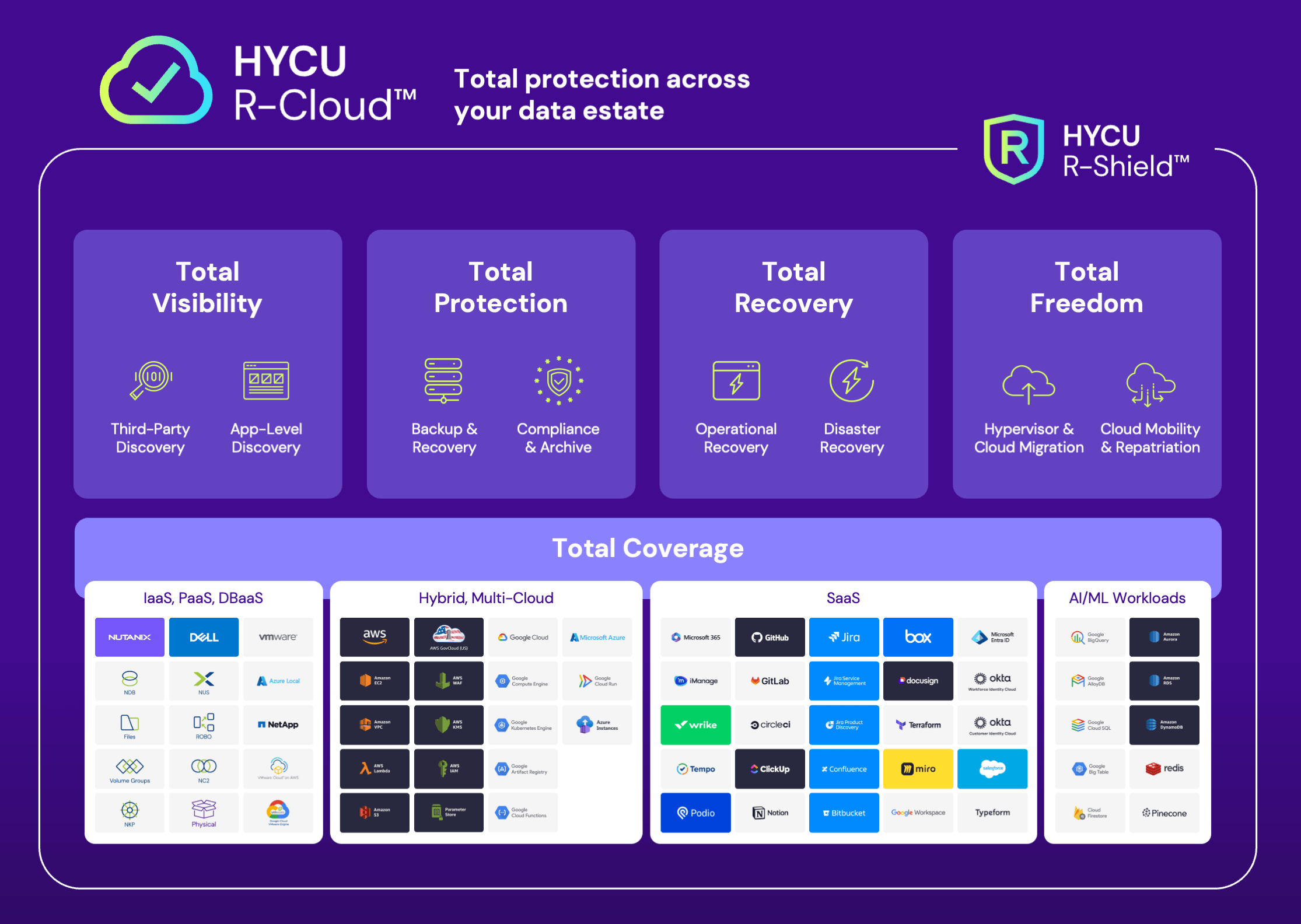
HYCU, Inc. has announced an update to the HYCU R-Cloud Platform, extending data protection integration to cover hypervisor and SaaS workloads. In a modern technology environment, diversity of support is critical, but also needs standardisation and centralisation of management, a key feature of the latest R-Cloud update.
Background
HYCU, Inc. announced R-Cloud, a comprehensive data protection platform for SaaS applications, in February 2023. R-Cloud differed from other solutions available on the market by providing an API against which any SaaS vendor could build data protection integration from the HYCU platform.
The API approach provides scalability into the process of onboarding the estimated 30,000 or more SaaS applications available online (link). Without this structure, a data protection vendor would need to process each SaaS application independently, focusing on only those platforms with the greatest number of customers and leaving many platforms without adequate protection.
R-Cloud was updated in February 2024 to add AI-enabled onboarding for SaaS vendors to accelerate the API integration process (see our coverage here). HYCU further extended the platform through an holistic approach to data protection with a strategy called R-Shield (coverage here). We are now seeing some of that thinking being delivered in the latest updates to R-Cloud.
Single Pane
One interesting aspect of the evolution of many SaaS-based data protection solutions has been the focus on a single cloud platform. Naturally, there is logic to this approach, as the size of the public cloud vendor determines the initial size of the market. However, looking across AWS, Microsoft Azure or Google Cloud, it is clear that although the services offered are similar (virtual instances, networking, storage), the implementation details are dramatically different. The result is limited cross-platform support from data protection vendors and little or no single-pane visualisation across platforms, because harmonisation is hard.
HYCU took a different approach with R-Cloud, as the solution was initially developed as an on-premises platform for Nutanix HCI that later added public cloud capability. The “look and feel” of each deployment was consistent. Now, with the latest release, that management capability will be available through a single management platform.
Why is this feature important? Even though cloud and on-premises solutions all differ in implementation, the operational aspects of data protection will be application-based and so need to be consistently applied. A single management plane makes this task much easier, as well as providing a single reporting point. As we’ve highlighted many times before, as workloads move between physical locations, a single management reporting plane makes it simpler to ensure policies are applied accurately and consistently.
Hypervisor
The VMware acquisition debacle has made it abundantly clear that dependency on a single hypervisor platform is a poor strategy. Although it may seem hard to believe, interest in Microsoft Hyper-V is rising, in addition to other alternatives such as native KVM.
R-Cloud now supports a broader range of hypervisor options, including Hyper-V and early access Citrix XenServer. This is in addition to VMware vSphere, Nutanix AHV, Azure Local and Dell PowerScale (with embedded VMware). We would like to see Scale Computing added to that list. There is also a question over the future inclusion of solutions such as Proxmox, although this platform appears to be highly SMB-focused at present.
Scope
In addition to hypervisor support, R-Cloud has been extended with further SaaS support (Microsoft Planner, Box, iManage Cloud) and expanded offline recovery for Microsoft 365, EntraID, Okta and GitHub. This provides access to data even if the primary platform is down.
Efficiency
One fascinating addition is the ability to use Dell PowerProtect Data Domain Managed File Replication (MFR) for multi-site and multi-copy backups. Data Domain Corporation was originally a start-up founded in 2001 and subsequently acquired by EMC (and in turn, Dell Technologies). Data Domain implements data deduplication, which, when used as a replication tool, can be highly efficient at data transfer and reducing the volume of data stored.
The use of Data Domain MFR within the public cloud could be a game changer for many companies that want to implement additional security (and reduced risk) by placing data across multiple clouds, but are inhibited from doing so by the extra costs associated with multiple copies of data. This is an area we will return to in another piece of content.
The Architect’s View®
The IT landscape continues to evolve in breadth and complexity. The five operating models we highlighted in an editorial post earlier this year (available here) are further complicated by many choices of vendors and platforms in each category.
The common theme across all of these customer choices is data. Data must be protected wherever it resides, with increasing regulation placed on certain businesses (such as those under DORA) to ensure those organisations can respond to operational challenges that could jeopardise the ability to run their businesses.
Fragmentation in data protection is simply not an option. It introduces the risk of critical data being unprotected and possibly lost. In a world where there is typically no alternative to digitally created content, this scenario is unthinkable.
HYCU continues to extend and enhance R-Cloud, crucially by aligning the key aspects of a data resiliency strategy.
- Ensuring no data goes unprotected, wherever it resides.
- Ensuring consistency of policy application.
- Ensuring consistency of reporting into a single view.
- Providing customers control over their backup data.
Data is the core of business; the infrastructure that surrounds it is merely the processing engine that can be upgraded or replaced as required. This places data protection solutions at the centre of all organisations, making it arguably one of the most critically important operational tools for any business.
The improvements made to the latest version of R-Cloud will expand the base of customers for whom HYCU could be the best solution for data protection. While this is good news for those customers, perhaps the more interesting aspect is the ability to introduce data mobility through Data Domain MFR running on a virtual instance. After all, multi-cloud support is only so good unless data is truly mobile between operating platforms.
Once again, data protection evolves as the landscape for applications becomes more diverse. HYCU continues to address the needs of the customer in this latest enhancement to R-Cloud.
Copyright (c) 2007-2025 – Post #2b3b – Brookend Ltd, first published on https://www.architecting.it/blog, do not reproduce without permission.