
“Only the Paranoid Survive”, ex-Intel CEO Andy Grove opined in his similarly titled book from 1996. With news that Intel is to join forces with AMD to drive forward the evolution of the x86 instruction set architecture (ISA), it appears that paranoia has well and truly gripped the current management echelons at Intel – which is probably a good thing.
Background
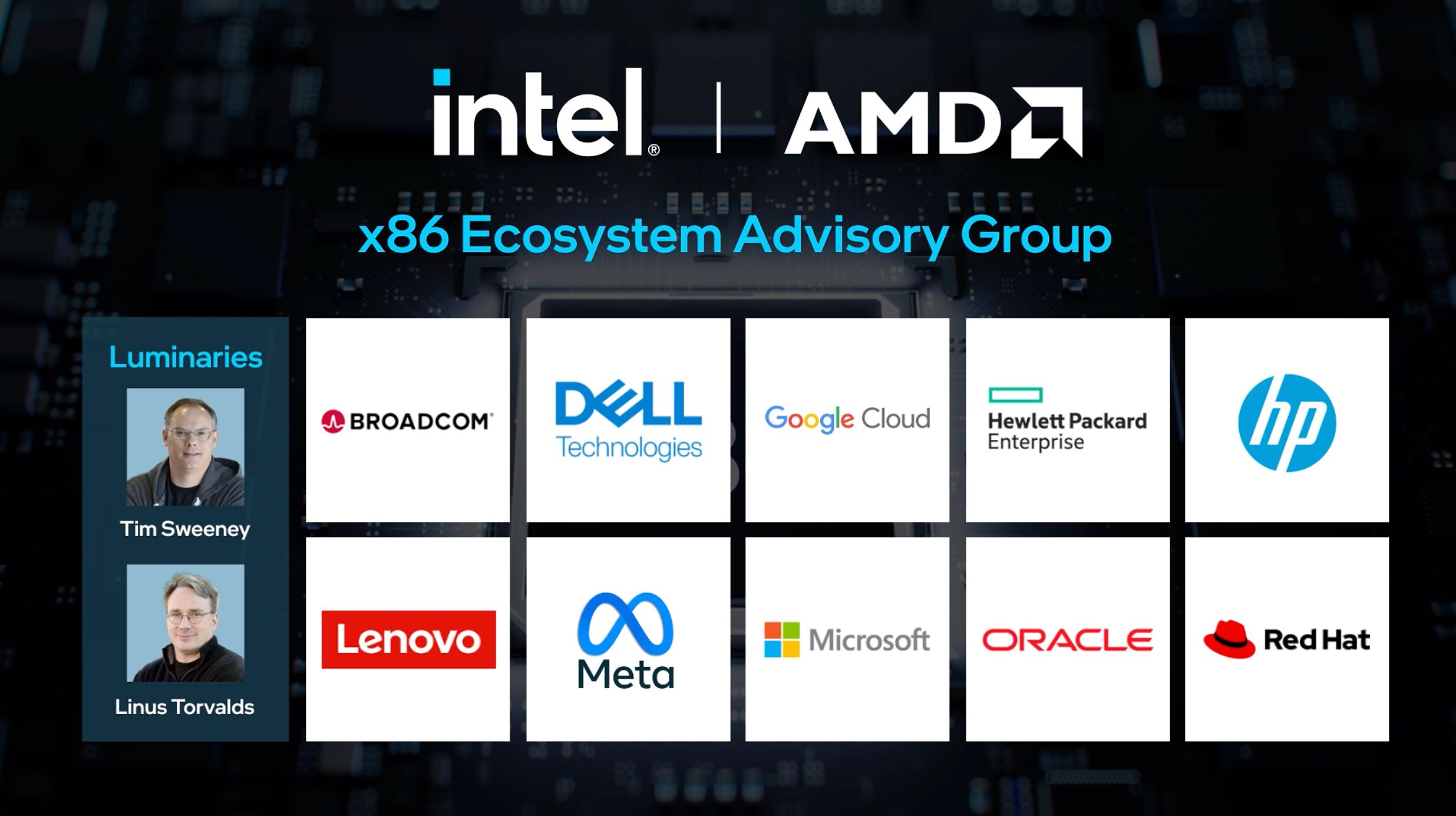
On 15th October 2024 at Lenovo Tech World, Intel and AMD jointly announced (here and here) the x86 Ecosystem Advisory Group to standardise and accelerate the development of the x86 Instruction Set Architecture. The statement included quotes from a host of other founding members, including Broadcom, Dell Technologies, Google Cloud, HPE, HP Inc, Lenovo, Microsoft, Oracle and Red Hat. Linux creator Linus Torvalds and Tim Sweeney (founder of Epic Games) are also group advisors.
The joint statement issued by both x86 product manufacturers implies a future collaboration effort to further the value of x86, standardise the architectural designs and interfaces for x86, but doesn’t preclude continued competition between the two companies that are now “frenemies”.
Why has this partnership been announced now, some four decades after the initial development of the core of the x86 architecture and over 42 years since AMD first signed a contract for the rights to produce x86 processors under licence?
The answer is clearly the threat posed by Arm and the rising threat of RISC-V.
Arm
As we’ve covered with numerous articles, Arm has evolved from a low-power mobile processor developer to the creator of processor blueprints for the data centre and laptop devices. Arm creates designs and licenses them to third parties, for integration into mobile phones, tablets and portable devices such as laptops. However, the company is also making inroads into the data centre.
- Arm Architectures in the Public Cloud
- Are ARM Processors Ready for Data Centre Primetime?
- Analysis: Arm Holdings PLC announces Q1 FY2025 Results
- Research Note: Arm announces new third-generation Neoverse designs
Amazon Web Services first announced Graviton, an Arm-based virtual instance, in November 2018. This design was based on an Arm Cortex-A72 core, then quickly superseded in Graviton2 by the Neoverse N1 architecture (based on Cortex-A76). Since then, Arm has expanded Neoverse to a third generation, while developing performance optimised (V-Series), power optimised (N-Series) and data throughput optimised (E-Series) variants.
Neoverse supports PCIe 5.0, CXL 3.0 and DDR5 memory, which makes these processors comparable with the latest Intel and AMD x86 designs. However, Arm isn’t a manufacturer, and that’s a sticking point for data centre deployments.
Cloud
As we highlighted above, AWS uses Arm as the basis for its Graviton range of power and cost-efficient processors. Microsoft Azure has recently announced Cobalt, an Arm-based virtual instance family that went GA only last week. Google Cloud announced Arm-based virtual instances branded as Axion at Google Next in April 2024. Google previously had virtual instances based on AmpereOne cores, as does Oracle Cloud, which has offered A1 instances based on Ampere Altra since 2021.
The public cloud service providers have done something that traditional on-premises vendors have been unwilling to do – to build virtual instances using Arm processors rather than with Intel chips. Admittedly, the cloud vendors have been required to do the engineering and build SoC (system on computer) designs to incorporate the Arm cores. However, there is no reason why traditional vendors such as Dell and HPE couldn’t have offered something similar (HPE previously offered Arm servers as part of the Moonshot platform).

For the cloud vendors, efficiency is everything, so being able to create virtual instances with processors that are more efficient than x86 has provided two benefits. Firstly, those instances can be used to power internal services such as DNS and management tooling, reducing the overhead of the supporting infrastructure of the cloud.
Second, cloud service providers can offer Arm-based instances to their customers, with the capability to reduce their costs, especially for workloads that don’t need heavyweight instructions such as AVX-512. This makes Arm suitable for infrastructure servers and database servers as just two examples.
O/S
Of course, an operating system is required to run on Arm. Fortunately, Linux has a long history with Arm, dating back to 1994 (link) and the Android operating system. Today, Linux is available for Arm (as many Raspberry Pi owners will know), while Microsoft Windows also has an Arm variant. There are binaries available for all modern applications, making Linux on Arm a genuine alternative to x86. Note that Windows also has an emulator called Prism that enables Windows x86 application binaries to be executed on Windows running on Arm.
Consumer
Intel and AMD would perhaps not be too worried by the adoption of Arm in the public cloud, as uptake by customers would require some testing and validation to show applications could be deployed more efficiently compared to x86-based instances.
However, Intel and AMD face another threat from the consumer market. As we highlighted in an article published in May 2024, the announcement of a plethora of portable devices based on the Qualcomm Snapdragon X processor (which uses Arm cores) represents a significant threat to the consumer x86 business. Arm-based devices have been shown to be more power efficient than x86, creating devices that operate for longer on a single charge. Apple moved to MacBooks based on Arm cores in 2020, with the M1 and is due to announce M4-based systems imminently. That’s a cadence of a new generation almost annually, with each update offering tangible improvements in performance. (I have personally tested M1, M2 and M3-based systems and can confirm this is true).
It’s worth remembering that in FY2023, Intel made 54% of its gross revenue from the Client Computing Group (consumer), which is twice what the Data Centre Group generated. So, the desktop continues to be the most important product category for Intel and one in which it can ill afford to lose ground. A recent report suggests that within five years, Arm could represent 40% of the desktop market.
Advisory Group
What becomes obvious as we look at the evolution of Arm is the risk it exposes to the future growth of x86. Historically, AMD and Intel haven’t co-operated on x86 development. AMD was first to develop a 64-bit x86 instruction set (x86-64) twenty-five years ago, while Intel was focused on developing the Itanium architecture (although Intel did have a 64-bit x86 design).
There are differences in implementation between x86-64 on Intel and AMD processors, for example, that requires hypervisor and O/S vendors to manage the differences (see this post we wrote on hypervisors). The latest advanced vector extensions in x86 are supported on AMD (AVX-512) but the revised implementation, AVX10, is unlikely to be added to the Zen architecture until 2028, representing a divergence of design between Intel and AMD.
For x86 to continue in the market and compete against Arm, the hardware vendors (Intel and AMD) need to have joined up thinking on designs and capabilities, rather than a fractured approach to the introduction of new features.
Partners
What’s in it for the other partners in the advisory group? Obviously, Broadcom wants to promote the on-premises x86 server virtualisation ecosystem; Dell wants to sell x86 servers, as does HPE. Microsoft, Lenovo and HP Inc. all have a vested interest in the success of x86 devices, either from the hardware or operating system perspective. These vendors depend on either on-premises enterprise business or consumers (and in some cases, both).
For Oracle, Google Cloud and Red Hat (effectively IBM), the benefits seem less clear-cut. Indeed, each of those companies (and arguably Microsoft) already have a foot in the Arm and x86 camps, so look to gain, whichever platform wins out. Maybe for them, it’s a question of stability and standardisation, reducing the impact, for example, of running many unique instances of x86 and AMD virtual machines that could be simplified.
Although I know nothing about Tim Sweeney, the engagement of Linus Torvalds is interesting, as he also has the benefit of both Arm and x86 kernel development. His role strikes me as one of advisor on maturity of both platforms, and the emerging RISC-V architecture.
RISC-V
While we’re on the subject, we should discuss the impact of RISC-V further. RISC-V (pronounced RISK-FIVE) is an open-source processor instruction set architecture that is gaining traction with several companies, including the Raspberry Pi Foundation, SiFive, Andes Technology and Akeana.
What makes RISC-V interesting is the royalty-free usage licence, compared to the commercial licence for Arm designs. Currently, the public cloud vendors must either pay for x86 hardware or licence and build Arm designs. With RISC-V, they could save additional costs in licensing and build bespoke processors directly, using a “known” instruction set architecture.
We say “known” in comparison to the late 1980s and 1990s designs of solutions such as SPARC, PA-RISC, and IBM POWER, which are all proprietary implementatiointel gpu 0%
ns that required custom operating systems and applications. Theoretically, RISC-V would need only one new O/S.
In the near future, we envisage a scenario where one of the leading cloud platforms acquires a RISC-V startup and deploys RISC-V-based virtual instances in the public cloud. There is “form” for this already, with the acquisition of Annapurna Labs by AWS and Fungible by Microsoft. As an aside, we also think that one or more storage controller manufacturers will also be acquired, but that’s a discussion for another day.
So, imagine a future where the cloud platforms have pushed further away from x86, reducing their costs by using open-source hardware and putting in place their own cadence on future product evolution. Meanwhile, the on-premises vendors are left with the cadence of Intel and AMD (which aren’t aligned) and the overhead of licensing or buying processor hardware. We could quickly reach a point where on-premises cloud becomes much more cost-effective than building any type of on-premises solution (hence the participation of HPE, Dell & Co).
The Architect’s View®
Intel is facing the “perfect storm” of challenges in both the enterprise and consumer markets. The x86 platform is the only unique offering Intel has. The company has divested Optane, its storage division, and soon will float off Altera. The GPU business isn’t competitive, which means x86 must be successful for Intel to survive. The Foundry business is years away from being competitive if it ever gets there at all.
For AMD, the advisory group is a win-win. If x86 declines, the company could look at licensing Arm or developing RISC-V solutions, if there’s sufficient market demand. AMD’s GPU business is doing well. Within the Advisory Group, AMD would help form future x86 ISA direction, or at least be aware up-front of enhancements and additions, enabling better product alignment.
As Andy Grove wrote, “only the paranoid survive”. Intel is at an inflection point that requires a different approach, one that Pat Gelsinger, as CEO of Intel, will be hoping the new advisory group can deliver.
Copyright (c) 2007-2024 – Post #c3e2 – Brookend Ltd, first published on https://www.architecting.it/blog, do not reproduce without permission.