

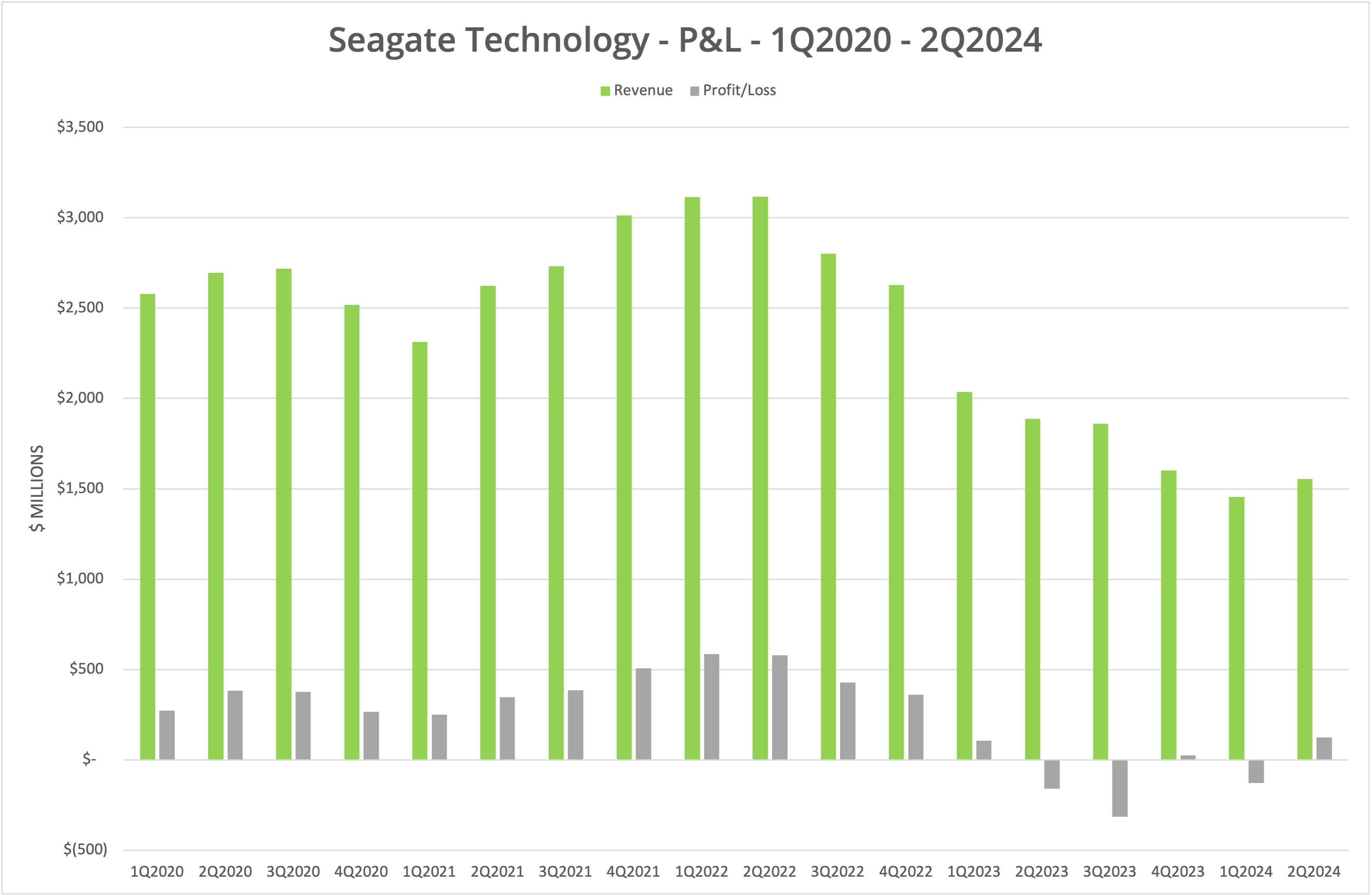
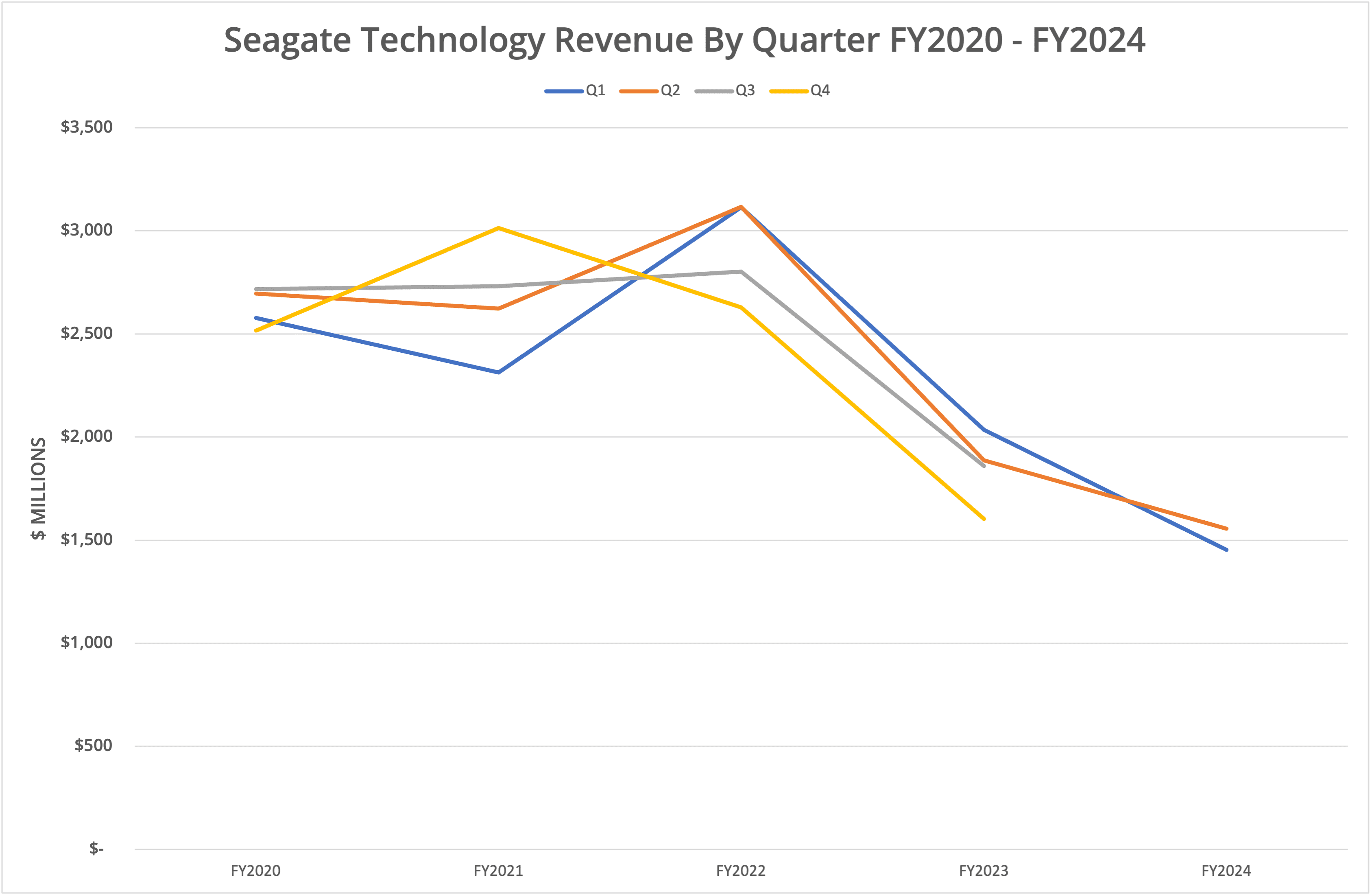
Seagate has announced financial results for the second quarter of FY2024. Revenue is down 17.6% on the same period in FY2024, but up 6.9% on the previous quarter (sequentially). Is this the start of a recovery in the capacity media market, and what will it mean for Seagate as HAMR starts to be rolled out?
Background
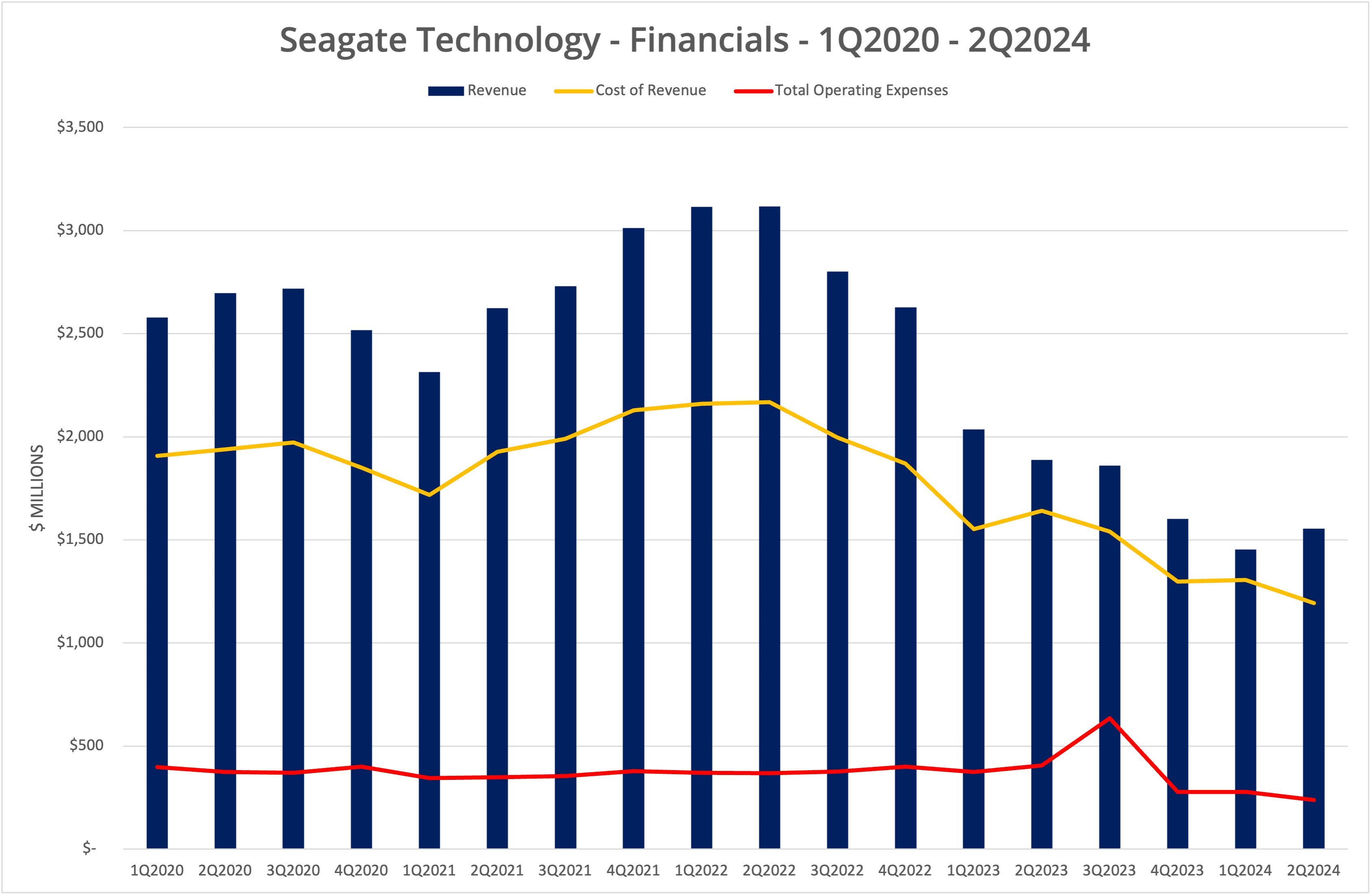
Seagate reported second-quarter financial results for FY2024 on 24 January 2024. The data (shown in figures 1 & 2) highlights an upturn in revenue (6.9%) sequentially. However, as shown in Figure 3, income is down compared to the same period in FY2023. The rate of decline is improved compared to the Q1 data.
Hyperscale
Seagate is still highly dependent on the HDD market, with 87.6% of revenue in the current period generated from hard disk sales. Only 12.4% is generated from SSDs and systems. With the gradual evolution towards solid-state in the enterprise data centre, Seagate and all the HDD manufacturers have a focused dependency on hyper-scalers, where the demand for HDDs is greatest. We can see this trend in action simply by looking at the new features in hard disk drives and the associated protocols (see podcast links below).
HAMR
As we highlighted in our Q1 FY2024 post, HAMR was on the cusp of delivery. On 17 January 2024, Seagate announced Mozaic 3+, the first stage of a multi-release cycle to bring 30+TB, 40+TB and eventually 50+TB HDDs to the market. In addition, the increased areal density of HAMR will enable Seagate to deliver cheaper and more efficient lower-capacity drives (for example, 20TB drives with half the platter count).
We expect to see an increase in revenue for Seagate as HAMR drives are shipped to hyper-scale customers and Exos 24TB and 28TB become mainstream. For the hyper-scalers looking to replace existing drives that are out of warranty (e.g. 5 years old), the savings translate to roughly double the capacity per HDD in the same slot, with only a slight increase in power draw (16TB to 30TB).
The Architect’s View®
With such a significant dependency on both hyper-scalers and hard disk drives, Seagate needs HAMR to be a success. However, as we discussed in the previous post, there are significant headwinds in the HDD market (which continues to decline).
- Business spending is reduced or diverted to activities such as the enablement of AI to drive competitiveness.
- Flash storage is quickly becoming the standard deployment choice for traditional applications and will drive AI/HPC workloads.
- SSDs are already at higher capacity than HDDs and close to greater cost-effectiveness, depending on the TCO parameters chosen.
- Sustainability concerns will drive the adoption of tape for cold data or data sets that need to be transitioned between active and archive use.
HAMR-based products will increase revenue for Seagate or, at best, stem the decline observed over recent quarters. With the adoption of HAMR for smaller-capacity drives, there is some opportunity for the enterprise, but these products aren’t expected until the second half of 2025 (see the Seagate earnings transcript, page 5), by which stage SSDs will have achieved another 18 months of capacity growth.
Assuming Seagate can produce 50TB drives in a few years’ time, then the I/O density of these HDDs will be 1/3 of the current 16TB models. With 550TB of annual warrantied I/O (read or write), this equates to a DWPD of approximately 0.03 and way under the lowest endurance QLC drives (which are only limited on write I/O). It’s even possible that PLC NAND drives could have greater endurance than the 50TB Mozaic drives.
Where does that leave Seagate? We see a continual decline in HDD demand over the next two decades. The result will be consolidation from three to two HDD vendors. It’s possible that this market could eventually be a single supplier. While the tape market continues to grow, the HDD market and the vendors that manufacture them look set to shrink even further.

X-Ray: Seagate Technology PLC
This Architecting IT report takes a deep dive into Seagate’s history, products, services, and future outlook. This report is only available for download via paid subscription.
Copyright (c) 2007-2024 – Post #68aa – Brookend Limited, first published on https://www.architecting.it/blog, do not reproduce without permission.