

HPE is holding its annual Discover conference this week. At the 2019 Discover three years ago, CEO Antonio Neri promised all hardware solutions would be sold under the GreenLake banner within three years. Now we’ve reached that point, has the promise been realised?
Radio Rentals
When I was a boy, my parents used to rent a television. In the 1970s, TVs and the emerging VCRs were expensive, so rental made sense. Customers didn’t need to find thousands of pounds to buy a set but instead could rent monthly, with no initial outlay and the peace of mind that upgrades and repairs were covered by the renting company.
However, the market eventually changed as cheaper products appeared, and the rental market died out. During our renting time, I never once remember having a TV upgrade. We must have paid for our TV at least five times over during the years of renting. There was no “value-add”.
GreenLake
Fast forward to the 2010s and Antonio Neri’s bold move to place all infrastructure offerings under the GreenLake banner. What does that really mean? The most obvious step is to move to the Radio Rentals model and simply rebrand existing leasing services. In the first instance, this is what HPE appeared to be doing. When GreenLake was announced, I investigated the pricing models and found minimum terms of three or four years. This restriction isn’t a service model, it’s just a reworked form of leasing. At the time, it was difficult to see any “value-add” to the initial selling model.
Discover 2022
However, watching some of the presentations from Discover 2022 (BTW, I wasn’t invited this year, HPE doesn’t see me as an analyst, only an “influencer, none of whom were on the invitation list), it’s clear that HPE has developed “value-add” that exceeds the simple packaging of products into another method of purchase or consumption. I was pleasantly surprised to see Omer Asad demonstrating canned videos of HPE’s GreenLake storage offerings, including Block Storage and data protection. Both presentations show a centralised GUI and processes for applying consistent policies to on-premises and cloud-based workloads.
Value-Add
There’s clearly added value in the evolving GreenLake platform, and where possible, we’ll be taking some of these new solutions for a test drive. But how has this transformation affected the bottom line? Have HPE’s finances improved because of the shift of the portfolio?
- HPE Introduces Alletra and the Data Services Cloud Console
- Understanding HPE’s Storage Product Portfolio
A quick look at HPE’s financial data from 2016 to 2021 shows that things have been pretty flat. The company incurred a loss in FY2020, which we can probably assign to the impacts of the COVID pandemic. Since then, revenue has risen modestly but not to pre-COVID levels. Note, we can’t easily show data before 2016 due to the spin-off of HPEs services business in 2017, which at the time accounted for around half of the reported revenue achieved.
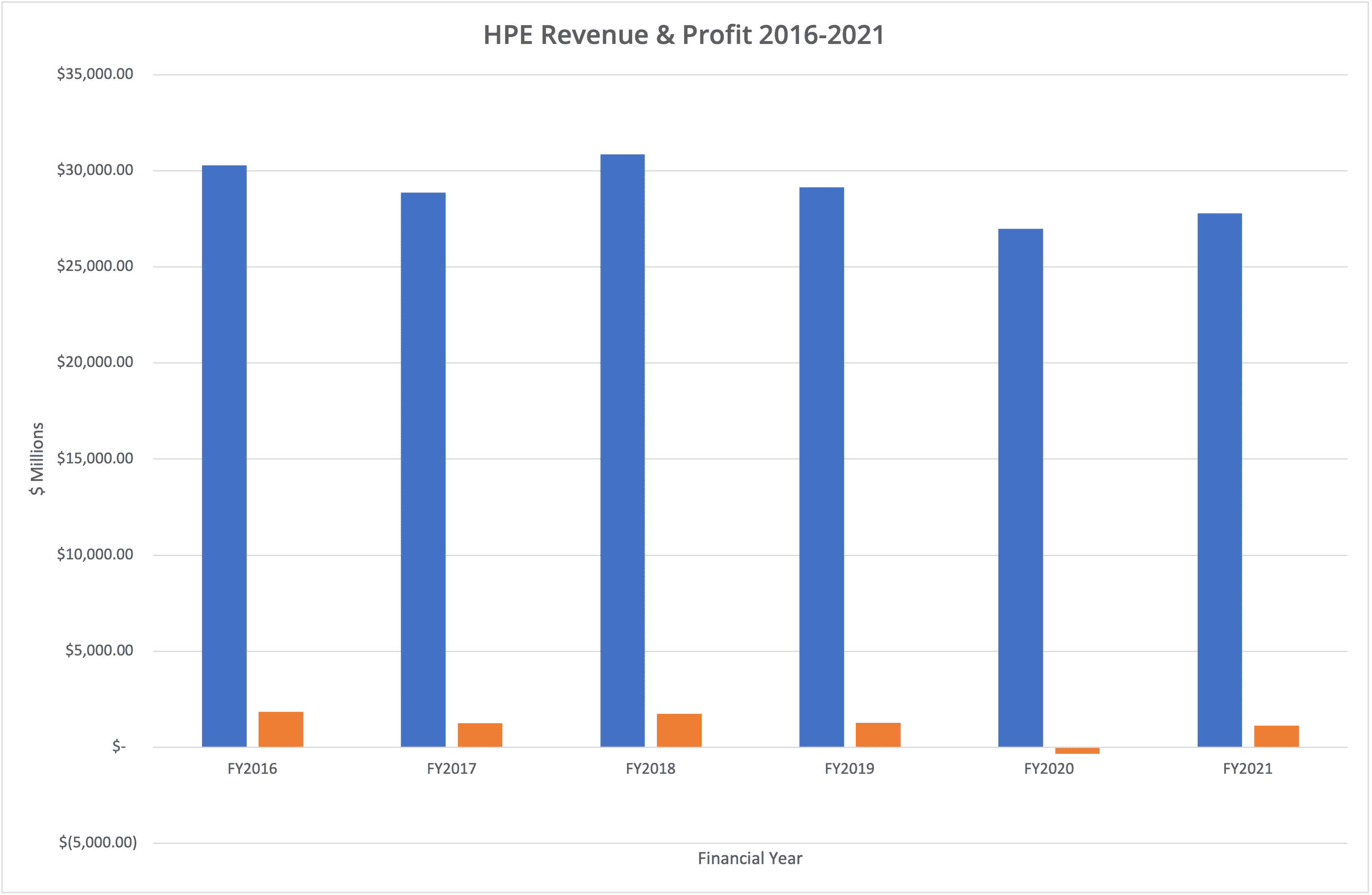
As reported in Blocks and Files, revenue for the first two quarters in FY2022 has also been flat. The blame has been placed on supply chain issues. However, we see this as an excuse and a big problem for a company looking to move to a recurring revenue and services model. If you can’t source the hardware, you still don’t have a business – whether sold as services or not.
The Architect’s View©
HPE seems to be making headway in transforming into an “as-a-service” business, but there are still issues. Supply chain challenges shouldn’t be a problem if customers are converting to an annual recurring revenue model unless the business isn’t growing. In our view, ARR is a smoke screen to divert from quarterly inspection of revenue but simply pushes the discussion to an annual review. Customers can still drop away, but perhaps not as quickly, depending on their subscription commitments.
Supply chain problems don’t appear to have affected all server and storage manufacturers in the industry, although we hear anecdotal stories of many challenges with lead times on networking equipment. With such a dominant position in the market, we question why HPE hasn’t been as agile as, say, Pure Storage, NetApp or even Dell.
One final observation is to look at the design and architecture of HPE products. In the storage market, for example, HPE has simply rebranded existing products (Alletra 9000 is Primera, is the child of 3PAR, Alletra 6000 is Nimble). These solutions haven’t been re-engineered for a cloud model, unlike the route taken by Pure Storage. As we pointed out in this blog post, legacy vendors may feel their products are good enough for packaging as a service model, but in the long term, hardware needs to be modularised to meet the demands of the cloud model.
We have more work to do in analysing HPE’s portfolio under GreenLake (and Ezmeral). However, we can see a transformation in progress, but more time is needed to see if customers are convinced HPE is taking the right path.
Copyright (c) 2007-2022 – Post #9aa6 – Brookend Ltd, first published on https://www.architecting.it/blog, do not reproduce without permission.