

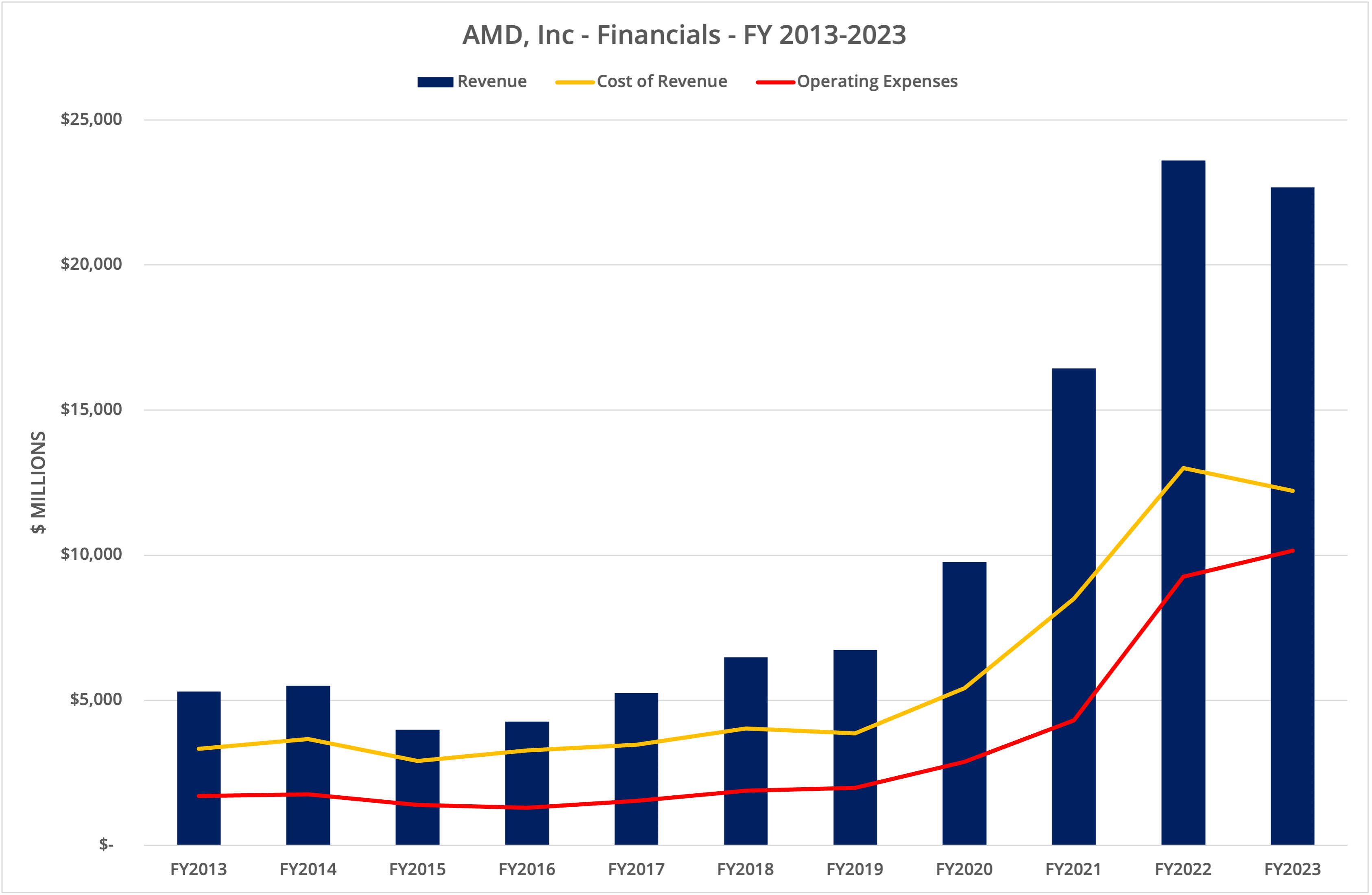
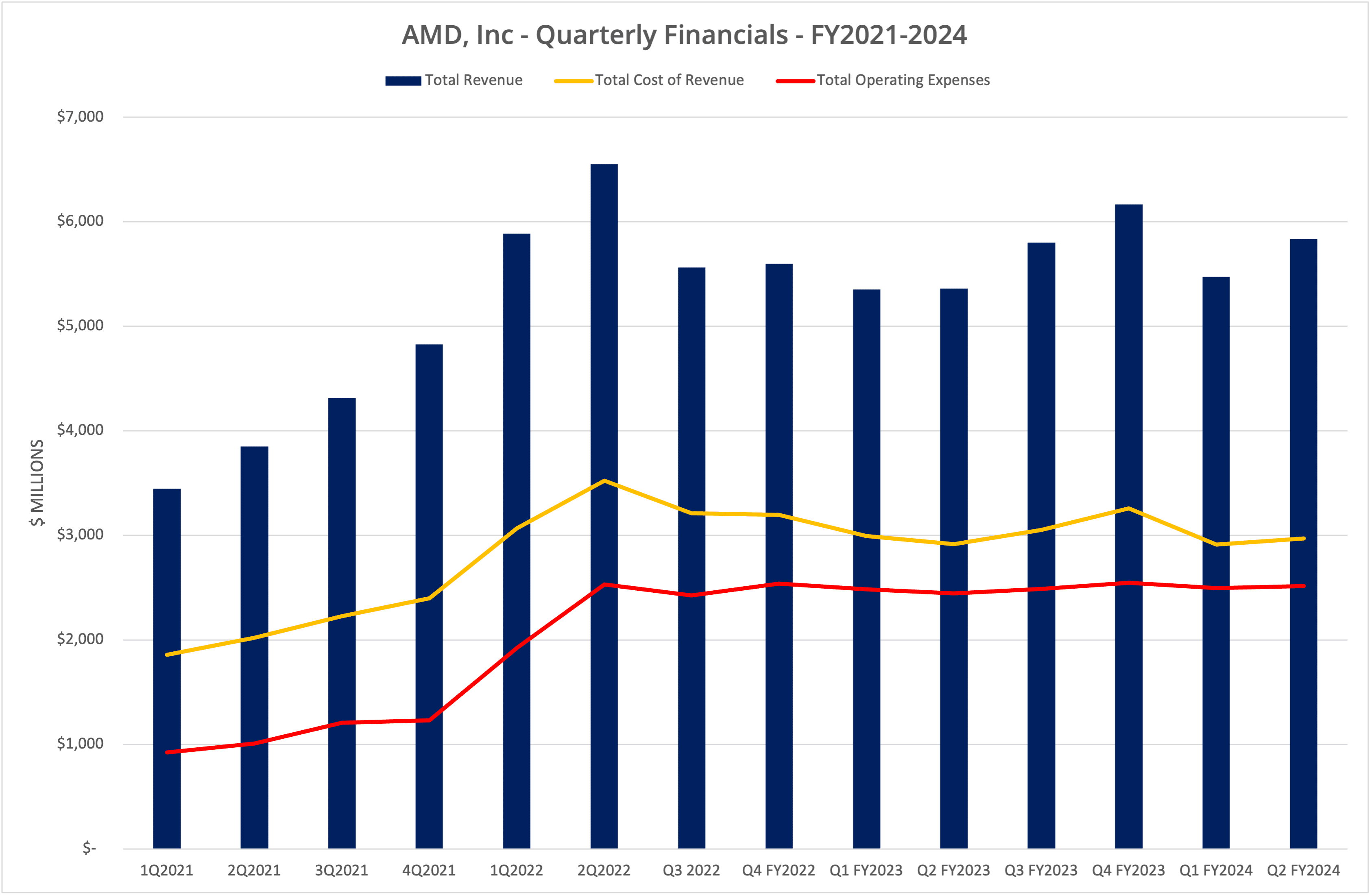
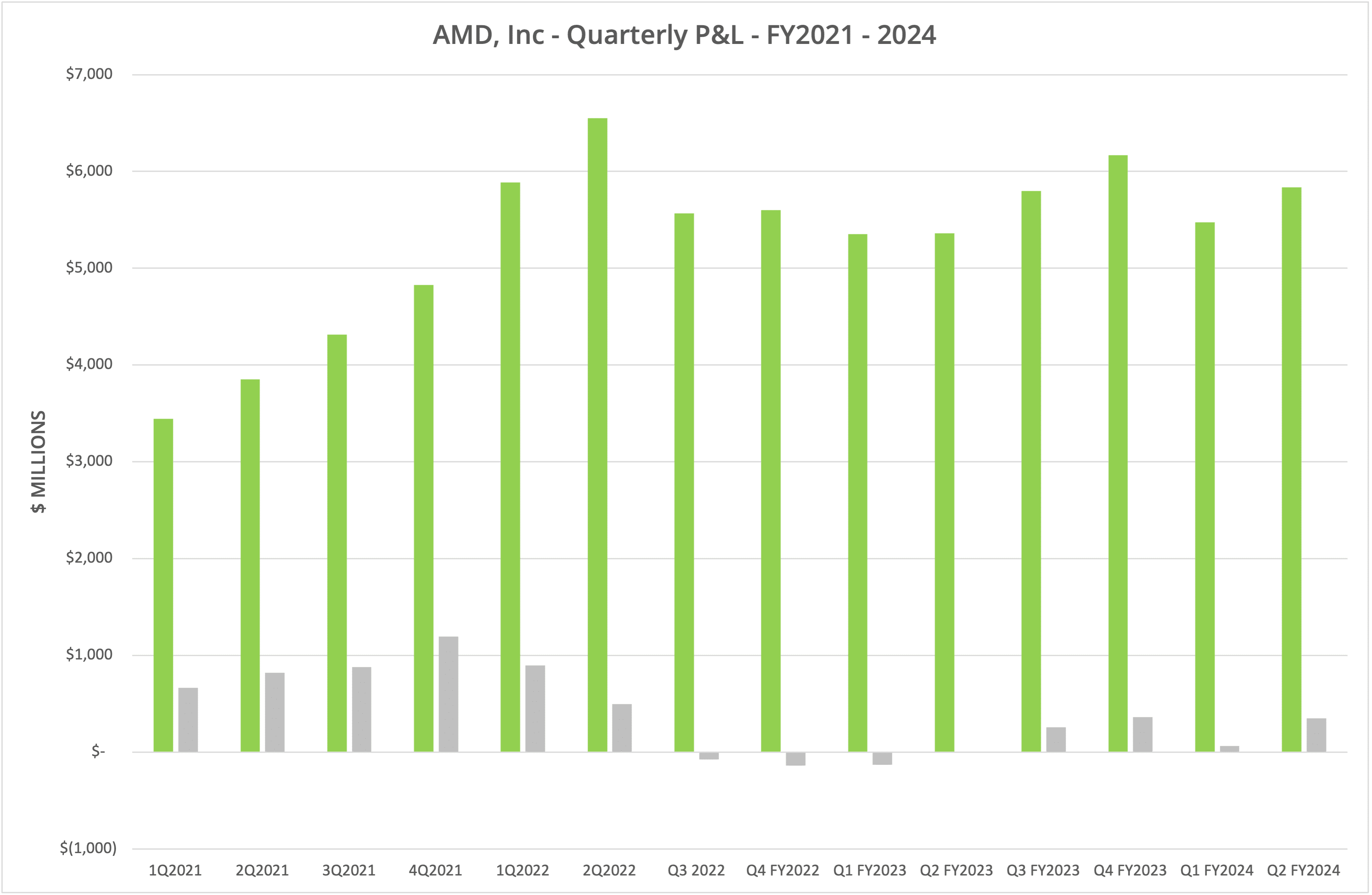
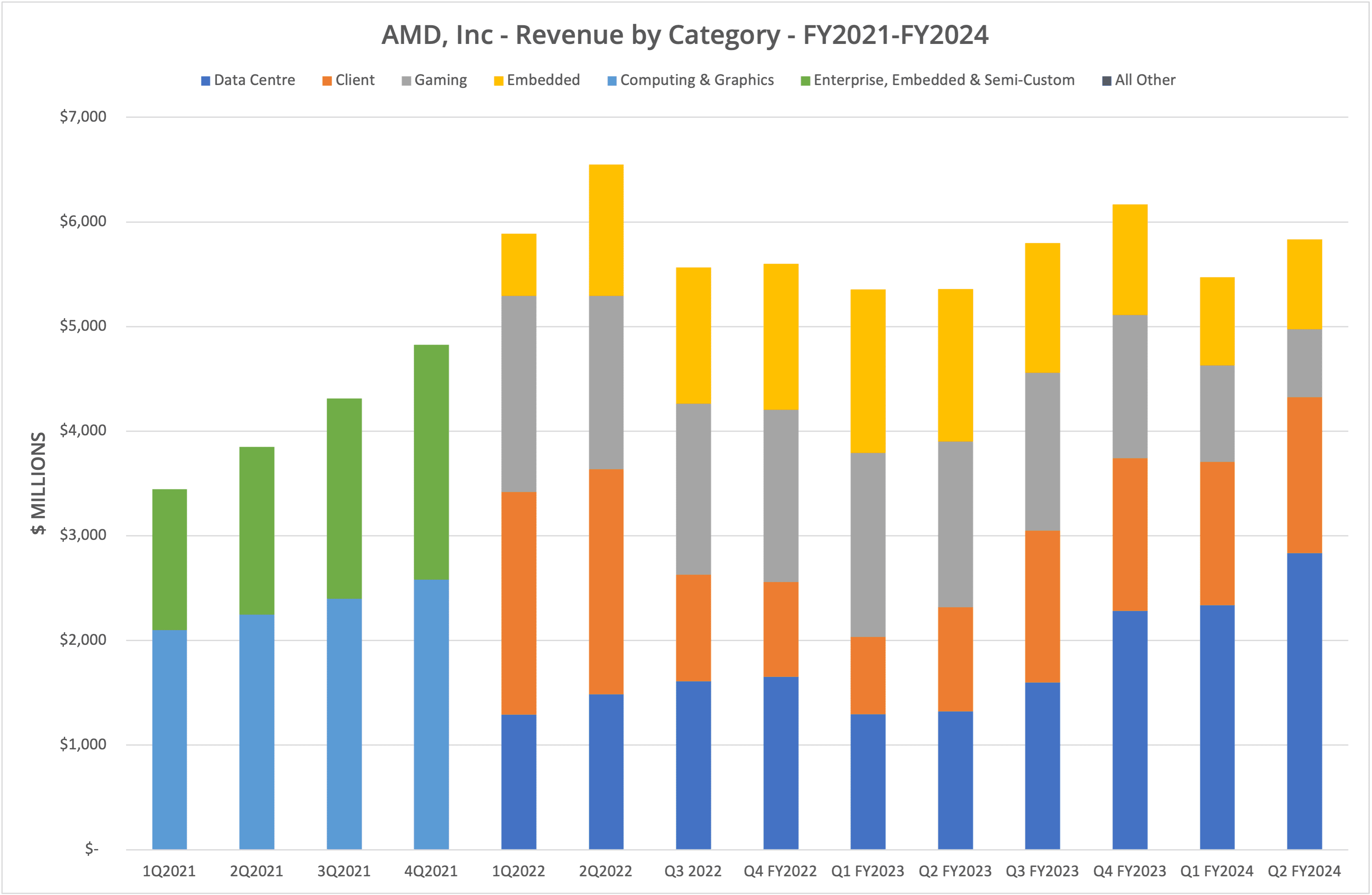
AMD, Inc. has announced financial results for the second quarter of financial year 2024 (ending 30 June 2024). The data shows a year-on-year increase in revenue of 8.9% to $5.8 billion, while the Data Centre and Client revenue streams increased to 49% and 26% of total revenue, respectively. This data shows significant benefits from the AI boom, as well as strong products in the server market.
Background
AMD, Inc. has reported financial data for Q2 FY2024 (ending 30 June 2024), with overall revenue increasing by 8.9% compared to Q2 FY2023 and 6.6% sequentially. By business division, the Data Centre segment grew 115%, Client grew 49%, while Gaming declined 59% and Embedded also declined by 41%.
We show the data in four graphs, one representing annual data and the other three showing quarterly figures. These are labelled Figures 1 to 4.
Segments
AMD accounts for the substantial improvement in Data Centre year-on-year revenue as the result of Instinct GPU shipments and sales of 4th generation EPYC processors. Sequentially, the growth is attributed to GPU sales. In Client, Ryzen consumer processors drove the increase, although we are not clear on how much of that can be attributed to Ryzen AI processors at this time.
Enterprise Focus
AMD has had a busy year. At Computex 2024, CEO Lisa Su used her keynote presentation to announce an expansion of the Instinct GPU range with the new MI325X. This device uses 288GB of HBM3E memory and delivers 6TB/s of throughput. It represents an upgrade to the MI300X announced only the previous December (2023), which offered 192GB of HBM3 memory and delivered 5.3TB/s of bandwidth. Microsoft already supports the MI300X in Azure with Azure ND-MI300X virtual machines.
The roadmap for Instinct was also shared during the keynote, with MI350 using the CDNA 4 architecture due in 2025 and an MI400 due from 2025 onwards using an as yet unspecified CDNA design.
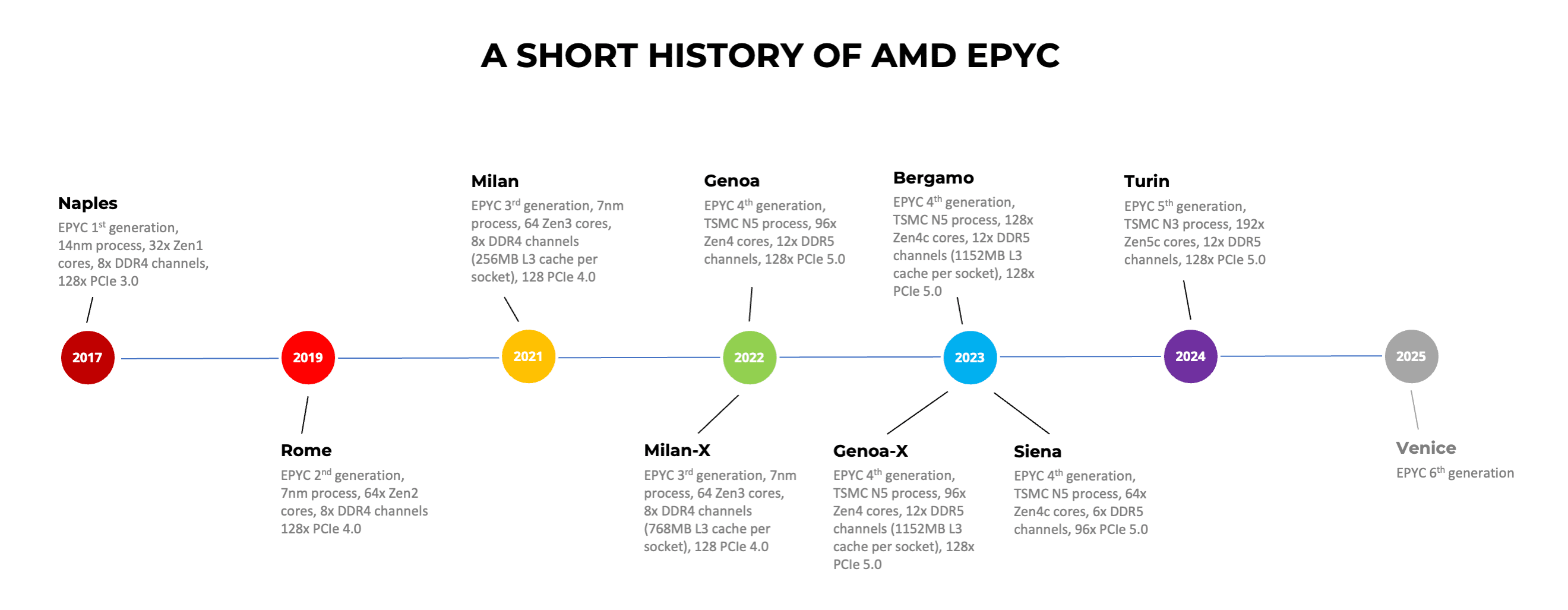
The 5th generation of EPYC processors, codenamed Turin, was also previewed in June. Based on the new Zen 5 core architecture, Turin will offer up to 192 Zen 5c cores, 12x DDR5 memory slots, 128x PCIe 5.0 I/O bandwidth and be built with 13 chiplets using a combination of 3 and 6-nanometre technology.
AMD claims both the latest Instinct and EPYC processors will outperform their respective competitors (specifically NVIDIA and Intel, respectively). Of course, this is AMD internal data and would be expected to show the products in a favourable light.
Consumer
In the mobile space, AMD announced Ryzen AI 300 processors, delivering 50 TOPS of AI performance from the latest XDNA 2 NPU. In the same keynote at Computex, Lisa Su used the opportunity to bring onstage hardware partners and demonstrate the range of solutions already on the market or close to release.
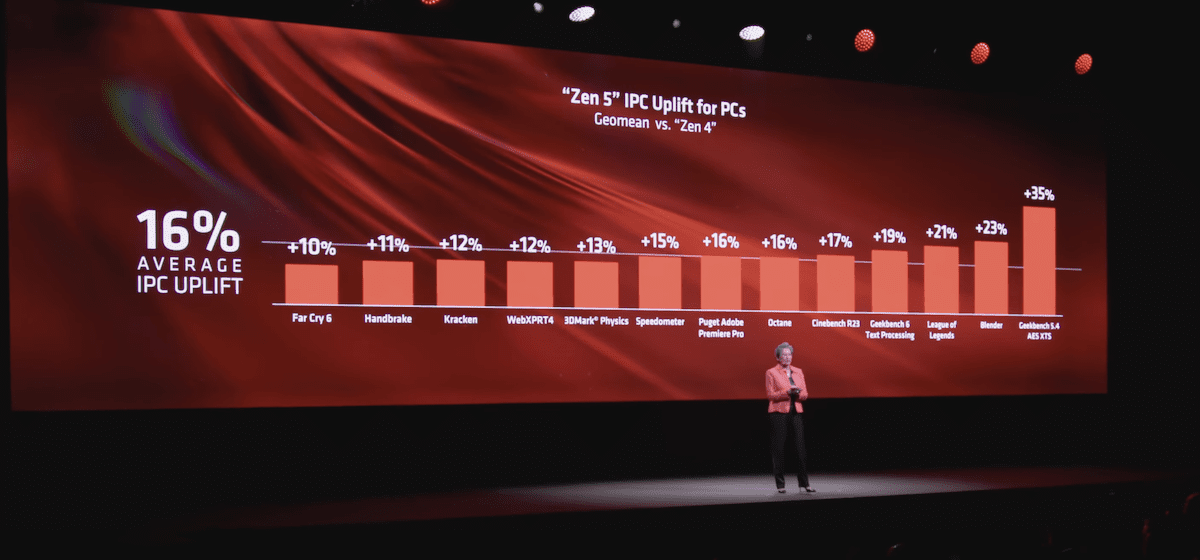
Ryzen 9000 desktop processors using Zen 5 cores were also announced, completing the transition to the latest core architecture that AMD claims offer significant performance over Zen 4 (an average of 16% cross a range of benchmarks).
The Architect’s View®
AMD is in a strong position with products that are currently in demand within the enterprise and consumer space. Since its launch in 2017, the EPYC range has grown significantly in performance, with a regular cadence. The 6th generation of EPYC, codenamed Venice, is rumoured to be based on a new Zen 6 architecture (and SP7 processor socket), with support for 16 memory sockets (one third more than Turin). The measure of competitiveness against Intel, Arm and Ampere will be core count, throughput and how they align with power consumption.
The processor space deserves more research, as there are now significant alternatives to Intel x86 chips. AMD is clearly challenging Intel in the x86 market, both in the data centre and on the desktop. However, Arm devices are also in both places too. From an end-user perspective, there are more computing choices available, arguably since the heyday of Sun SPARC, Itanium, and PA-RISC. The public cloud makes it easy to move between architectures and vendors with little application refactoring.
In AI and the GPU market, NPUs will drive innovation on the desktop. AMD claims its architecture provides int8 levels of performance with float16 accuracy, meaning customers don’t have to trade speed for accuracy in inferencing. This benefit could be a differentiator for the AMD XDNA architecture.
We will be following AMD closely and working on research to help our readers discern between the range of modern processors now available for the data centre and public cloud.
Copyright (c) 2007-2024 – Post #7873 – Brookend Limited, first published on https://www.architecting.it/blog, do not reproduce without permission.