

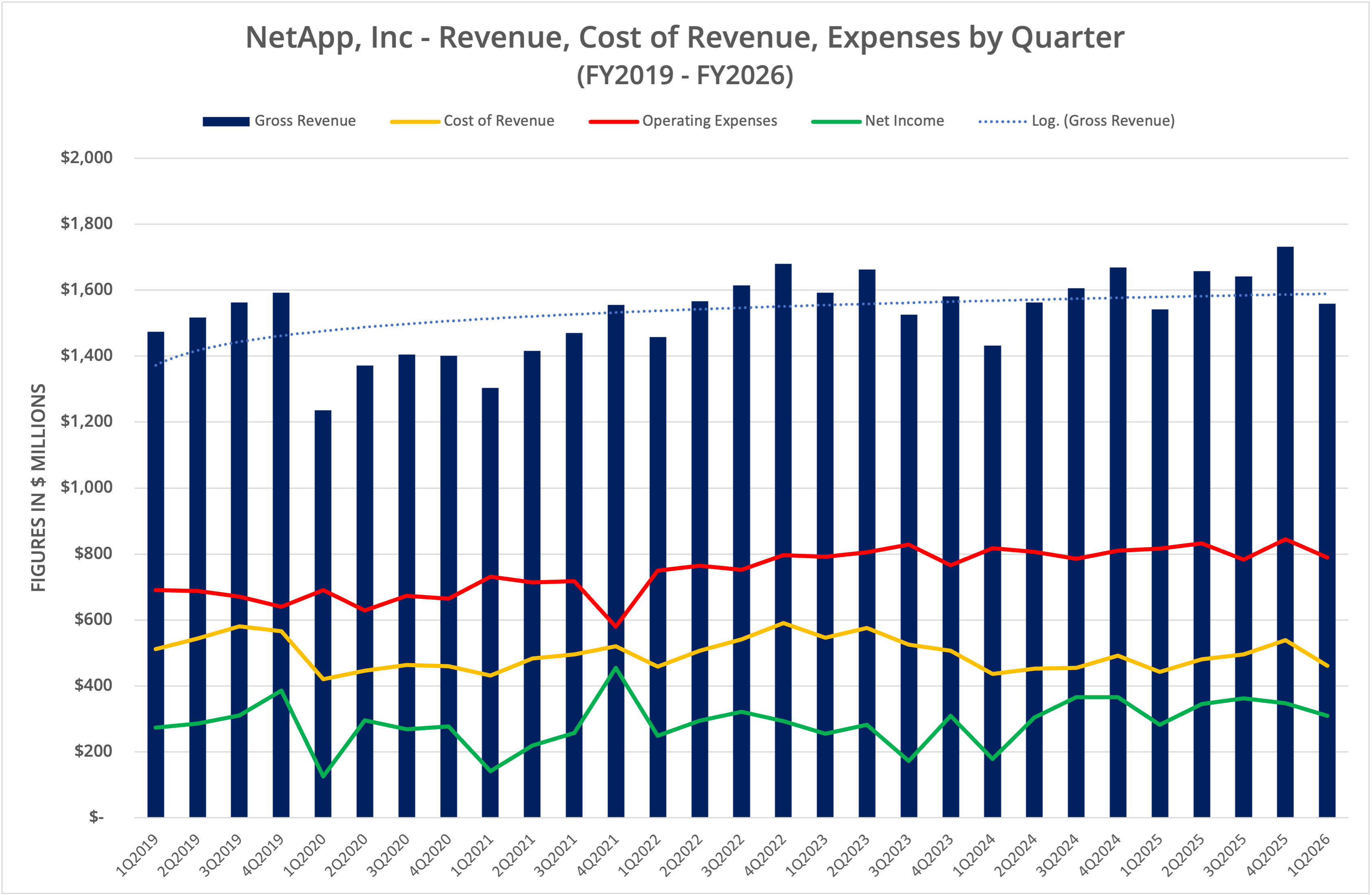
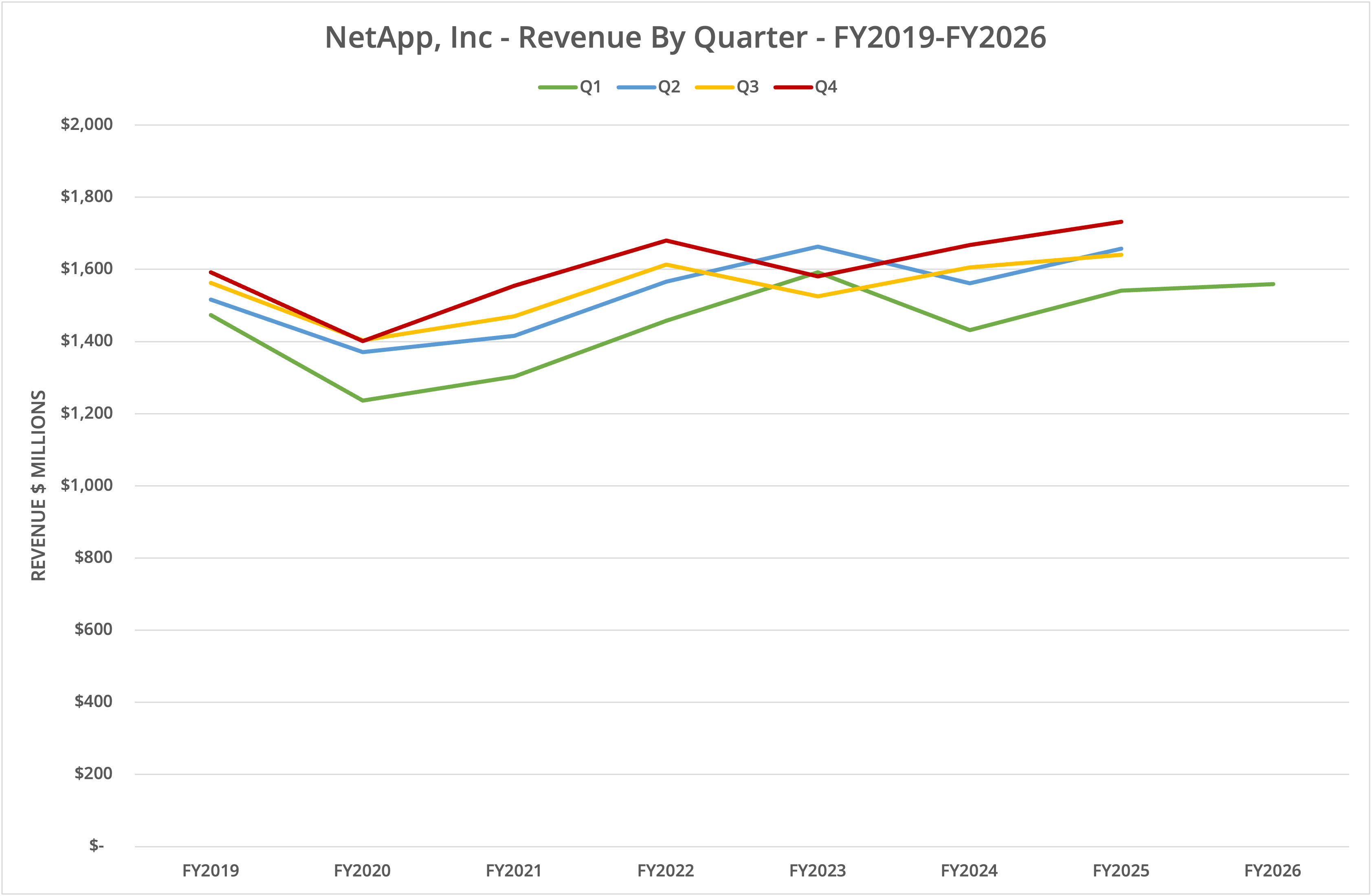
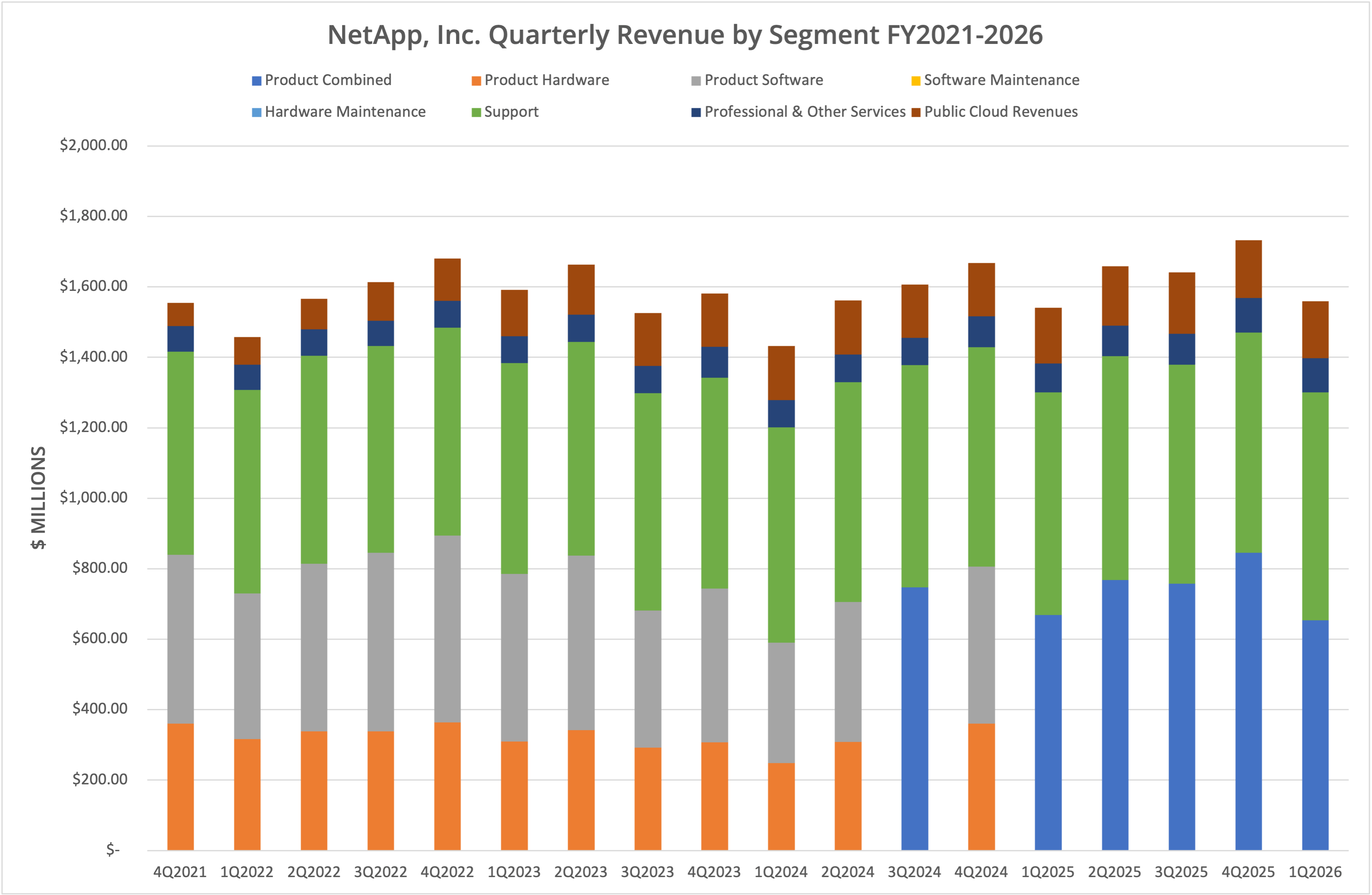
NetApp, Inc. has announced financial results for the first quarter of FY2026. Revenue rose 1.2% to $1.56 billion for the quarter compared to Q1 FY2025, although sequentially that figure represented a 10% decline. Product sales declined 2.2%, while Public Cloud revenues increased by just 1.3% (year-on-year). Has NetApp reached another inflection point?
Background
NetApp, Inc. declared financial results for Q1 FY2026 (the period ending 25th July 2025) on 27th August 2025. Total revenue rose 1.2%, supported by positive increases in Support, Professional Services and Public Cloud. However, Product revenue declined 2.2% year-on-year, despite the company gaining a 6% increase in all-flash array revenue, which reached $893 million in Q1.
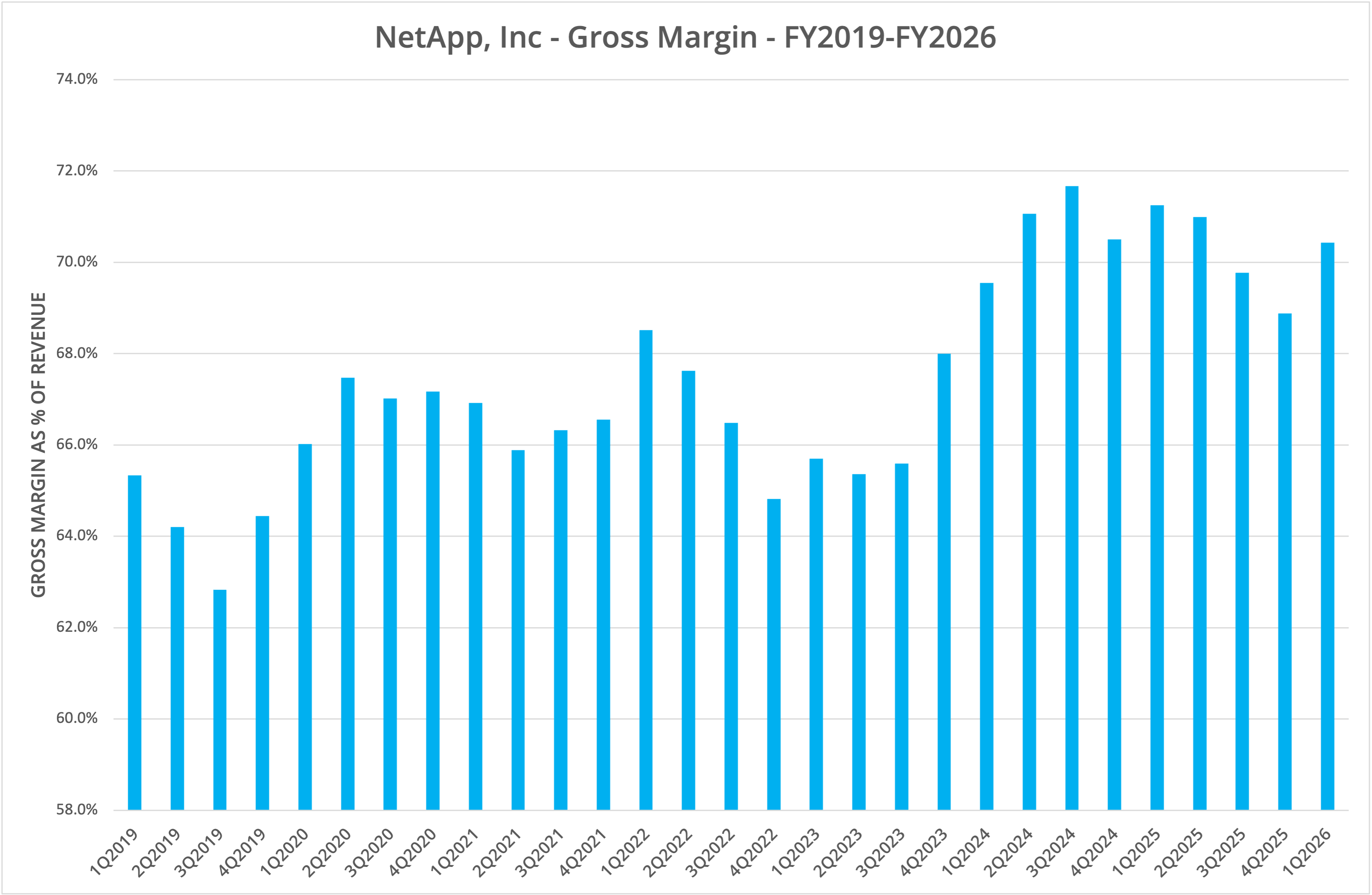
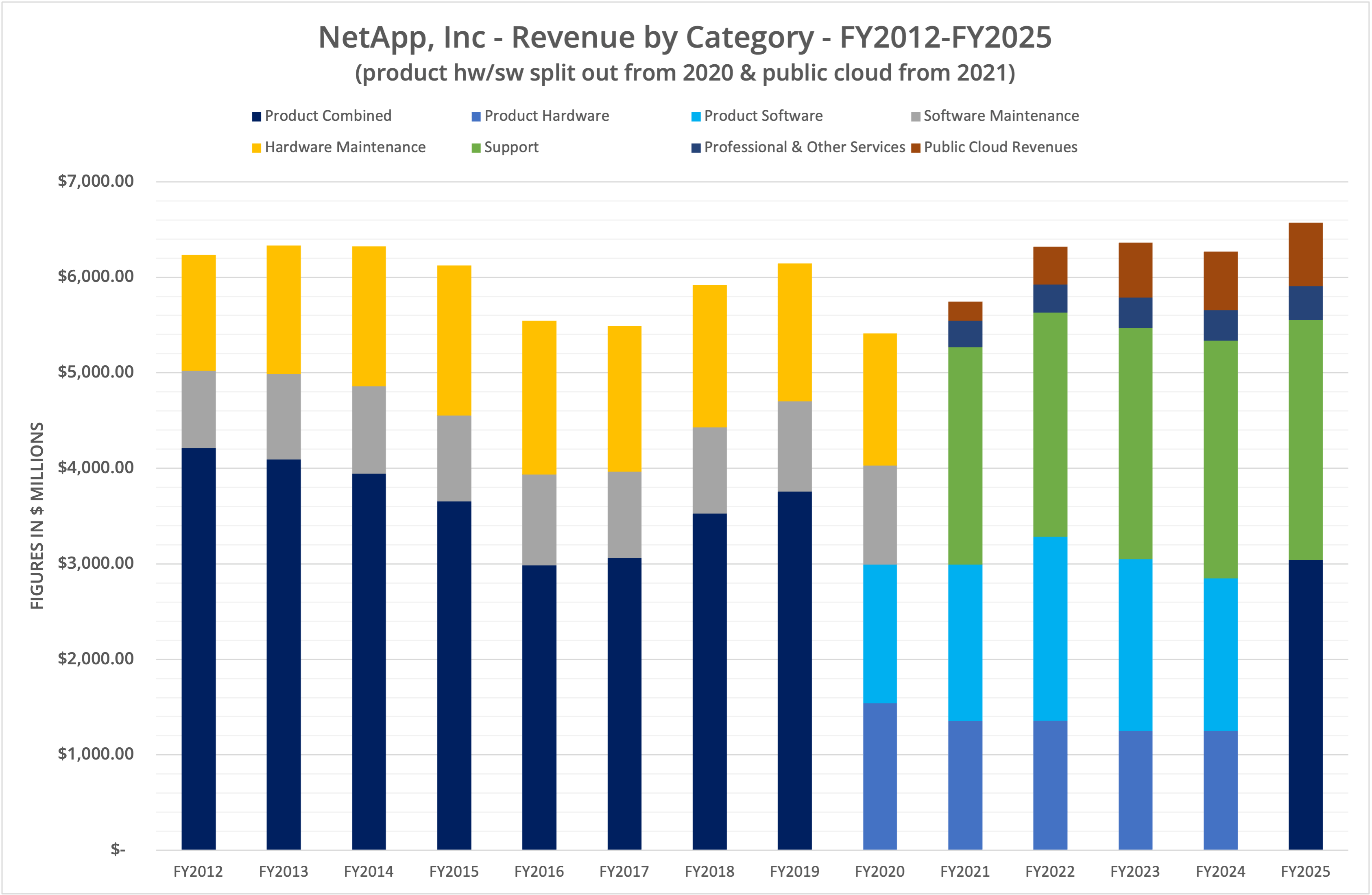
We present the data in six graphs, labelled Figures 1 to 6.
Mixed Bag
Sometimes the headline data doesn’t fully explain what’s going on within a business. For example, all-flash revenue (up 6%) comprises both product shipped and support services, which is $893 million of the $1,398 million hybrid cloud revenue declared, or around 64%.
It could be argued that the relatively flat revenue number is a consequence of hybrid or HDD systems being avoided by customers in place of all-flash, but the overall mix is still not as positive as it could be – all-flash systems should be more expensive on a $/TB basis. NetApp indicated in prepared remarks that 45% of installed systems are now all-flash products, which aligns with the increased $/TB revenue from the all-flash segment.
Cloud
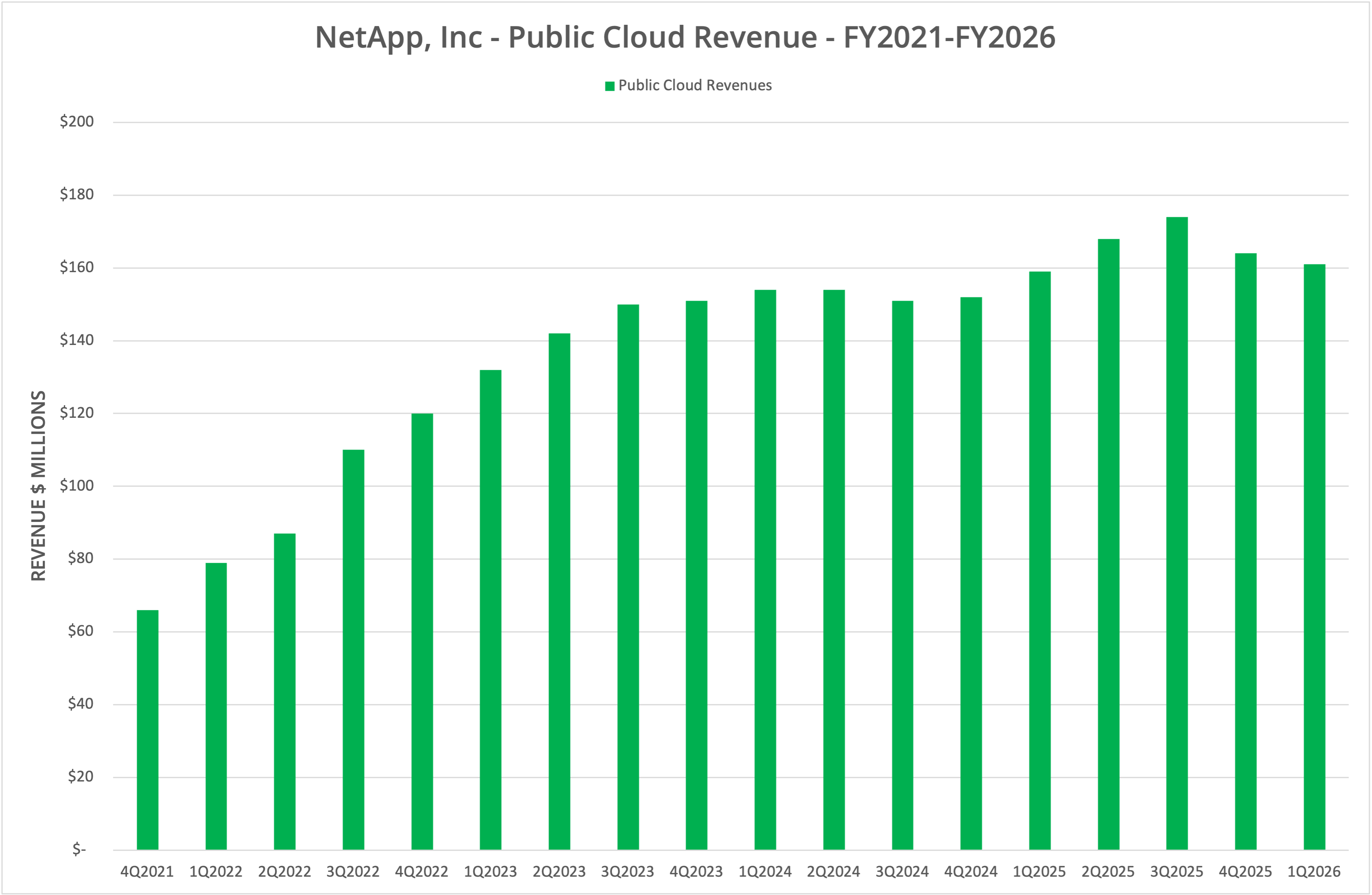
The offload of the cloud businesses earlier in the year (coverage here) has clearly affected revenue in the public cloud segment. NetApp claims a 33% revenue increase in first party and marketplace public cloud storage services in the quarter, but this translated to only a 1.3% total increase of revenue for that segment. The difference was presumably the loss of Spot and associated solutions.
Back to Basics
NetApp has been on a journey to return itself to its core values. The entire ONTAP product range has been revamped over the last few years, re-introducing the All-SAN array (coverage here) and upgrading or revamping existing all-flash systems with the latest (or later) processor generations.
This has been both a good thing for the business due to sales growth (Q4 FY2025 was the best quarter ever for revenue), while product gross margin has increased and stabilised at around 70%.
But the public cloud business appears to have stalled, as shown in Figure 4. Of course, the data doesn’t clearly highlight the contribution made by Spot and associated solutions, which is no longer in the mix. We will need a few more quarters of new figures to see if Q4 FY2025 and Q1 FY2026 are just a blip as that revenue rolls out.
The Architect’s View®
The biggest question for NetApp is – what next?
In the product space, we’re being promised a disaggregated ONTAP solution (see this coverage) that was first announced at NetApp Insight 2024. Presumably, that product (whatever it may look like) will be unveiled next month at Insight 2025. However, previous experience tells us that new products take time to be adopted. So, we shouldn’t expect disaggregated ONTAP to drive a meaningful amount of revenue for some years.
Public cloud ONTAP is now a line item, but there doesn’t appear to be a new strategy for how this business will grow and evolve. More alarmingly, NetApp has seen the departure of many architects of the public cloud strategy.
Jonsi Stefansson (previously CTO) left the company in July 2025 to establish a new startup venture (he joined from the Greenqloud acquisition). Eiki Hrafnsson (also Greenqloud) announced he was leaving just two weeks ago, also headed for the same startup as Stefansson. Hrafnsson was previously VP of Cloud Engineering, and most recently, the CTO of Cloud Innovation at NetApp. Marc Fleischmann (responsible for CloudOps) left in July 2025 and is now at KUKA. Of course, Anthony Lye, the original architect of the cloud strategy, departed in July 2022.
Like many other businesses, NetApp has leaned towards artificial intelligence, delivering some hardware and software solutions that assist customers in building and managing LLMs. But the AI software capabilities just feel like another route to sell more hardware, rather than a truly unique additional product category.
NetApp Insight 2025 will be critical to observe, as we will gain significant insight (no pun intended) on the direction of NetApp as a company. For now, the public cloud dream is well and truly over (as we highlighted previously). Meanwhile, the company needs to find new ways to compete against successful newcomers like Weka and VAST, as well as out-compete the existing market.
This is truly another NetApp inflection point, very much like the one we highlighted in April 2014.
Related Content
- Commentary: NetApp’s Public Cloud Experiment is Over
- Analysis: NetApp, Inc. announces Q4 FY2025 and Full Year financial results
- Analysis: NetApp offloads FinOps assets to Flexera
- Research Note: NetApp teases new disaggregated storage architecture for ONTAP at Insight 2024

X-Ray: NetApp, Inc.
This Architecting IT report takes a deep dive into NetApp’s history, products, services, financials and future outlook. This report is only available for download via paid subscription.
Copyright (c) 2007-2025 – Post #b5c5 – Brookend Limited, first published on https://www.architecting.it/blog, do not reproduce without permission. NetApp is a Tracked Vendor for data storage solutions.