

Dell Technologies, Inc. has announced Q1 FY2025 financial results, which show a 6.3% growth in total revenue and 42.5% growth in ISG Servers & Networking. However, sequentially, revenue is flat, while CSG Consumer declined 14.5%. The AI Server hardware sales saved the day, but there’s no sign of a boost from the AI PC or storage.
Background
Dell Technologies, Inc. has reported financial data for the first quarter of FY2025. Overall, revenue was flat (statistically unchanged) sequentially, with a 6.3% growth compared to Q1 in FY2024.
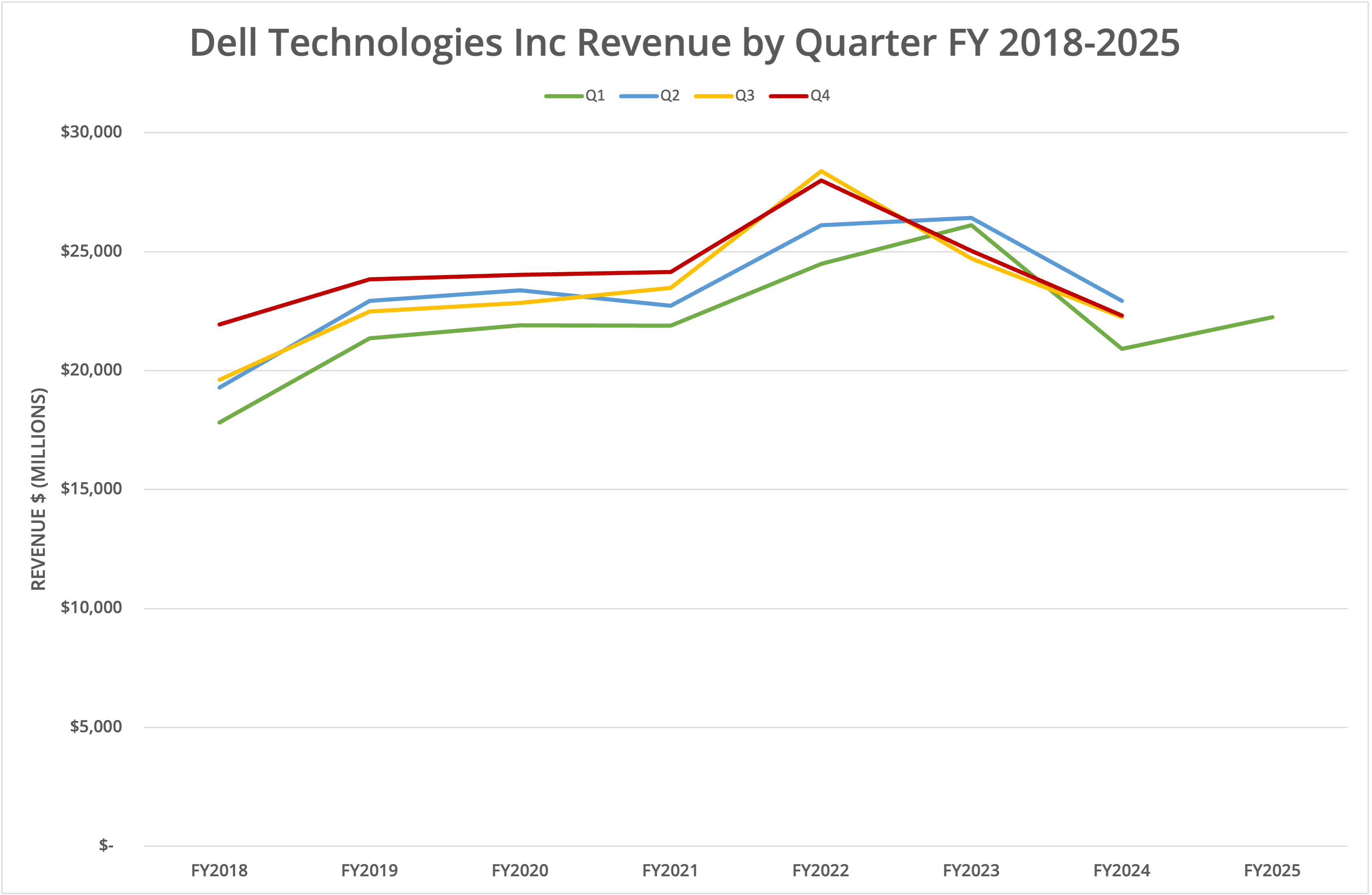
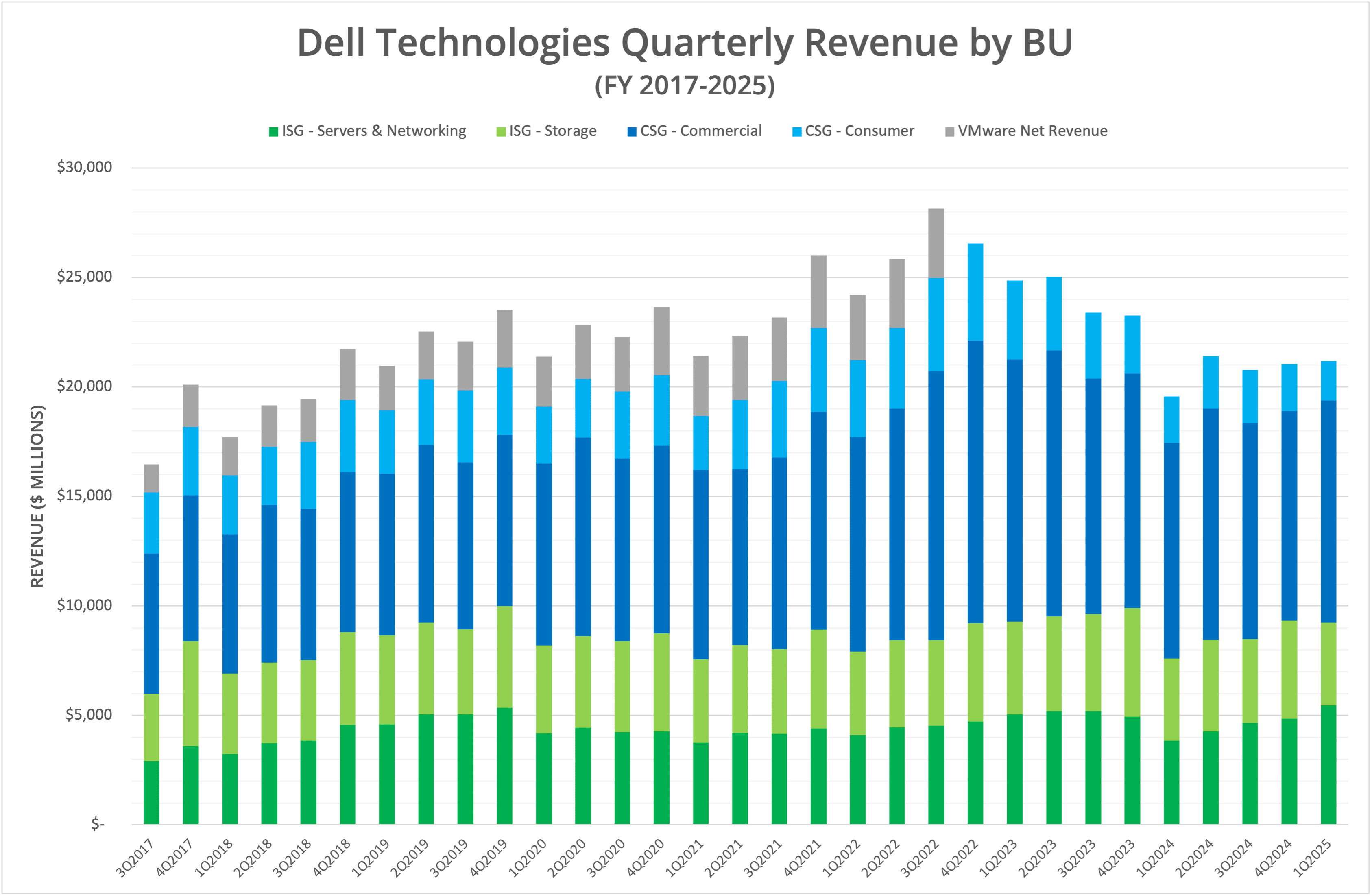
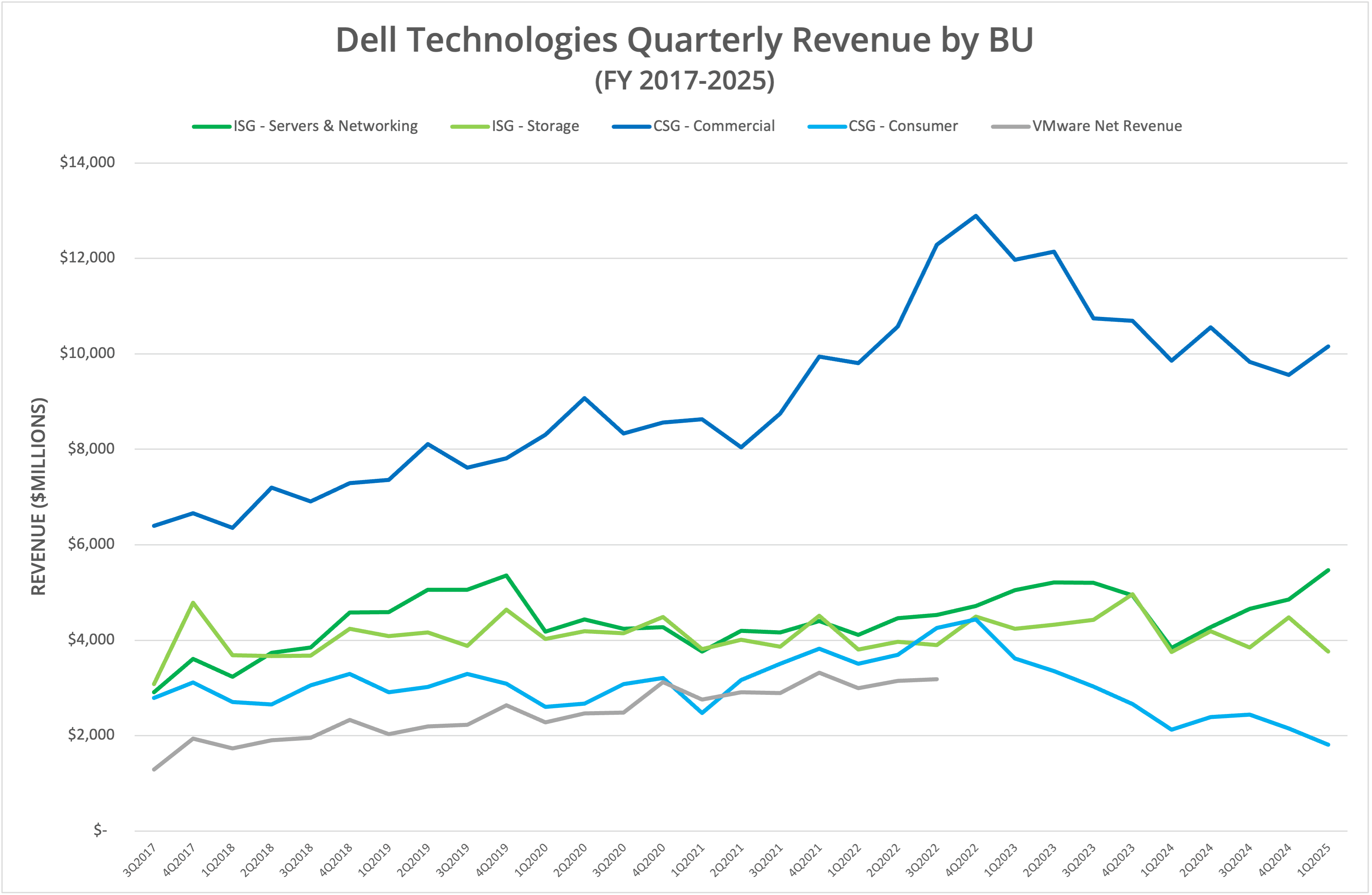
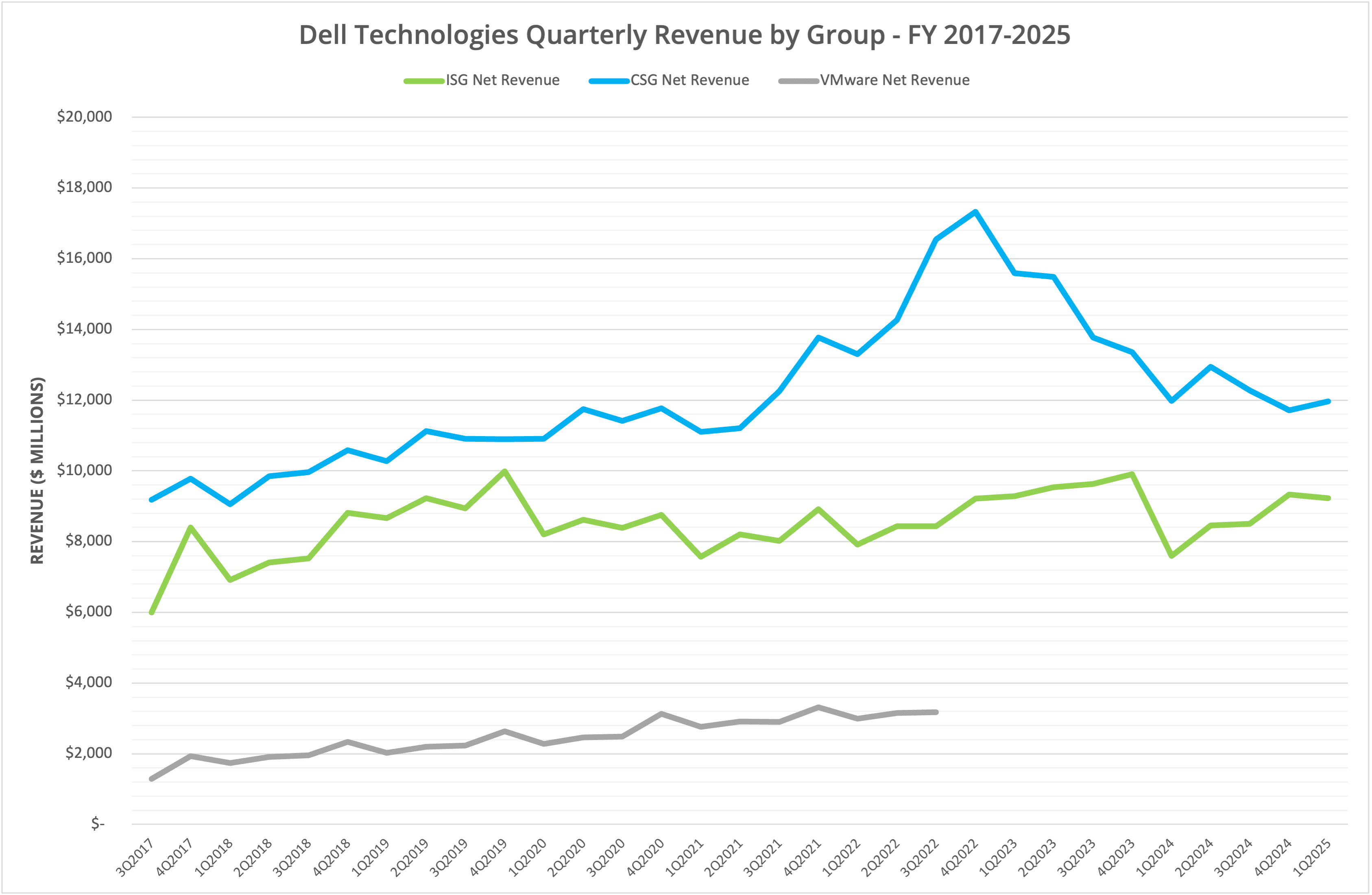
By operating division, ISG rose 21.5% year-on-year (flat sequentially), with Storage flat year-on-year and down 16% sequentially. CSG revenue was flat year-on-year and up 2% sequentially. Where CSG Consumer declined 14.5%, CSG Commercial was up 3% (both YoY). Overall, ISG and CSG operating income declined, most notably with ISG, where sequentially, there was a drop from 15.3% to just 8%.
We display the historical financial data in four graphs, these show overall revenue mapped by quarter (Figure 1), revenue by business unit (Figures 2 & 3) and by Group (Figure 4).
Servers
From the perspective of ISG (Infrastructure Solutions Group), server sales saved the quarter, with a YoY increase of 42%. However, as reported in the earnings call following the announcement, AI server backlog increased by $900 million to $3.8 billion. It’s also notable that operating income for ISG dropped to 8%, presumably on the passthrough cost of GPUs, which are unlikely to have much, if any, added margin.
The Storage group seems to be unable to lift revenues, despite new versions of PowerStore (see this research note) and PowerFlex. Dell is promising a parallel file system capability for PowerScale, but no specific details were announced at Dell Technologies World.
Similarly, the AI PC revolution has yet to create any impact on sales. This is possibly because the hardware features in the first generation of AI PCs are not enough to meet Microsoft Copilot+ requirements (see this commentary).
The Architect’s View®
We mainly follow Dell Technologies for the storage and data protection businesses. Neither of these areas have been market leaders in recent years, although both still maintain leadership positions in sales, due to the EMC acquisition in 2015.
Unfortunately, Dell faces a problem with the rise in popularity of AI, as its storage solutions aren’t adapted for the AI market. For example, there was no mention of AI in the recent PowerStore 4.0 press release, while the PowerScale parallel file system and ObjectScale solution rely on existing technology. Twelve months ago, Dell COO Jeff Clarke claimed AI would drive storage demand (see this Blocks & Files article). However, this hasn’t materialised in increased sales (at least not for Dell).
What is going wrong? Remember that PowerStore is a revamped Clariion/Unity/VNX solution that is only just maturing into the product feature set previously offered by the legacy solutions. The hardware is two generations back on processor revision (Cascade Lake) and has only just started using QLC drives.
PowerScale is the historical Isilon solution, acquired by EMC in 2010. This is a 20+ year-old platform, which wasn’t developed for the all-flash era. New platforms such as Weka and VAST Data provide software-defined scale-out storage with NVMe and SSD-focused architectures.
PowerFlex, the ScaleIO solution was also developed pre-flash, with a design that was aimed at overcoming the slow random I/O performance of HDDs. This problem no longer exists in the flash world, negating any benefit of this architecture.
Simply put, Dell’s solutions aren’t competitive in a competitive market. Its peers have better solutions, with more flexible service models and are more cost-efficient. Pure Storage, for example, has created innovative ideas such as data centre power rebates, which it can use as leverage against its competitors.
Dell also has no real presence in the public cloud, choosing to port PowerFlex to AWS and Azure, rather than PowerStore, which is clearly used by many more customers. The reason for this is probably architectural and technical (we could provide a long explanation, but see this post where we discuss some of the challenges).
Through the EMC acquisition, Dell has a large customer base, with products that are good enough to prevent mass attrition, especially in a service-based consumption model. Equally, products and solutions aren’t good enough to entice customers from competitors.
We continue to see a future of slow attrition for the Dell storage business, with no likelihood of future acquisitions to bolster the portfolio. Back in 2019 we saw an opportunity for Dell to start from scratch and literally build a new storage platform from the ground up. This was a path not taken, instead “Midrange.NEXT” emerged as a VNX/Unity clone. This was a missed opportunity and one that will have ramifications long into the future.
Copyright (c) 2007-2024 – Post #e323 – Brookend Ltd, first published on https://www.architecting.it/blog, do not reproduce without permission. Dell Technologies is a tracked vendor for data storage and data protection solutions.