

It’s been reported that Pavilion Data Systems has gone out of business. Another storage start-up fails to gain traction in the market. So, what could have gone wrong and is this anything other than the natural selection of vendors in the start-up world?
Challenges
First of all, nobody likes to see a start-up go out of business. From personal experience, I can say that creating an idea, building a team, and gaining funding are hard enough. Then convincing potential customers to buy is even harder. I’ve done it twice during my career, the first time taking a company public, the second not managing to raise money past a seed round. Both scenarios were equally stressful, so I can empathise with what the Pavilion team are feeling now.
Circle of Innovation
The success or failure of start-ups is a normal part of the evolution of new technologies. Many ideas get incubated into potential concepts that hopefully result in a product customers want to buy. Getting to market often involves many iterations and changes of path before the final product emerges. Even then, the mythical “3.0” version is the one most customers will wait for; unless they have an appetite for being early adopters.
From initial funding to IPO or acquisition, many (arguably most) start-ups fail along the way. Knowing this doesn’t make the process any easier, but it is a reflection of reality.
Quantifying Success
What does success look like? We might think that success is about being in the right place at the right time, but there’s much more to it than that.
- Products and services need to solve a problem for the customer. If they don’t, then the customer won’t resonate with the vendor and the solution. Generally (but not exclusively), the problem being solved is unlikely to be financial, but one of business agility or another commercial or technical roadblock.
- Solutions need to offer a 10x improvement over the status quo. While that number isn’t a hard and fast rule, typically, a 5-10% saving or improvement isn’t going to be enough to counter the inertia of change. Moving to a new solution can involve significant expense (retraining, write-off of old solutions, product integration), so the payoff must be worth it (for the customer).
- Mass market appeal. Assuming the solution fits the customer’s needs, then the vendor will need to gain widespread adoption to be successful. Niche products may find only a handful of buyers, which equally applies if the problem being solved is also niche.
These statements probably seem obvious to most people, however it’s amazing how many times I hear “a solution in search of a problem” to describe start-up ideas.
Pavilion
How does all this relate to Pavilion Data Systems? Let’s look at the technology the company has been developing since 2014. The Pavilion HyperParallel Data Platform is a rack-scale high-performance storage appliance based around a central redundant PCIe bus, up to 72 2.5” NVMe SSDs and up to ten dual controller I/O line cards. Each controller supports four 100GbE ports (or ten 200GbE/InfiniBand). When I first saw the system, I was reminded of a network director, as each of the I/O blades and management controllers is hot-swappable.
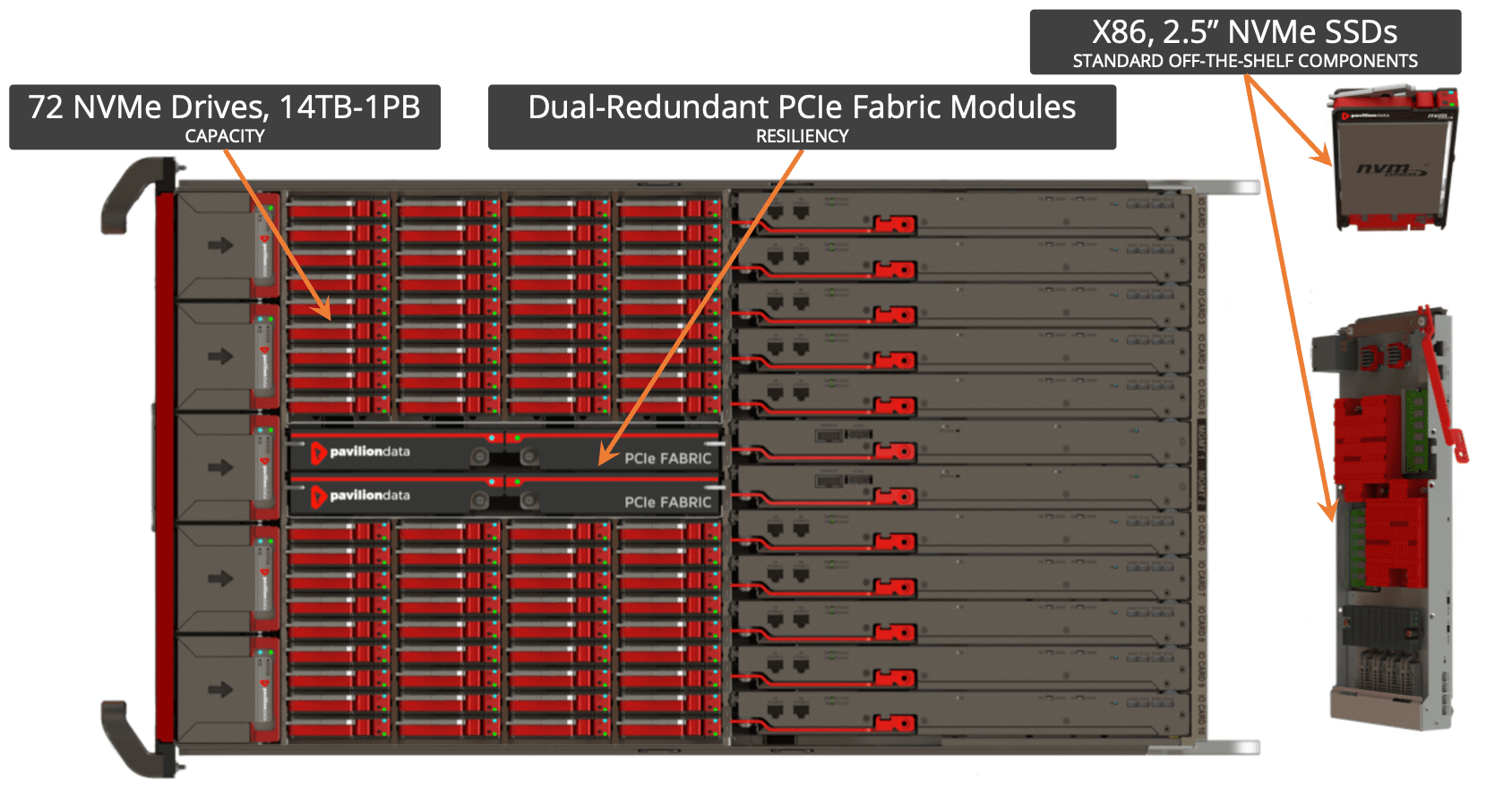
Internally, drives are assigned to zones, which are mapped to I/O controllers. Pavilion claimed performance throughput of 120GB/s at 100µs latency (which I believe was improved even further to around 40µs). Later versions of the product extended the NVMe over Fabrics support to NFS and object storage.
Speed
With any new product that enters a similar existing market, time is of the essence. In the all-flash space, new entrants needed to gain market traction before the incumbents adapted existing solutions to be good enough. Arguably, only Pure Storage achieved this goal, although Nimble Storage had gone public before its acquisition by HPE.
Looking back at the review of vendors in our NVMe in the Data Centre 3.0 report (2019), Apeiron, E8 Storage, Excelero and Vexata have all gone out of business or been acquired. The vendors that are still with us have developed software-only solutions rather than choosing the appliance model.
Compared with our brief set of success criteria, we can see that Pavilion fixed problems for customers with high throughput and low latency requirements. In block storage that market segment is probably quite small, so the company added the additional unstructured protocols. With this change, Pavilion was attempting to gain more traditional customers where the unique architecture may have been a challenge for some customers. Scalability was probably also an issue, especially for customers with unstructured requirements. Expanding the TAM by adding new protocols arguably diluted the original performance message, making Pavilion seem just like another all-flash storage vendor.
The Architect’s View®
Pavilion had an interesting product but one that addressed a relatively small niche. Perhaps the company hoped that the niche would become mainstream, or a major vendor would consider adding the technology to its portfolio. Neither of those possibilities has developed, so with a lack of sufficient traction, the company has closed down.
The data storage market is a mature ecosystem where a new feature such as NVMe over Fabrics isn’t enough to support an entirely new platform. While some businesses need ultra-high performance, many want to address other challenges, such as operational simplicity, efficiency, and cost. In 2014 it was hard to justify the need for another hardware platform. In 2022, I think it’s almost impossible.
Copyright (c) 2007-2022 – Post #6189 – Brookend Ltd, first published on https://www.architecting.it/blog, do not reproduce without permission.