

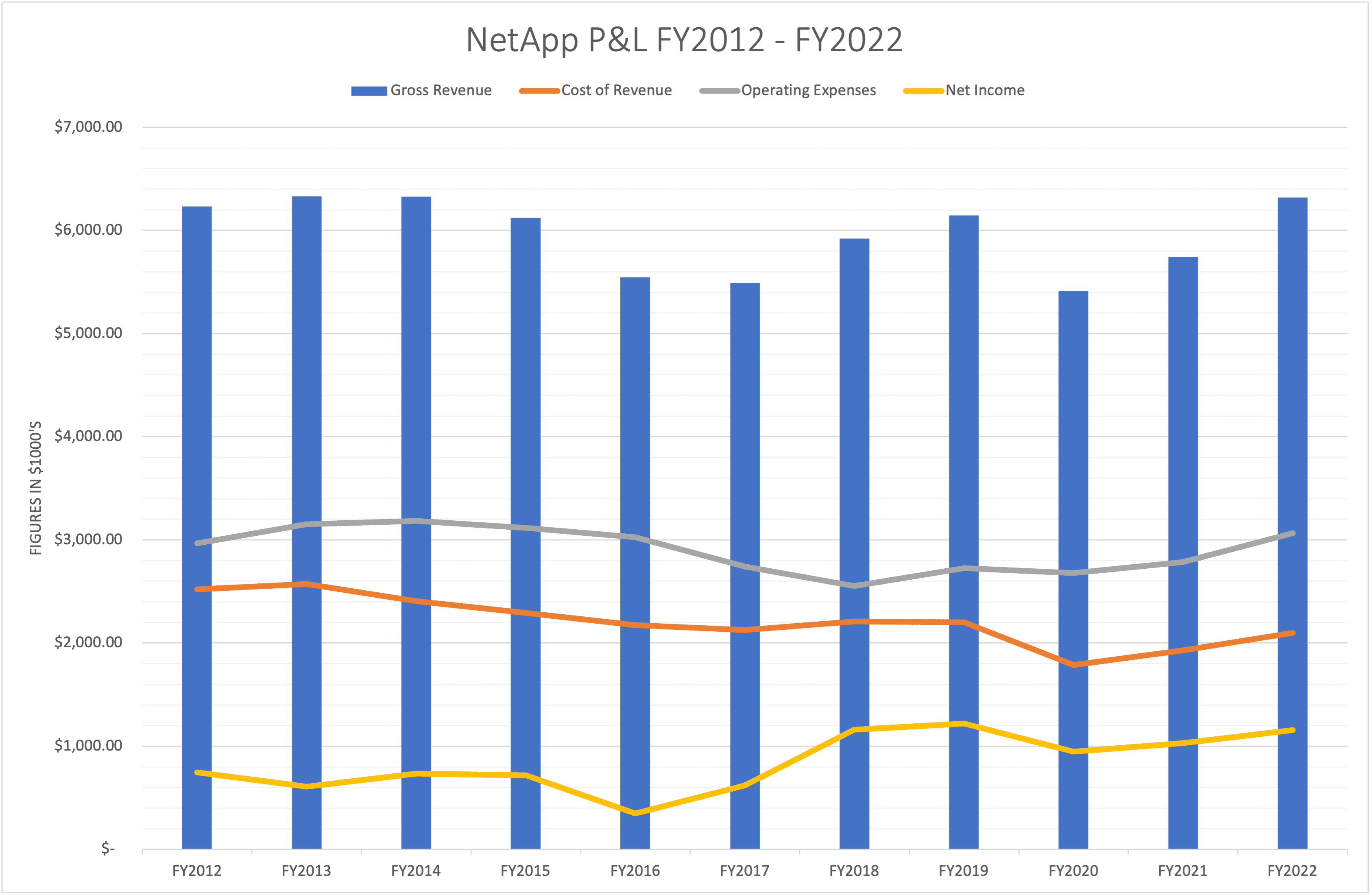
NetApp has announced FY2022 figures showing 10% year-on-year growth in revenue with a 12% increase in net profit. Public cloud revenues doubled to $396 million for the year, however, with so many acquisitions in play, improved messaging is still needed on the public cloud management story.
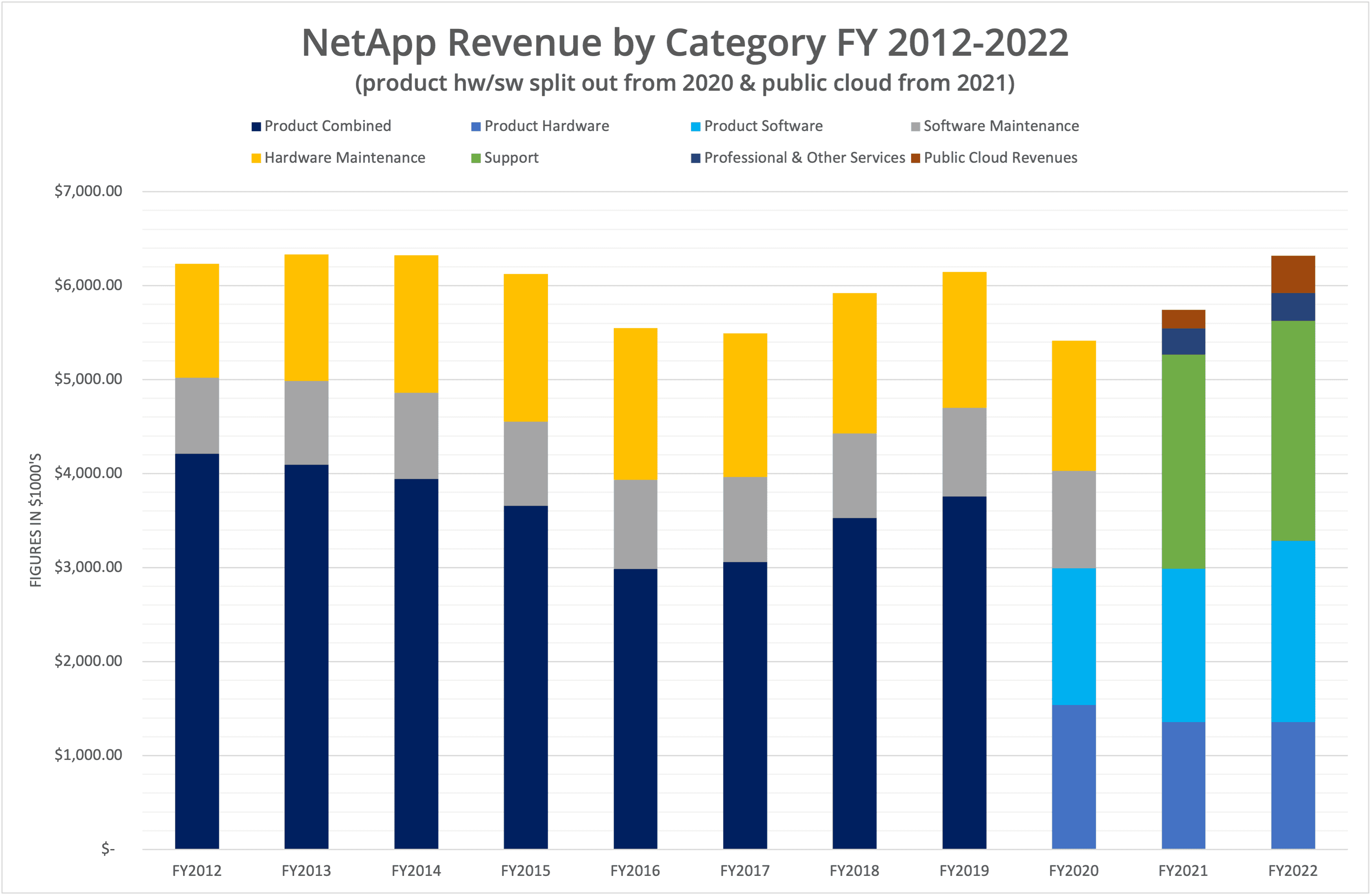
Following on from the data presented in our September 2021 post (here), we’ve added FY2022 data, as shown in figures 1 & 2. NetApp has chosen to restructure revenue reporting, now divided into public cloud revenue (brown on our graph) and hybrid cloud revenue (everything else). This data is highlighted in figure 1, where we’ve reformatted FY2021 data to meet the new categorisation. One interesting aspect we can see from this repositioned data is how the hardware component provides increasingly less revenue on a percentage basis.
Transformation
As we highlighted in this post from February 2022 (here), NetApp is in a process of both transformation and bifurcation into two increasingly distinct businesses. The Cloud BU recently added Fylamynt, CloudCheckr and Instaclustr to the family, while continuing to release new services based on the Spot acquisition of 2020.
There’s a lot going on in the Cloud BU, and with so many new products, services, and features, then conveying the strategy to customers is always going to be a challenge. These acquisitions are part of a multi-year strategy to transform away from a dependency on on-premises infrastructure and continue the integration into the public cloud.
The Architect’s View®
NetApp has obviously changed financial reporting to move away from continued emphasis on hardware and products. The company wants future discussions to focus on services, covering both hybrid and public clouds. The financial restatement highlights that currently, public cloud is still a small part of the business in terms of revenue. Solutions such as FSx for NetApp ONTAP are growing, but the messaging around Spot and associated services is currently less clear.
As a vendor of storage products, NetApp has a natural “legacy” of followers that will still see the company as a vendor of on-premises infrastructure. The long-term trend for this part of the market is either stagnant or trending down, so long-term growth has to come from elsewhere.
The Cloud Business Unit within NetApp has started a remarkable transformation through acquisitions and internal development. The Data Fabric story is one facet of Public Cloud adoption, while the other is efficient resource (meaning application) management. This is where Spot and the other recent acquisitions come in.
The next big challenge for NetApp will be to transform the acquisitions into a leadership position in application workload management for the public cloud. The components are there, but end users and businesses need to see how they will all operate together.
In the coming months we will be reviewing NetApp’s public cloud strategy, in light of the recent acquisitions. Register for our newsletter and blog alerts to ensure you don’t miss out.
For more information on our coverage of NetApp, visit our dedicated NetApp Microsite. NetApp is a tracked vendor for Data Storage, Data Protection, and Cloud Storage.
Copyright (c) 2007-2022 – Post #2123 – Brookend Ltd, first published on https://www.architecting.it/blog, do not reproduce without permission. NetApp is a client of Brookend Ltd.