

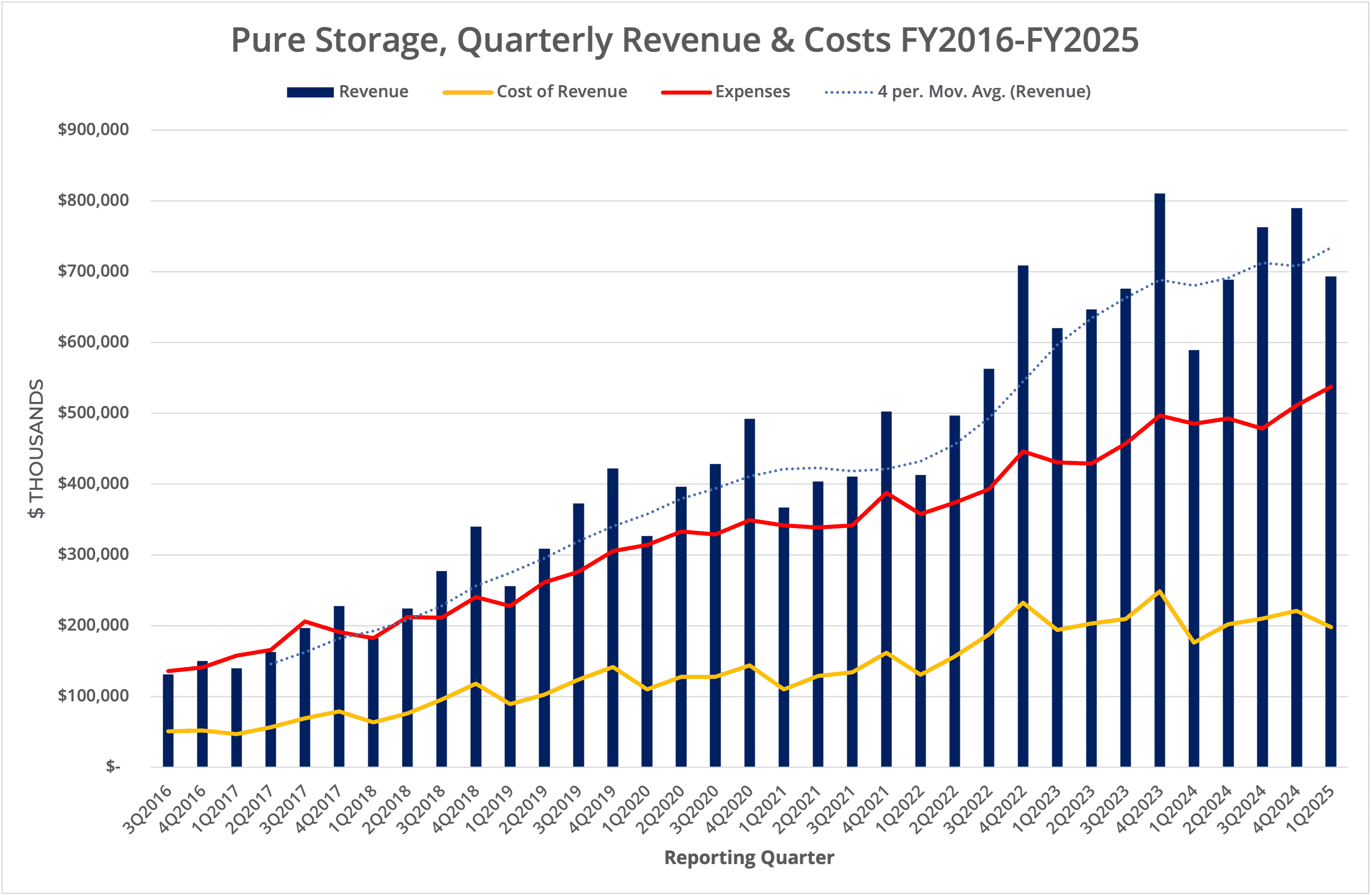
Pure Storage, Inc. has announced financial results for the first quarter of FY2025. Revenue is up 17.6% year-on-year, although the company made a loss (down 58% on Q1 FY2024). Momentum continues, with subscriptions now 50% of revenue for the first time.
Background
Pure Storage has announced Q1 FY2025 financial data that shows revenue for the period at $693 million, up 17.6% on the equivalent quarter from FY2024. The company declared a loss of $14.8 million, which has been the case in Q1 for the past few years.
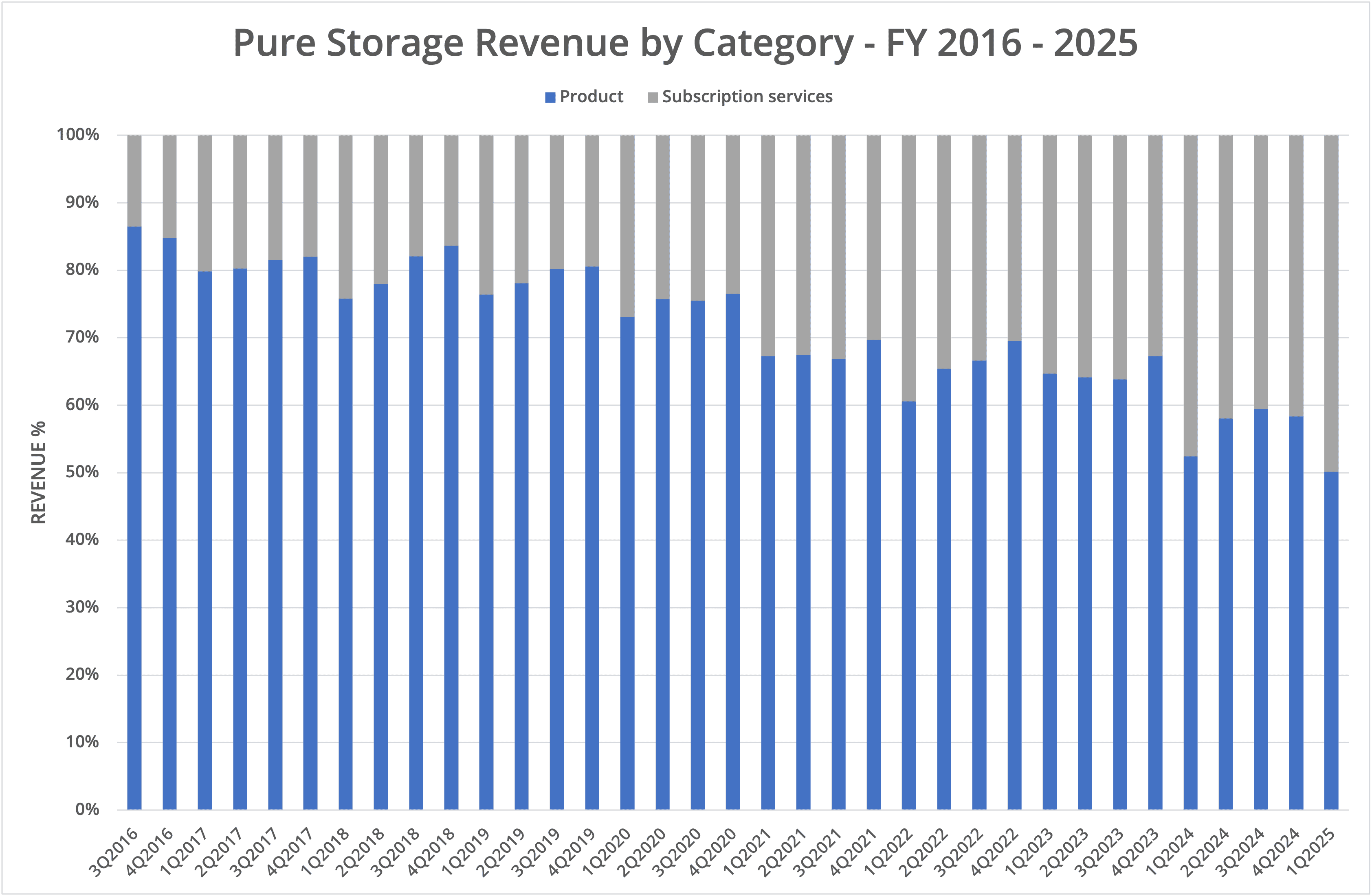
Subscription revenue has now reached 50% of overall sales (up 23% YoY), as indicated in Figure 3. This is an important psychological milestone as it highlights the ongoing transition towards the Evergreen consumption model and storage-as-a-service. Subscription ARR is up 25% YoY.
Consistency
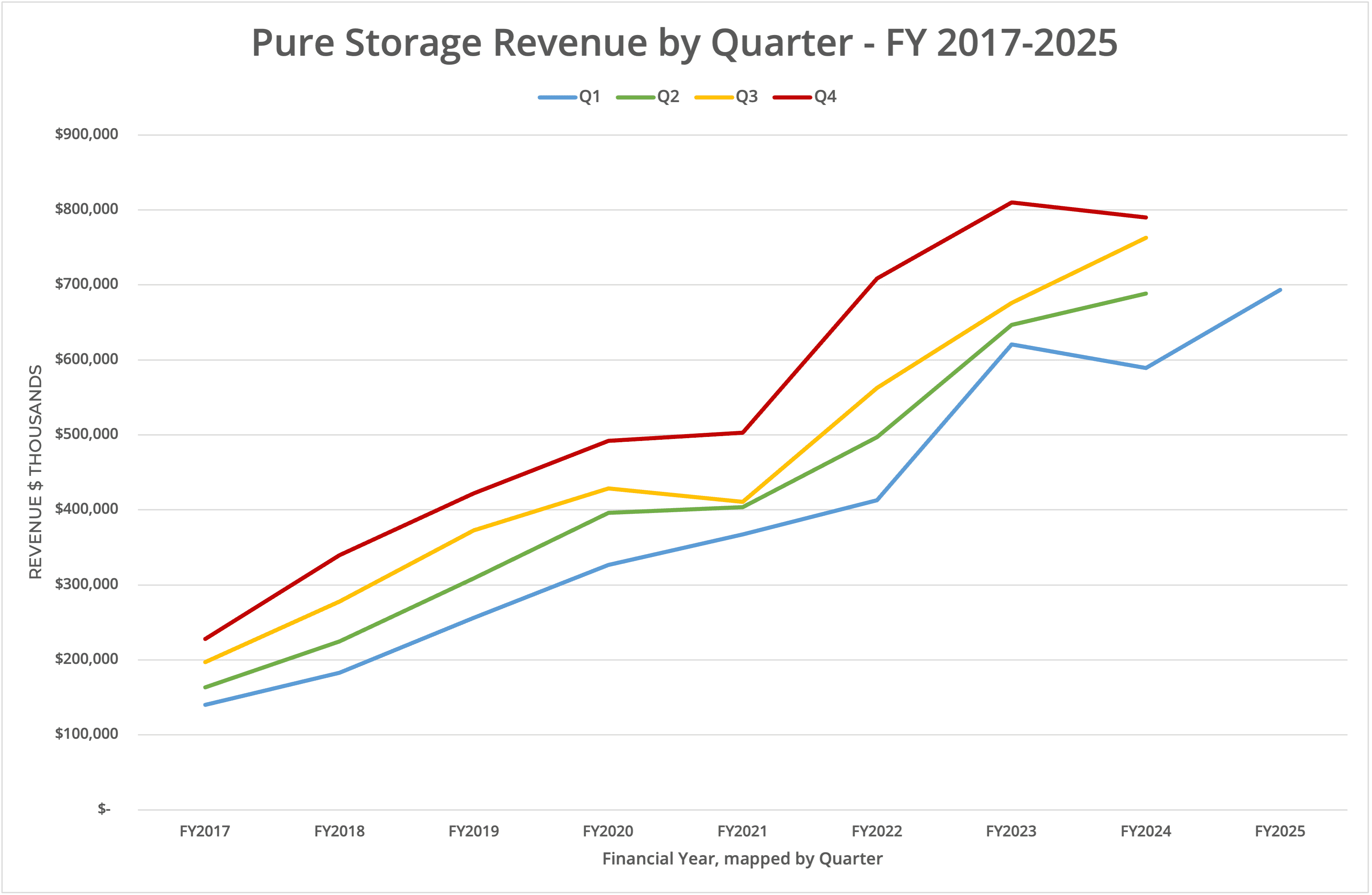
Other than highlighting the consistent trend upwards in revenue, is there anything else we can glean from the current financial data?
By the time Q2 figures are announced, we will have received news of product and solution announcements at Pure Accelerate in June (sadly for the second year, we are not attending due to a clash of commitments).
In previous years we have seen new product releases that improve performance and extend the capacity of existing systems. Most recently, Pure Storage has begun to focus more on software-based services, such as Disaster Recovery-as-a-Service and on operational efficiencies such as SLA guarantees and power rebates.
As we move into the extended hype-cycle of Generative AI, we can expect news and product announcements that reflect this current trend in the data centre. However, rather than push customers simply to buy more stuff, we hope that Pure Storage focuses on customer needs and (for example) mitigating the rising cost of storage.
The next iteration of Direct Flash Modules has already been teased, with an announcement of 150TB capacity devices this year and perhaps 300TB next year or the year after. For customers with significant data growth, systems based on the latest DFMs will be a welcome sight.
The Architect’s View®
While the hardware-focused increase in systems capacity will be good news, the more relevant measure for customers is the overall total cost of ownership and the long-term trend to optimise costs in private data centres. While the rise of GenAI seems to be initially based on public cloud offerings, we believe that the long-term direction of the current AI wave of adoption is to bring data and applications on-premises (especially where retrieval augmented generation is concerned). The current trend of AI exploration will transition into one of deployment and operation. At that point, the value of GenAI models will need to be aligned against costs. Solutions will need to be cost-efficient, including storage.
Pure Storage has moved on from the initial focus of all-flash and centralised storage solutions that discussed IOPS, throughput and latency. These attributes are table stakes. Instead, the differentiators of the future will be operational efficiencies, including TCO and the efficient management of resources across multiple data centres. To that end, we continue to believe Pure Storage is well positioned, if not the leader, in this approach to customers and the enterprise data centre.
Related Content

Essential Features of Primary Storage Systems 2024 – Market Perspective
This Architecting IT report reviews the market for primary storage systems, typically those offering block-based storage for the enterprise. This report rates vendors using our Trimetric. Premium download – $495.00 (BRKWP0307-2024)
Copyright (c) 2007-2024 – Post #d222 – Brookend Ltd, first published on https://www.architecting.it/blog, do not reproduce without permission. Pure Storage is a tracked vendor for data storage and data protection solutions.