

Micron Technology, Inc. has announced three new products; the high-performance PCIe 6.0 9650 NVMe SSD, the high-capacity 6600 ION NVMe SSD and the cost-optimised 7600 NVMe SSD. Together, these new devices extend the capabilities of Micron’s data centre products, enabling an even greater number of workloads to be moved away from hard disk drives.
Background
Micron markets solid-state disks (SSDs) in three main families of products, with an additional two solutions for specific workload types (the XTR for extreme endurance and 5400 for SATA connectivity).
The 9000 series represents the top end of performance and connectivity, now with a PCIe 6.0 interface. The 6000 ION SSD continues the family of 6000 series products first introduced with the 6500 ION in May 2023. The latest iteration, based on PCIe 5.0 and QLC NAND, extends capacity to 122TB in an E.3S form factor, with the promise of a 245TB drive in the future.
The Micron 7600 NVMe SSD is probably best described as a “cost-conscious” option, scaling to 15.36TB in the PRO option or 12.8TB with the 7600 MAX (PRO drives offer 1 DWPD, while MAX drives have triple the endurance at 3 DWPD). This is still a high-performance product, but with an eye to deployments where costs (including power) are a consideration.
Evolution
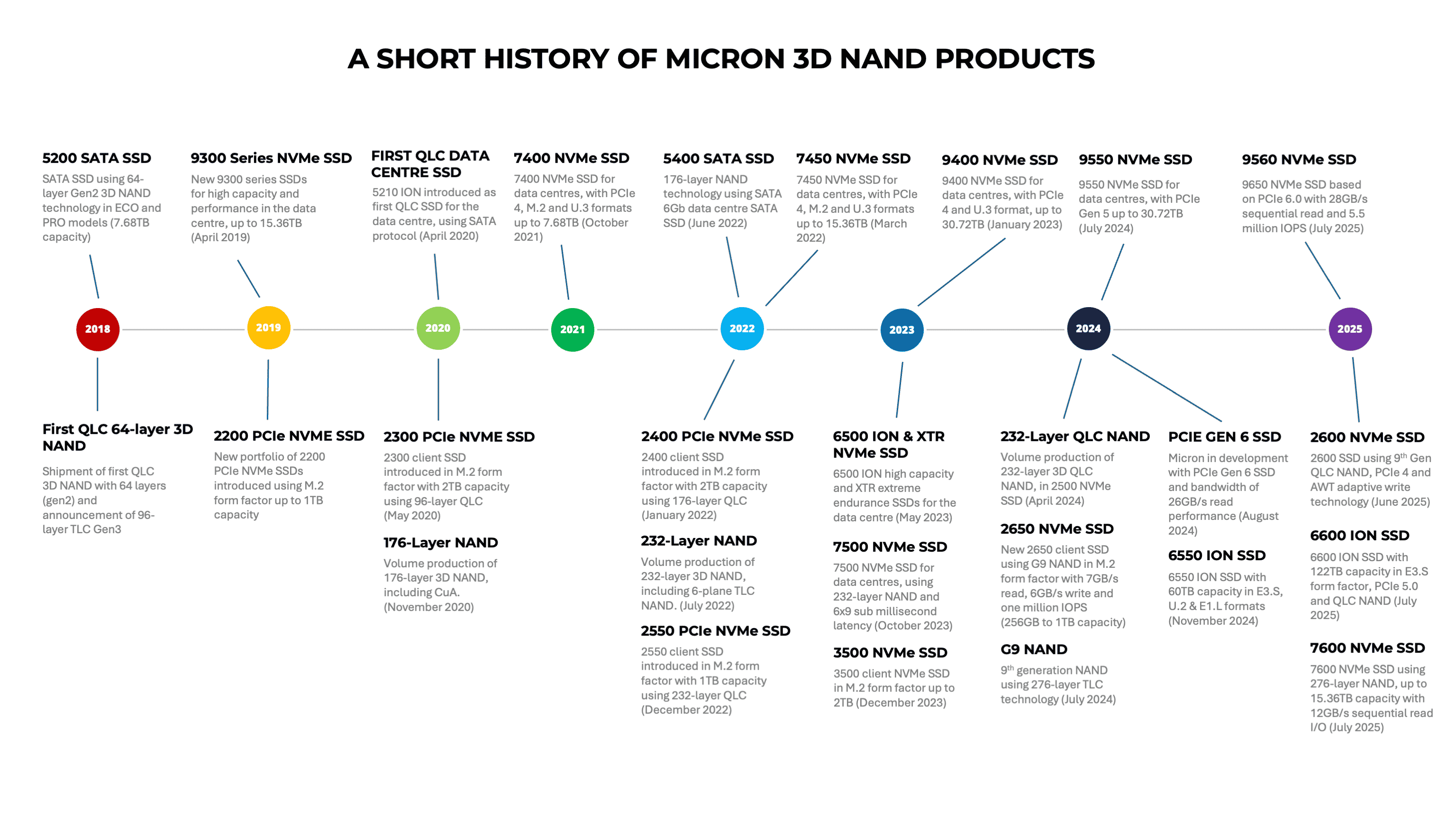
As Figure 1 shows, the 9000, 6000 and 7000 series drives have been continuously evolving over the last decade (our diagram shows only the 3D-NAND-based products). Successive 9000 series products, for example, have delivered increased capacity and throughput, the latter generally by implementing the next iteration of PCI Express interface.
Micron develops its own 3D-NAND products, which are currently at the ninth generation using 276 layers. The latest chips use 6-plane technology, which increases the amount of parallel I/O that can be performed. This parallelism is required as SSD products evolve to use the PCIe 6.0 standard (and possibly PCIe 7.0 way into the future).
The 6600 ION takes advantage of improvements in die density, delivering 122TB in an E3.S form factor, around the size of a traditional pack of playing cards. As we discussed in this commentary post from November 2024, 122TB drives have already been announced or are shipping, generally using the U.2 or E1.L format. The 6600 uses E3.S 1T, which has approximately half the volume of a U.2 or E1.L drive.
The Micron 7600 NVMe SSD probably won’t set any records for capacity or performance, but it is a good middle-ground SSD, delivering 2.1 million random read IOPS (400,000 random write) and 12GB/s of read throughput (7GB/s of write). These are good numbers considering typical (sequential) power demand per device is less than 14 watts.
The Architect’s View®
Why should we care about these latest products and yet another round of improved speeds and feeds? Firstly, with ever-growing data demands, both in performance and capacity, we need to see product improvements otherwise new technologies such as AI will become economically impractical.
Second, we need to consider these products in their entirety and how the market is developing. In the data centre space, Micron now has five product types – the 9000, 7000 and 6000 series, plus the XTR for extreme endurance and the 5000 series for SATA interfaces. Each of these options had subtly different performance, capacity and cost characteristics.
If we scale this observation across the industry, we see dozens of choices available to the enterprise. How can we decide which is best, especially when reliability and availability also must be considered? This issue is one that will continue to be a challenge for enterprises taking data storage media directly rather than as part of a packaged appliance. As a result, we will be looking across the broader market in a separate paper.
Micron continues to push the capabilities of NAND flash storage further forwards, justifying the use of the technology on a wider range of application use cases. However, we are seeing a bifurcation of products into those that are read-intensive (with greater capacity) and performance-intensive (with corresponding lower capacity). Once again, the spectre of data mobility and tiering will appear, forcing decisions to be made on where best to situate active and inactive data, as well as move it around dynamically.
For now, though, we see Micron’s announcements as positive for the industry, with no obvious let-up in capacity density and performance improvements.
Copyright (c) 2007-2025 – Post #3ecd – Brookend Limited, first published on https://www.architecting.it/blog, do not reproduce without permission.