

IBM has announced that from the start of 2023, Red Hat Storage solutions, including ODF and Ceph, will be transferred into the IBM Storage division. This move represents a significant transition away from the original promise to keep the Red Hat business operating as a separate entity. So, what’s the rationale behind this change, and how will it affect customers?
Background
IBM has been a pioneer in the storage industry since the early days of computing, inventing both persistent disk media (1956) and commercial tape drives (1952). The history of IBM Storage over the past seventy years is packed full of product research, development, and acquisitions too numerous to detail in this article. However, from a strong start, IBM Storage has been challenged in recent years, as the demand for on-premises storage has fragmented due to the public cloud, software-defined storage and many new entrants into the market.
Today, IBM has hardware solutions that include FlashSystem, Elastic Storage System, SAN Volume Controller (SVC), and the DS series (mainframe specific). There are also tape drives and both physical and virtual tape libraries. Software-defined solutions include Spectrum Virtualise (the software behind SVC and now FlashSystem), Spectrum Scale (GPFS), Cloud Object Storage (the Cleversafe acquisition) and the product portfolio under Red Hat Storage.
Red Hat
Red Hat Storage has had many naming iterations and products, including Red Hat OpenShift Container-Native Storage, Red Hat OpenShift Container Storage, Red Hat Ceph Storage, Red Hat Storage Server, and Red Hat Gluster Storage. Red Hat acquired Gluster in 2011 (the developers of the Open Source GlusterFS) and Inktank in 2014 (the developers of Ceph), both of which have appeared in the portfolio as separate products or as the foundation for Red Hat storage services.
The current platform, Red Hat OpenShift Data Foundation, is based on a combination of Ceph, Rook and NooBaa. These three products replaced Gluster with the introduction of OpenShift 4.2. The OpenShift Data Foundation name was introduced with release 4.9. In Red Hat terms, at least, it looks like Gluster will become end-of-life by 2024.
Assimilation
Figure 1 shows the expected transition as IBM refocuses the storage portfolio. Spectrum Fusion, which previously used GPFS as the storage layer, will “integrate” with ODF. We read that as meaning over time, customers will be migrated toward ODF solutions.
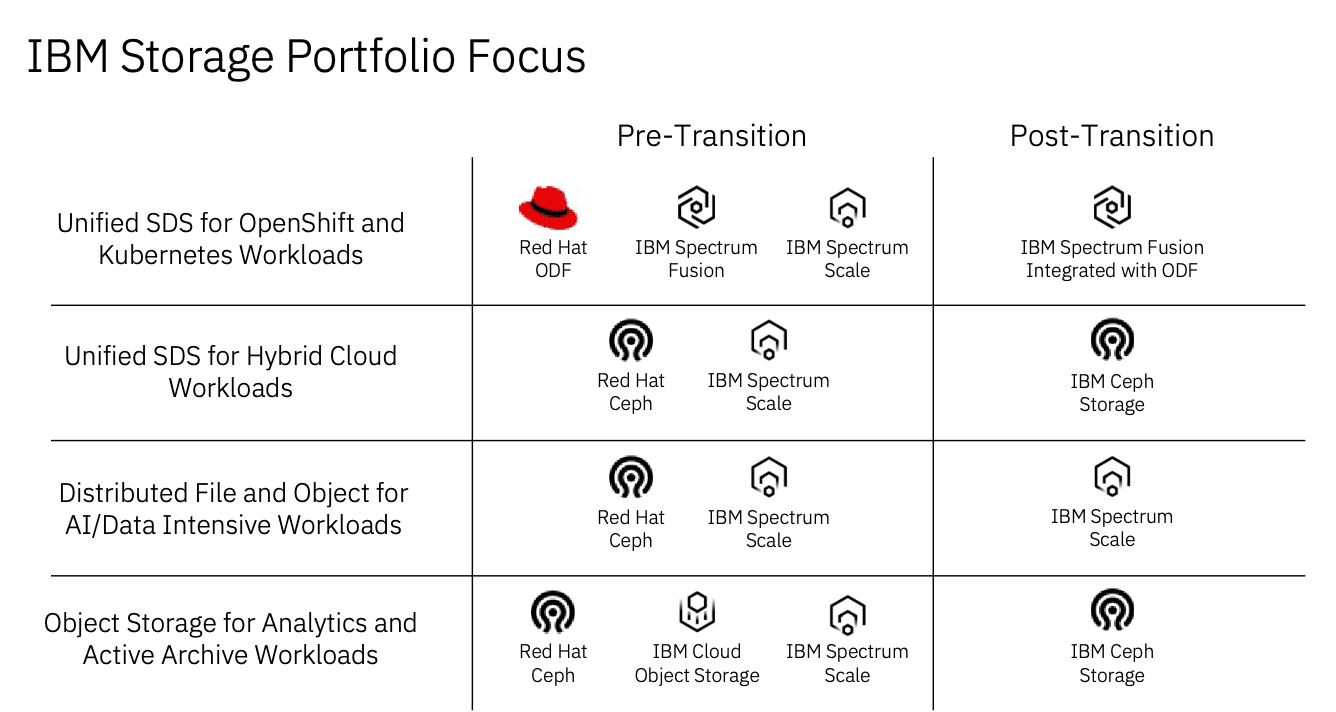
Spectrum Scale (GPFS) is replaced across the board in every use case except the data-intensive workloads such as AI. Whilst GPFS isn’t being side-lined as such, it’s clear that future investment is focused on open-source solutions, specifically the Red Hat products.
Simplification
In fairness, for customers, this consolidation does represent a simplification of the solutions available across the IBM portfolio. In addition, Ceph and Rook, in particular, are platforms that have been developed with cloud-native storage solutions in mind. Ceph is designed to offer file, block, and object protocols, while Rook is the glue to implement orchestration. Ceph is arguably more scalable at an object level than GPFS, with native block support (GPFS uses filesets as the logical object for a container volume).
Anywhere, Anytime
One advantage already highlighted by Red Hat is the ability to run Ceph, Rook and NooBaa across private and public clouds with a consistent interface to the Kubernetes platform. These solutions obfuscate the underlying hardware, allowing developers to write applications that only need to change the storage class when being ported from one platform to another (in respect of storage). This benefit should also apply to data protection, enabling applications backed up in one location to be restored elsewhere. We will be following up to learn just exactly how this capability might work and how IBM’s data protection solutions will be implemented going forwards.
Synergy
The commercial aspects of bringing Red Hat Storage “in-house” are clear. IBM can lead with a streamlined set of options that appeal more to the customers looking at hybrid cloud. IBM Storage revenues get a boost, although we won’t know the extent of this, as storage hardware sales are reported under “Distributed Infrastructure” and no longer itemised separately.
Does this transition offer other opportunities for synergy? Possibly. Back at Flash Memory Summit, we spoke to both Scott Baker (IBM Storage CMO) and Andy Walls (Fellow and Storage chief architect) about the opportunities for technologies such as FlashCore Modules (FCMs). FCMs have the capability to operate as computational storage and already implement compression and other data integrity functions. It’s possible that with Ceph BlueStore, IBM could provide greater integration between Ceph OSDs (the object storage daemons) and physical media, implementing acceleration functions for compression and de-duplication. It could even be possible to offload snapshot features too.
Why would IBM bother doing this when the Red Hat philosophy has been to enable software to run in any location? These designs could be good for both the customer and IBM. The customer gets increased performance and efficiency; IBM gets a product with differentiation in the market compared to its competitors.
The Architect’s View®
Consolidating the data storage features of IBM and Red Hat into a single set of products is a relatively easy sell to customers. ODF had already been moved to a separate licensing model from the core OpenShift products, so moving ODF to IBM is just part of a transition already in progress.
IBM needed to address the mixed messaging of an internal portfolio using ageing GPFS (and Cleversafe) technology, potentially competing with the Red Hat offerings sitting outside the IBM Storage family. Does this mean IBM is about bring other solutions directly under IBM and keep Red Hat as a brand in name only? We don’t think so – at least not yet.
Throughout all this discussion, we have only one reservation, and that’s whether Ceph represents the best-of-breed product in the market. In our testing (see this document, free registration required), Ceph’s performance was acceptable but not the winner. In our comparison of container-native storage solutions (updated July 2022), we rated Rook the weakest performer (download here, paid report). Perhaps bringing Ceph into the IBM Storage fold is a way of committing more resources to accelerate the maturity of the platform.
The changes to Red Hat Storage are expected to be completed by 1 January 2023. We will probably need 12 months to see the results. We hope IBM has good news to report the next time we review the CNS marketplace.
Copyright (c) 2007-2022 – Post #5618 – Brookend Ltd, first published on https://www.architecting.it/blog, do not reproduce without permission.