

HPE has announced the fourth iteration of GreenLake for Block Storage with Alletra MP that further extends the scalability of the platform. In addition, there is now the option to run GreenLake for Block Storage within AWS as a virtual storage instance. Yes, there have been two other updates that seemed to pass us by.
Background
We first discussed the GreenLake for Block Storage with Alletra MP back in April 2023. The first iteration consisted of two controller nodes in a single 2U chassis with up to 24 SFF NVMe drives. Each controller supported either eight or 16-core CPUs with 256GB of DRAM.
As we highlighted in our comments on that post, the first instantiation of GreenLake Block Storage with Alletra MP (which we will call GBSAM) offered no scale-up or scale-out and was a relatively fixed configuration.
Release Cadence
Since Release 1, HPE has continued to extend the platform, albeit with rather poor communication on the rate of progression. Release 2 was announced in October 2023, introducing the capability to add up to two JBOF expansion shelves of 24 drives. This enabled a system to scale from 15.36TB to 1.1PB. This release also introduced iSCSI support (which seems quite a lacking feature from Release 1, but probably needed additional I/O modules).
Release 3 was announced at the beginning of December 2023 (we think, as the post details we’ve linked here don’t really tie up). This update introduced the disaggregation capability promised when Release 1 was first announced. The expansion capability was extended to eight JBOF shelves for 15.36TB to 2.8PB of capacity using 8-24 drives per enclosure in 2-drive increments. Our working assumption is that the core of GreenLake Block Storage OS is 3PAR/Primera, and so requires a 6+2 parity group minimum configuration per JBOF. Release 3 also introduced NVMe/TCP host connectivity.
Release 4 was announced on 15 May 2024, extending support from eight to sixteen JBOF shelves, doubling the maximum capacity to 5.6PB.
Disaggregation
HPE claims that GBSAM is the “industry’s only disaggregated scale-out block storage with 100% data availability guarantee”. Let’s think about what disaggregated means in this sense. We generally think of disaggregation as the separation of a system into its component parts. In this podcast from 2017, we first discussed disaggregated storage.
We also talked about disaggregation in 2018, with reference to the architecture of Datrium (acquired by VMware in 2020). Vexata (acquired by StorCentric) introduced a disaggregated architecture, which we discussed in 2019. Perhaps HPE is referring to the 100% guarantee and conflating this with disaggregation, as disaggregation alone is certainly not new.
To be fair, Release 3 did introduce support for two or four-node configurations, each with a single CPU and with 256GB or 512GB of system memory. It’s interesting to note that the expansion “JBOF” also has a single CPU and 64GB of system memory. We believe this is because the expansion connectivity is provided by RDMA (the JBOF CPU acts as the NVMe translation layer between the devices and the system).
Release 4 Architecture
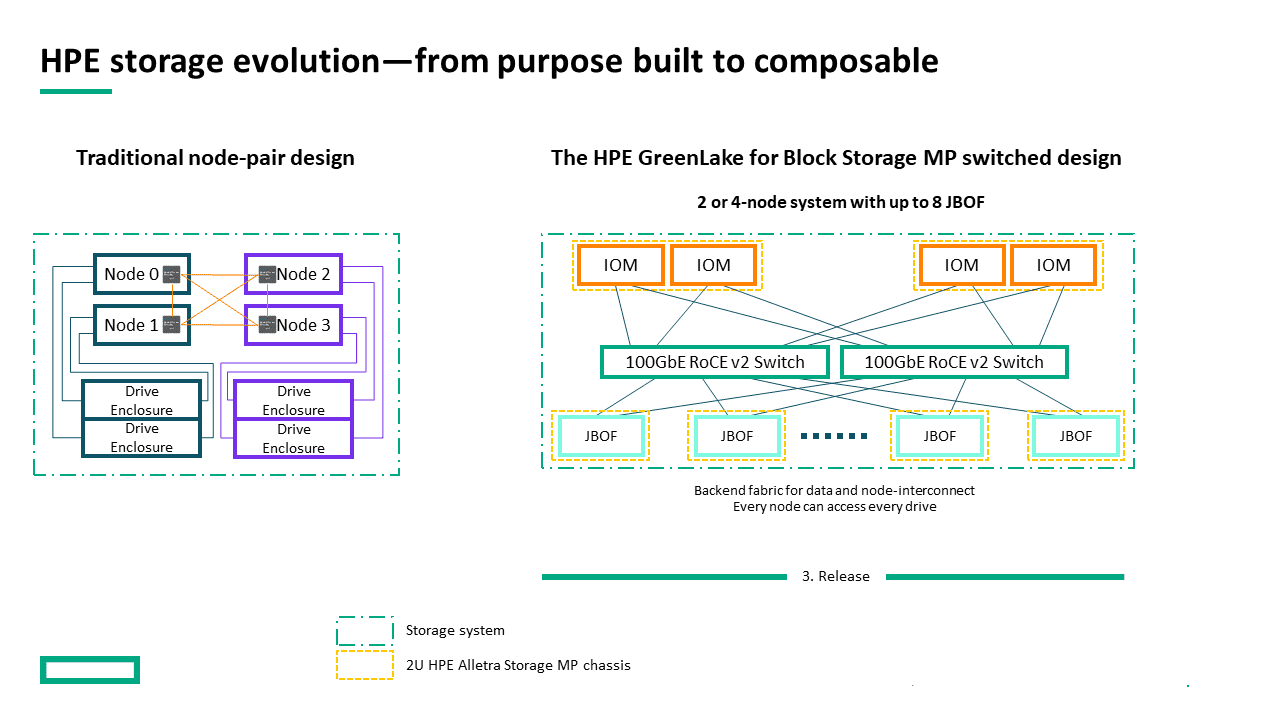
From the various blog posts, presentations, white paper, and Quickspecs documents available on the HPE website, we believe that the current architecture is a two or four-node design, with redundant Ethernet switching connecting to JBOF shelves of SSDs. Comparing the hardware to the File Storage MP product we discussed back in April 2023, we can see that there has been an alignment in design, with both file and block configurations having three components – controller nodes, switching and data nodes.
Whether any of these pieces are interchangeable is not clear. A review of the Quickspecs of the two platforms shows only chassis, drives and switches are currently the same across both platforms.
3PAR on Steroids
Is GBSAM completely new? We don’t believe so. The GBSAM technical paper (available as a PDF here) still references many 3PAR-specific terms, such as GPGs, TPVVs and VVs. However, we do believe that HPE has performed considerable re-engineering of the core 3PAR design to move from a model of dedicated drives per controller to the shared-everything model. The differences between those models is shown in an HPE graphic (Figure 1).
GreenLake Block Storage for AWS
The details on GreenLake Block Storage for AWS (GBSAWS) are pretty sparse. However, from the few specification sheets and online videos available, it appears the solution is implemented as dual virtual instances with local EBS storage and provisioned directly through the data services console in GreenLake. We suspect this is done through a CloudFormation template that builds and configures the networking. The licensing terms appear to be per terabyte over one or three-year terms.
The Architect’s View®
It is disappointing that HPE doesn’t provide adequate information to understand how the GBSAM platform has evolved since it was first announced just over one year ago. The company assumes that potential customers who are interested are already part of the HPE Community site. Even then, the details are difficult to find. Unfortunately, there are no performance numbers to back up the claims made for each release of the product. In addition, we could find nothing to help understand the design of GBSAWS and the AWS cost model associated with the configuration. It would be helpful to know, for example, which virtual instances are available, how data is protected and how failure modes are handled.
In its day, 3PAR was a great platform. HPE invested significant resources in adding new features (many of which I covered in technical deep dive papers at the time). In 2019, we discussed why 3PAR had not moved to NVMe SSDs. That transition has clearly now happened, with further optimisation of the architecture to eliminate controller-locked resources.
However, without more comprehensive information, potential customers will be left struggling to make comparisons unless they revert to traditional RFP processes and wade through reams of vendor marketing documentation.
The rapid evolution of GreenLake for Block Storage with Alletra MP could be a good story, but the details just aren’t clear. One final comment – please, please change the marketing names. They’re impossible to remember and just add more confusion to the discussion. Even HPE employees seem to struggle with them, and that tells us all we need to know.
Copyright (c) 2007-2023 – Post #2a45 – Brookend Ltd, first published on https://www.architecting.it/blog, do not reproduce without permission. HPE is a tracked vendor for data storage solutions.