

In a re-run of history, rumours are again circulating that HPE could acquire Nutanix Inc. What rationale can we see for this approach and what value (or not) could it bring to customers?
Background
Nutanix was founded in 2009, taking in around $312 million in funding before going public in September 2016. At IPO, shares were priced at $16, opened at $26.50 and peaked at $40. For reference, at the time of writing, shares are trading at just over $30, having seen a spike from around $24 after the rumours of acquisition emerged.
To date, Nutanix has approximately 23,000 customers of its products, which initially started as hardware appliances and have evolved into a software subscription-based model. The company was arguably the first to create successful products in the HCI (hyper-converged infrastructure) category. However, Pivot3 was the pioneer in the market.
Although we believe HCI is an architectural choice rather than an entire market segment, it’s clear that customers were keen to move away from a shared storage model to one that offered scale-out computing and storage. The scale-out model has significant benefits for potential customers looking for options that require only IT generalists to operate or where many smaller deployments are needed. These are areas where Scale Computing and the packaged Dell VxRAIL solutions also work well.
Clash of the Titans
It’s not a surprise that over the years, Nutanix has been directly compared to VMware. Both companies provide the foundations for building a private cloud, offering much more than a simple virtual server farm. VMware introduced Virtual SAN (now vSAN) in March 2014 (after announcing it at VMworld 2012), which directly competes against the Nutanix HCI model. Nutanix countered in 2015, developing AHV (the Acropolis Hypervisor) based on Linux KVM. Significant time and effort were subsequently spent warning of the “VMware vTax” that AHV sought to liberate.
Simplivity
In 2017, HPE acquired Simplivity Corporation for $650 million in cash. Simplivity (founded in the same year as Nutanix) had built a solution called OmniCube that was essentially a distributed NFS storage layer with hardware acceleration to support data optimisation features such as deduplication.
Compared to Nutanix (of which HPE had been rumoured to acquire for years), Simplivity at the outset seemed like a good buy for HPE, as it was a practical option to counter the success of the VxRAIL solutions. However, the Simplivity solution seems to have been de-emphasised over time, with more focus on the dHCI design. Remember that OmniCube was a replacement for the vSAN component of VMware vSphere only, not an entire hypervisor.
Nutanix
Why would HPE want to acquire Nutanix now? At the time of writing, Nutanix has a market capitalisation of $7.13 billion, with any announcement of acquisition likely to require a purchase price exceeding $8 billion. HPE is currently valued at just under $21 billion, so Nutanix would be a big pill to swallow.
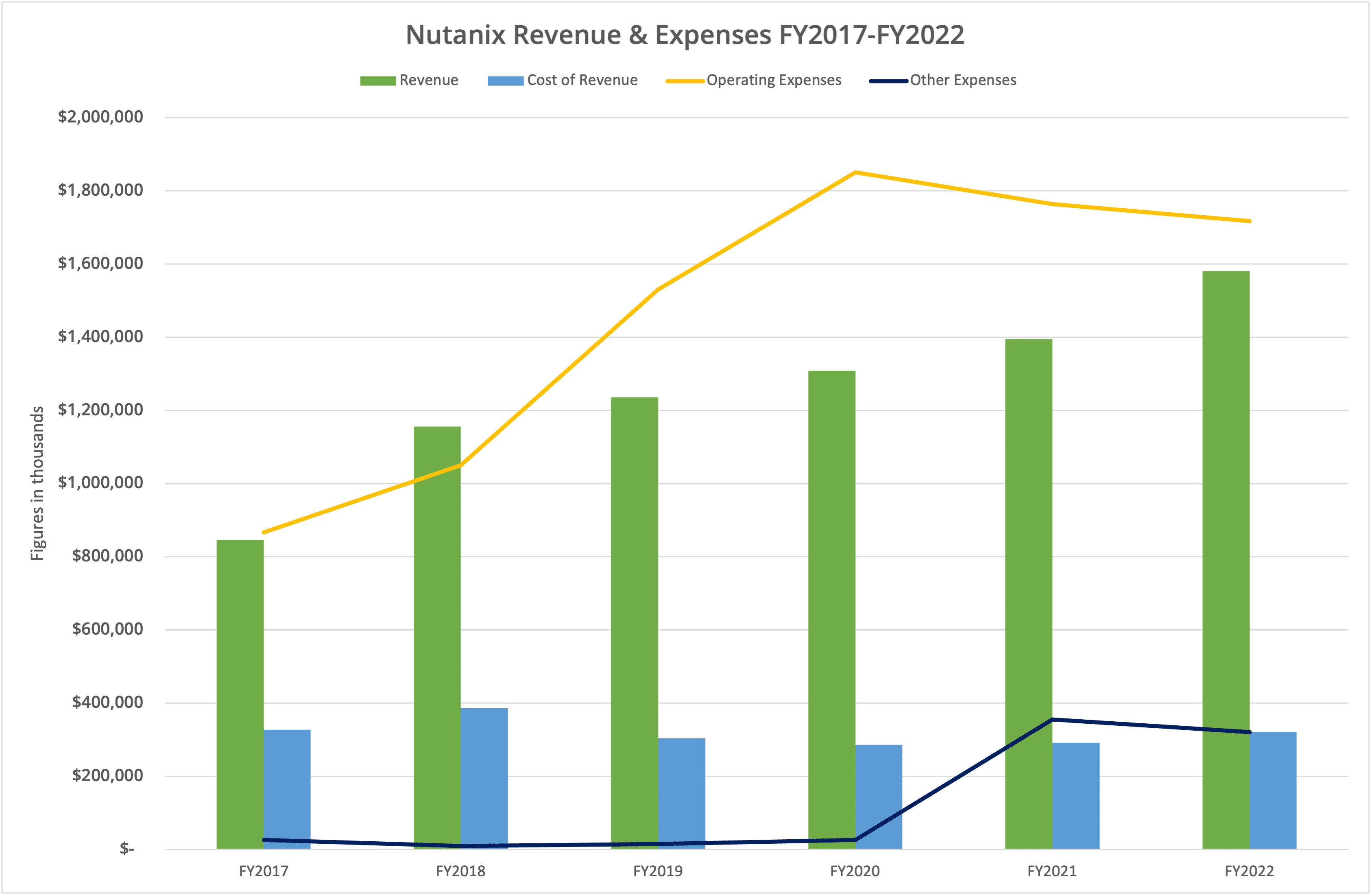
For its efforts, HPE gains around $1.4 billion in additional revenue from a company that is barely profitable. In fact, Nutanix has made huge losses over the years and has significant debt that continues to be refinanced over time. However, on the bright side, the current sales marketing spending of around $1 billion per year could be slashed significantly, as could general administrative costs, making a Nutanix division quickly profitable.
Cloud
Acquiring Nutanix also gives HPE a public cloud story with the cloud-based implementation of the Nutanix platform known as NC2 (Nutanix Cloud Clusters). Today, HPE doesn’t really have a public cloud story, but this could offer an entry point to start the discussions. It’s very much where VMware started a few years ago.
Broadcom
On the subject of VMware, we should also remember that Broadcom is due to close the VMware acquisition (subject to approval) in 2023. Moving on Nutanix now could represent a good defensive play if Broadcom decides to change the licensing model post-acquisition.
Assimilation
As with all relatively large acquisitions (relative to the size of acquirer and acquiree), the subject of cultural fit and overlap inevitably must be addressed. Nutanix is not a company that shies away from controversy, as we saw with the recent MinIO debacle. This may be a problem for HPE. Then there’s some overlap on products, specifically in the storage area with Nutanix file and object storage solutions. However, these aren’t standalone products, so may not be an issue.
The Architect’s View®
HPE has gone all-in on the GreenLake “as-a-service” strategy. Acquiring Nutanix at this point could help accelerate that program, bringing in some new customers but cementing a strategy of hybrid cloud that can add HPE networking and other solutions such as data protection. The acquisition could extend HPE’s “edge to cloud” strategy with more solutions for edge environments. We think it makes HPE a greater threat to Dell Technologies (and the last two of the soup-to-nuts infrastructure vendors). All in all, it could be a win-win combination. What headwind could there be? There’s integration, of course or a bidding war, but it’s difficult to see who else would be interested.
What’s in it for customers? At the outset, possibly not much change. HPE would push HPE hardware, but many customers will be there already. Over time the biggest risk for both HPE and Nutanix customers is whether the Nutanix platform becomes the only choice for HPE HCI customers and whether existing Nutanix customers continue to see increased innovation. There’s now lots of competition in this market; VMware, Scale Computing, Verge.io, plus the public cloud. It may be time, more than ever, for current HCI customers to look at their options.
Copyright (c) 2007-2022 Brookend Limited. No reproduction without permission in part or whole. Post #ea2c.