

As the Broadcom acquisition of VMware looms, we take the opportunity to look at alternative solutions to VMware, ESXi and vSphere. This introductory post takes us through what to expect, followed by further periodic posts covering vendor reviews and analysis comparisons.
Background
Broadcom’s intent to acquire VMware, Inc. was announced in May 2022. The deal is expected to close at the end of October 2023, but now appears to be held up solely by Chinese regulators. In the eighteen months between the announcement and the closure date, much has been written about the impacts of the deal and whether VMware customers will choose to look elsewhere at alternative server virtualisation solutions.
We looked at the issue in a blog post from September 2023. Our initial view is that we don’t see much changing from a customer perspective within the first twelve months. This opinion is based on the assumption that moving applications and workloads elsewhere is challenging while evaluating the cost implications is not trivial.
Natural Lock-in
Figure 1 shows the scale of the problem, depending on how far businesses have become embedded in the VMware ecosystem. It may be possible (and relatively easy) to run workloads on an alternative hypervisor, but once the infrastructure layers start unpeeling, we can see the migration challenge become trickier to achieve.
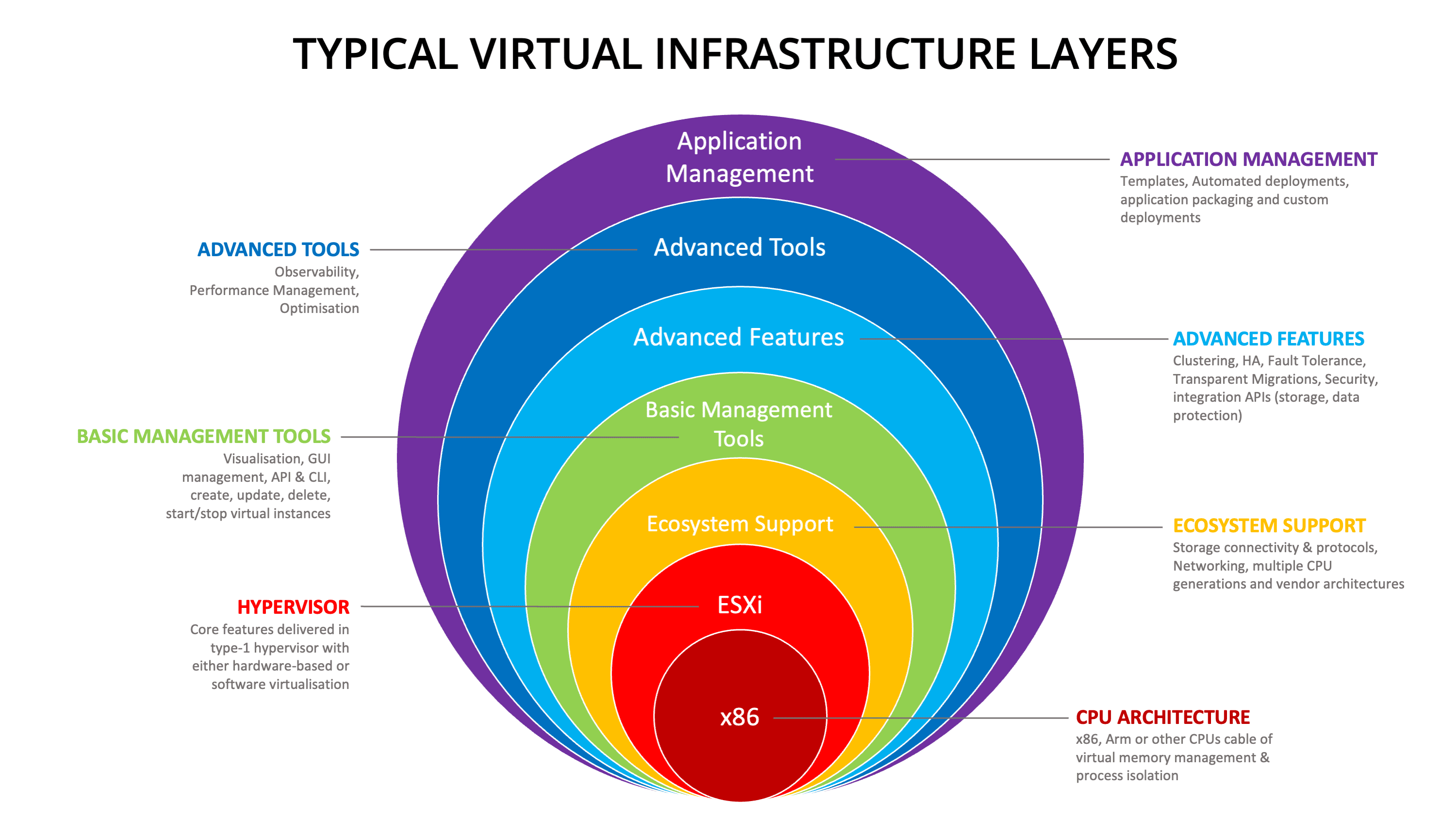
Of course, lock-in is arguably an issue with any technology, not a VMware-specific problem. However, we hope that as this series unfolds, we will highlight where lock-in can be avoided or at least mitigated.
Scope
To evaluate the vendors in our selection process, the scope of this analysis will consider the following aspects.
- The hypervisor – fundamentally the core of any server virtualisation platform. VMware has a strong product with ESXi that’s evolved over two decades to be the leading type-1 hypervisor solution. ESXi implements networking, persistent storage, memory, and device management, as well as pass-through for high-performance components. Competitive products need to match at least the core capabilities of ESXi.
- Platform support – specifically the scope of hardware support (including hardware compatibility lists), operating system support and dependencies, performance capabilities and acceleration options.
- The ecosystem – from the hypervisor outwards, the ecosystem of software platforms and tools provides the operational capabilities to run production workloads on server virtualisation. This includes CLI, GUI and API management at the most basic level, expanding to advanced features such as transparent migrations and data management APIs.
- Commercials – specifically looking at licensing both on-premises and the implications of the public cloud. Vendors are gradually moving towards consumption-based models, which impacts the TCO models used to determine the best strategy for licensing. In this area, we will consider both software-only and combined licensing options.
- Deployment model – can solutions be deployed at the edge, core data centres or in the public cloud? Public cloud deployments could also include bare-metal or direct support and nested deployments in virtual instances. We’re likely to see an increasing use of edge technology as applications become more autonomous in a distributed environment.
- Features – this category encompasses a wide-ranging set of capabilities that include the platform security model, data protection and data management, platform and virtual instance management, high availability, storage, and networking.
- Migration & mobility – opportunities to migrate on and off the platform, including vendor-supplied tools and processes. This aspect of the platform includes a review of whether solutions and capabilities offer a one-time option or whether ongoing “business as usual” features are offered. Migration from one platform to another also includes the necessary virtual instance transformation, such as driver injection, to support para-virtualised devices on target systems.
It’s clear that the server virtualisation market encompasses a vast array of features and functionality that have evolved over the last twenty years. When looking at the ecosystem, we will also consider whether vendors and solutions could be used as private cloud infrastructure. Rather than swap one vendor for another, a migration away from VMware represents an opportunity to refocus on the design of on-premises infrastructure that may currently only offer virtualisation capabilities but could be enhanced and developed into a complete private cloud model.
Vendor Inclusion
The vendor landscape has some obvious contenders, while at the same time offering several solutions that may not be initially obvious. In this review, we will consider the following vendors and options.
- Nutanix, Inc. – a mature vendor in the HCI market, with a robust ecosystem of products and solutions.
- Scale Computing, Inc. – focused more on the SMB/SME market, Scale Computing has specific offerings for edge computing and distributed organisations, such as retail.
- SoftIron – developer of an entire private cloud ecosystem, with efficiencies in storage and networking that exploit Arm-based processors.
- VergeIO – formerly known as Yottabyte, VergeIO offers a software-defined data centre with specific capabilities such as multi-tenancy.
- Proxmox – developer of the Proxmox Virtual Environment, with multiple hypervisor choices and a free-to-paid business model.
- Red Hat – with the deprecation of RHEV, Red Hat offers server virtualisation alongside containerisation, which may be a benefit for IT organisations looking to move to a mixed environment.
- oVirt – community-based virtualisation solution that could be practical for non-critical workloads.
- OpenStack – a free, open-source private cloud computing platform first released in 2010 and now encompassing a entire ecosystem of component solutions.
- Homebrew solutions – taking existing virtualisation solutions (Xen, KVM) and building a private cloud using other commercial or freely available components.
- Public Cloud – cloud infrastructure delivered on-premises, including AWS Outposts and Azure Stack.
- VMware on public cloud – using VMware on public cloud infrastructure where the licensing incorporates the hardware components and management of the solution.
We have excluded Oracle VM Server, Red Hat Enterprise Virtualisation, and Hyper-V Server as these solutions are deprecated and no longer actively supported or developed. We also exclude any vendor solution that is just a repackaging of existing VMware products or those that don’t have bespoke virtualisation components at their core, for example Dell VxRail and HPE HCI solutions.
The Architect’s View®
For many IT organisations, VMware represents the de-facto way to implement server virtualisation. With almost twenty-five years of products in the market, many IT professionals will not remember a time before VMware was the default server deployment model. This makes change a problematic step to consider and certainly puts many people outside their usual comfort zone.
- Incremental improvements from VMware at Explore 2023 ahead of the Broadcom acquisition
- Broadcom to acquire VMware as IT growth transitions to containerisation
- Will customers really jump ship when VMware is acquired?
Every industry has inflection points, and for server virtualisation, that time is now. Our content is aimed at helping end users determine the best route forward, which may also mean staying in the VMware ecosystem.
Copyright (c) 2007-2023 – Post #8df6 – Brookend Ltd, first published on https://www.architecting.it/blog, do not reproduce without permission.