

Nutanix, Inc. has announced a partnership with Pure Storage to integrate FlashArray within Nutanix Cloud Infrastructure and provide storage support for Nutanix AHV. Was this move inevitable, and what does it say for the future of HCI?
Background
Nutanix, Inc. has announced a partnership with Pure Storage that will develop integration and support for Pure Storage’s FlashArray platform within NCI (Nutanix Cloud Infrastructure), specifically with close integration into the AHV hypervisor and Flow networking. The integration will support NVMe/TCP, a high-performance protocol for block-based storage.
So far, the details presented by either company are relatively light. However, we can make some assumptions based on the market and competing products that allow us to imagine how an integrated solution might work.
Centralised Storage and Server Virtualisation
Before digging deeper into what might be on offer with the Nutanix/Pure Storage partnership, we should take a moment to look at the history of external storage, specifically with server virtualisation.
Centralised storage, particularly in the form of a storage area network or SAN, has been a standard design philosophy in the enterprise for the past quarter of a century. The initial premise of SAN storage was to reduce wastage, improve performance and improve availability with a highly resilient bespoke appliance.
Over the last two decades, Fibre Channel networking has made connectivity relatively simple, but the introduction of NVMe and specifically NVMe/TCP has taken that capability a step further. Storage and servers can now be connected across standard networking platforms that do not need bespoke Fibre Channel switches or interface cards (HBAs).
Modern Centralised Storage vs HCI
As we highlighted in a recent podcast episode recorded with Pure Storage (embedded below), centralised storage has an enduring legacy that is seeing a renaissance in the technology industry. In parallel, over the last fifteen years, virtualisation vendors such as Nutanix and VMware have been keen to push the concept of HCI, which implements storage integral to the hypervisor with onboard storage media.
Each server participates in delivering storage resources to guest virtual machines while implementing resiliency, availability, and the efficiency savings of traditional storage area network storage. However, HCI has some drawbacks. Typically, the scaling factors of performance and capacity require additional compute nodes, which may incur unnecessary licensing charges. Virtual machines are locked to a specific hypervisor platform and are not easily portable. Data optimisation processes consume CPU cycles and memory on the servers best placed to provide virtual machines, again increasing potential licensing charges.
While the HCI model works on a small scale, the requirements for even more advanced functionality such as workload mobility and ransomware detection/prevention, makes an external storage platform an arguably better solution at scale than the storage-integrated HCI model.
We discussed the merits of centralised storage in an Editorial blog written in June 2024. We made a case for “SAN 2.0” in a blog post from 2019. As far back as 2014, we looked at the options of vSAN (the VMware HCI model), VSA (virtual storage appliances) or dedicated storage platforms as three possible architectural choices (link here). It is clear the decision to use HCI (or not), has been a topic of debate for some time.
Nutanix NCI
Nutanix, Inc. was founded in 2009 and initially focused on the HCI model of server virtualisation using the marketing slogan “No SAN”. The first implementations of its software ran on VMware, with storage services deployed as a virtual machine across a cluster of server nodes.
The benefit for customers was the ability to eliminate SAN storage, seen at the time as expensive to acquire and operate. HCI, or hyper-converged infrastructure, provided a much simpler design, especially for smaller or medium-sized businesses.
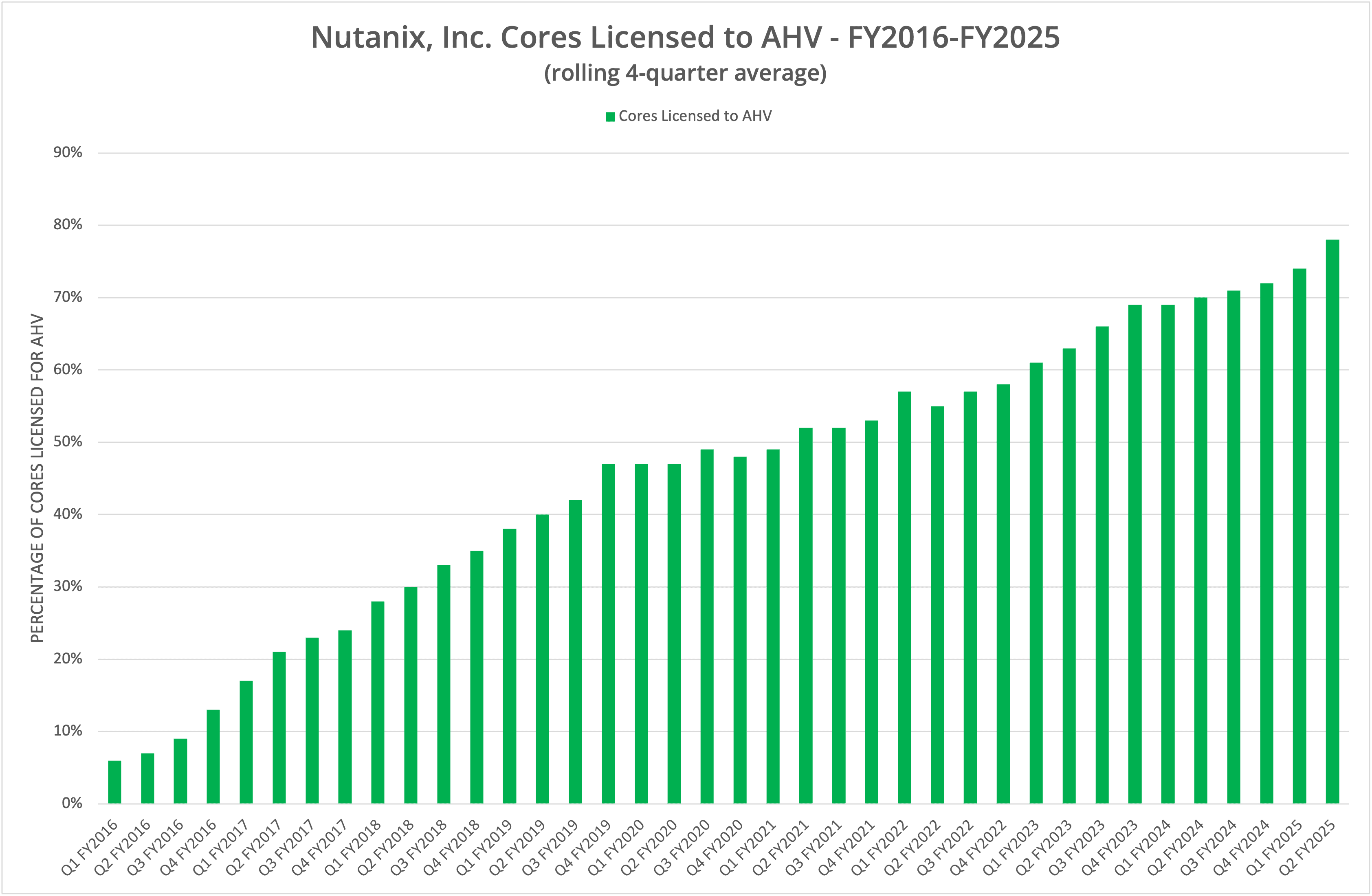
Over time, Nutanix introduced an internally developed hypervisor called AHV, based on the open-source KVM platform. Today, Nutanix has around 80% of licenced cores running AHV, rather than VMware. The growth of the adoption of AHV has been consistent over the last decade and can be seen in Figure 1.
Nutanix HCI
Nutanix uses an HCI model where storage capabilities are provided through a dedicated virtual instance running on each server in an NCI cluster. This contrasts to the design of HCI within VMware, Scale Computing and VergeIO where the storage functions are implemented in the operating system that supports the hypervisor.
It could be argued that running such a critical resource as storage alongside competing workloads is a poor design choice, from a performance and security perspective. However, Nutanix has made this configuration work for the last fifteen years, so why support external storage now?
From our perspective, we see the HCI model as one that is flawed, both from a scaling perspective and for data mobility requirements. HCI performance scaling depends on the capability of individual server nodes, which must be kept in line to deliver consistent performance for all virtual instances. This requirement introduces unnecessary costs and can make (for example) expanding a cluster an expensive or difficult proposition if the existing hardware has been discontinued or deprecated.
The inherent lock-in created by HCI makes it hard to move virtual instances between hypervisor families. This requirement has become more critical for some enterprises that are looking to move away from VMware, but don’t want to write off significant investments in SAN technology and the processes that underly them.
In recent years, vendors including Pure Storage have invested significant resources to deliver highly optimised platforms with SaaS-based management and reporting, and consumption-based pricing. The days of the forklift upgrade are long-gone. Instead, storage is now a platform onto which workloads can be deployed and operated. HCI now looks like an island in what should be an ocean of data.
Implementation
So far, we have not seen any specific details on how the integration with Nutanix NCI and Pure Storage FlashArray will work. Existing storage support should provide some context.
In May 2024, Nutanix and Dell Technologies announced support for PowerFlex on NCI. PowerFlex is the evolution of ScaleIO, a block-based storage platform running on many resilient storage nodes. Essentially it is a software-based solution that can be deployed within virtual instances, much as existing Nutanix HCI storage is today.
This initial implementation provides Nutanix with experience of supporting non-native storage on NCI, including aspects such as dynamic capacity and performance management, managing failure scenarios and storage software upgrades. This is a starting point for the integration of a dedicated hardware platform.
The Pure Storage solution could be implemented in one of two ways.
In the first scenario, FlashArray provides storage capacity to the hypervisor operating system, from where it is divided out. This mode could be compared to the implementation of datastores on VMware ESXi, where each datastore is a block storage volume that underlies a custom VMware file system. Nutanix already has a file system implementation within NCI, so this option could be relatively easy to deliver.
The second scenario is to use NVMe/TCP to present storage to virtual instances running on AHV. Each virtual machine talks to one or more unique block devices on FlashArray, rather than presenting large, aggregated volumes in the first scenario above. The benefit of this design is to provide the capability to deliver VM-level I/O performance capabilities at a much granular level than a single datastore. Nutanix has the capability to manage the networking aspects within the Flow architecture.
Of course, the integration between NCI and FlashArray could be a combination of both designs, or something totally unique. But we believe the options for integration at the protocol layer are limited. The “bigger prize” is the capability to implement data optimisation features and data resiliency features (snapshots, replication, DR) without the need to consume CPU cycles on the virtualisation hosts.
Take things a step further and we can see that abstracting the storage functionality from the hypervisor provides much better data (virtual machine) mobility between competing solutions and/or the ability to easily move data into and out of the public cloud.
The Architect’s View®
In many respects it is ironic that the original premise of the Nutanix platform predicated the elimination of shared storage. Coming full circle, NCI will support the very infrastructure it looked to eliminate a decade and a half ago.
However, the IT world continues to evolve. Nutanix started out as a solution for small and medium-sized businesses, but now wants a bigger piece of the enterprise market. With VMware still in a degree of turmoil following the Broadcom acquisition, the opportunity exists for Nutanix to take a greater share of the server virtualisation market. However, that needs centralised storage support, making a partnership with Pure Storage inevitable.
A measure of success for the relationship between Nutanix and Pure Storage will be the depth of integration between NCI and FlashArray. The details of this are, as yet, unknown, but we will be watching and reporting.
As a second thread, we will be watching for further platform integrations with alternative storage vendors. Dell has integrated PowerFlex, but in reality, the majority of customers will want PowerStore or PowerMax support. We should also expect to see announcements of integration with NetApp and HPE – both traditional storage vendors.
As a final comment, we wonder when Nutanix took the decision to accept the need to offer centralised (SAN) storage support. It’s a move that contradicts the original company ethos, but one that had to be made, in order to grab a greater share of the high-end enterprise market.
Related Content
- Analysis: Nutanix, Inc. announces Q2 FY2025 financial results
- X-Ray: Nutanix, Inc (Second Edition)
- Alternatives to VMware: Nutanix
- Microsite: Pure Storage
Copyright (c) 2007-2025 – Post #9bbb – Brookend Limited, first published on https://www.architecting.it/blog, do not reproduce without permission.