
HYCU, Inc. has announced R-Shield, a comprehensive and holistic approach to the challenges of data protection and recovery. Why do businesses need to look across all aspects of their ecosystem when managing resiliency? Because bad actors will attempt to exploit any opening, in a complex world. We look at what R-Shield means for modern enterprises.
Background
All enterprises understand data is a critical business asset that needs to be protected. Traditionally, backup and restore (otherwise known as data protection) was a solution to recover from typical issues such as hardware failure or user error (someone accidentally deleting data, for example).
However, as businesses have become increasingly dependent on digital assets, then the relative importance of data has increased. This puts data protection into the spotlight as a critical function for IT departments that must ensure timely backup and (more importantly) restore capability in the event data is lost or corrupted.
In parallel, the criminal community has identified an opportunity to exploit businesses for financial gain. Ransomware has evolved from a desktop issue for individuals into one of big business, with entire ecosystems dedicated to offering ransomware-as-a-service capabilities.
As the UK is experiencing right now, cyber-criminals will target any business that has sufficient funds to pay a ransom. Marks & Spencer, Harrods and the Co-operative are battling to keep online services available as they all deal with a live cyberattack against their businesses.
The ability to keep IT systems running is no longer about data protection but is now an entire strategy that spans proactive detection, mitigation and recovery.
Complexity
Modern IT is a complex system of many disparate solutions that incorporate SaaS, on-premises, public cloud and edge computing environments. We recently discussed this evolving data landscape in an Editorial post that can be found here – link. We recommend reading this post to gain a broader view of the challenges for modern businesses.
HYCU highlights this evolution in application deployment in a graphic shown as Figure 1. Businesses may have some or all the components shown in the “today” column. In fact, many may not realise just how many individual solutions are used by their business, especially SaaS applications.
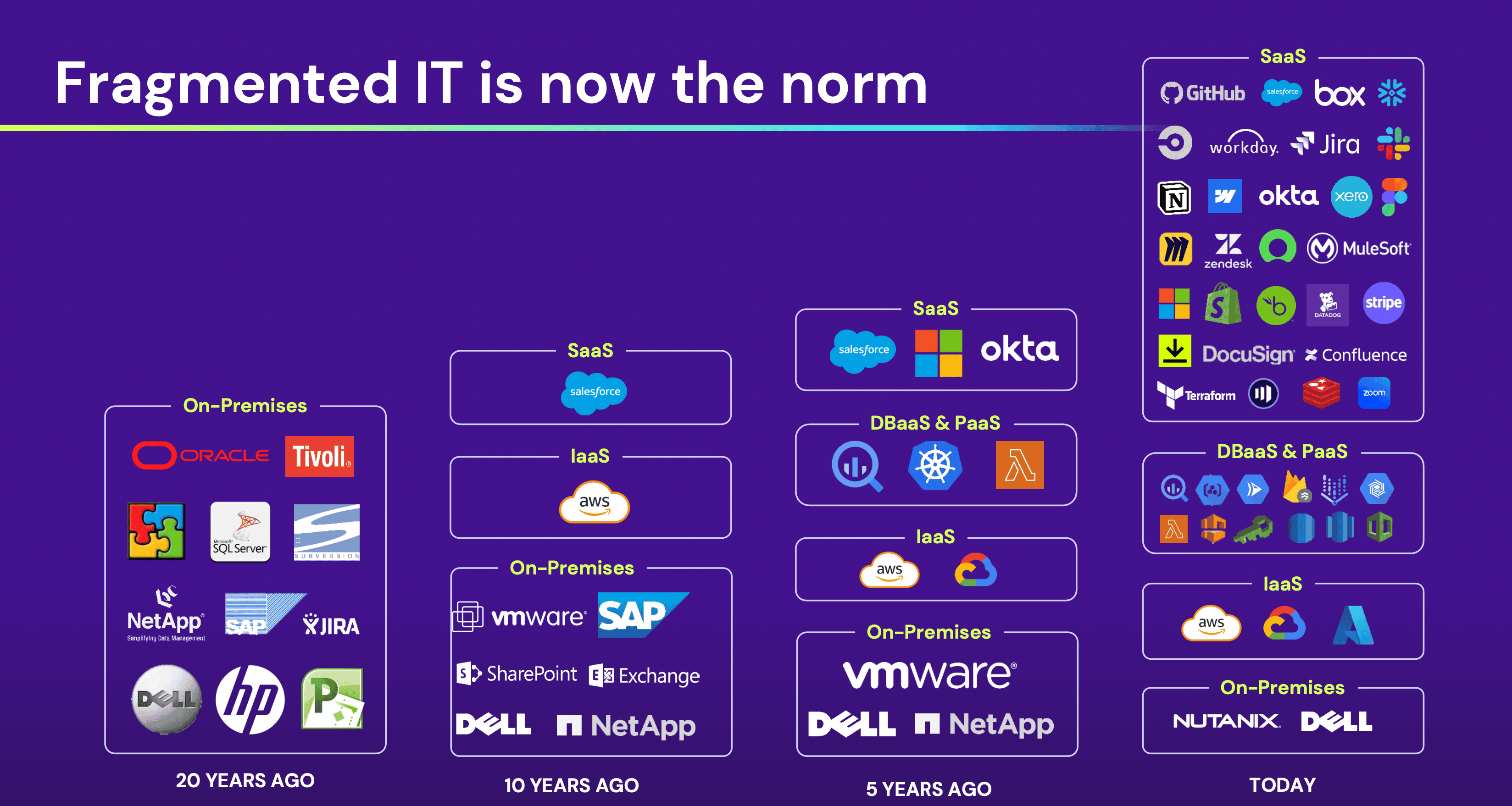
The HYCU State of SaaS Data Resilience 2024 report, which we covered in a March 2025 podcast (embedded below), highlights that over 35,000 SaaS applications exist today, with businesses typically underestimating their use by a ratio of 10:1.
Consider those statistics for a moment. Most businesses are using critical SaaS applications of which senior management is unaware. SaaS vendors do not generally implement a granular data recovery process for their customers. As a result, there are critical applications in play that do not have sufficient data protection by the business, which could have existential implications for those organisations.
Weakest Link
Another important factor introduced by the complexity of modern IT systems is the risk of being attacked through a platform or tool that introduces a weakness into the overall protection strategy of a business.
To explain what this means, consider the process of identity and credentials management. Historically, on-premises businesses typically used solutions such as Active Directory or LDAP. In the public cloud, each platform vendor has a unique identity management solution that operates in subtly different ways. Microsoft uses Entra ID, which integrates with AD. AWS uses IAM. There are also many other solutions, such as Okta, or open-source examples, such as Keycloak.
When implementing a single identity management strategy, businesses may integrate many of the above-mentioned solutions together. Understanding the implications of a security model change across the enterprise therefore becomes challenging and open to exploitation, if permissions are assigned (for example) at too high a level in a SaaS platform with weak password management and are propagated back into an on-premises platform. These are the opportunities hackers look to exploit in sophisticated ransomware attacks.
R-Shield
HYCU R-Shield is an ethos and framework that brings together the existing data protection and recovery capabilities offered by HYCU R-Cloud into a solution which addresses three core aspects (shown in Figure 2):
- Always Protected – a resilient backup infrastructure with immutability.
- Always Watching – proactive anomaly detection and application discovery.
- Always Ready – recovery validation, granular recovery and resilience testing.
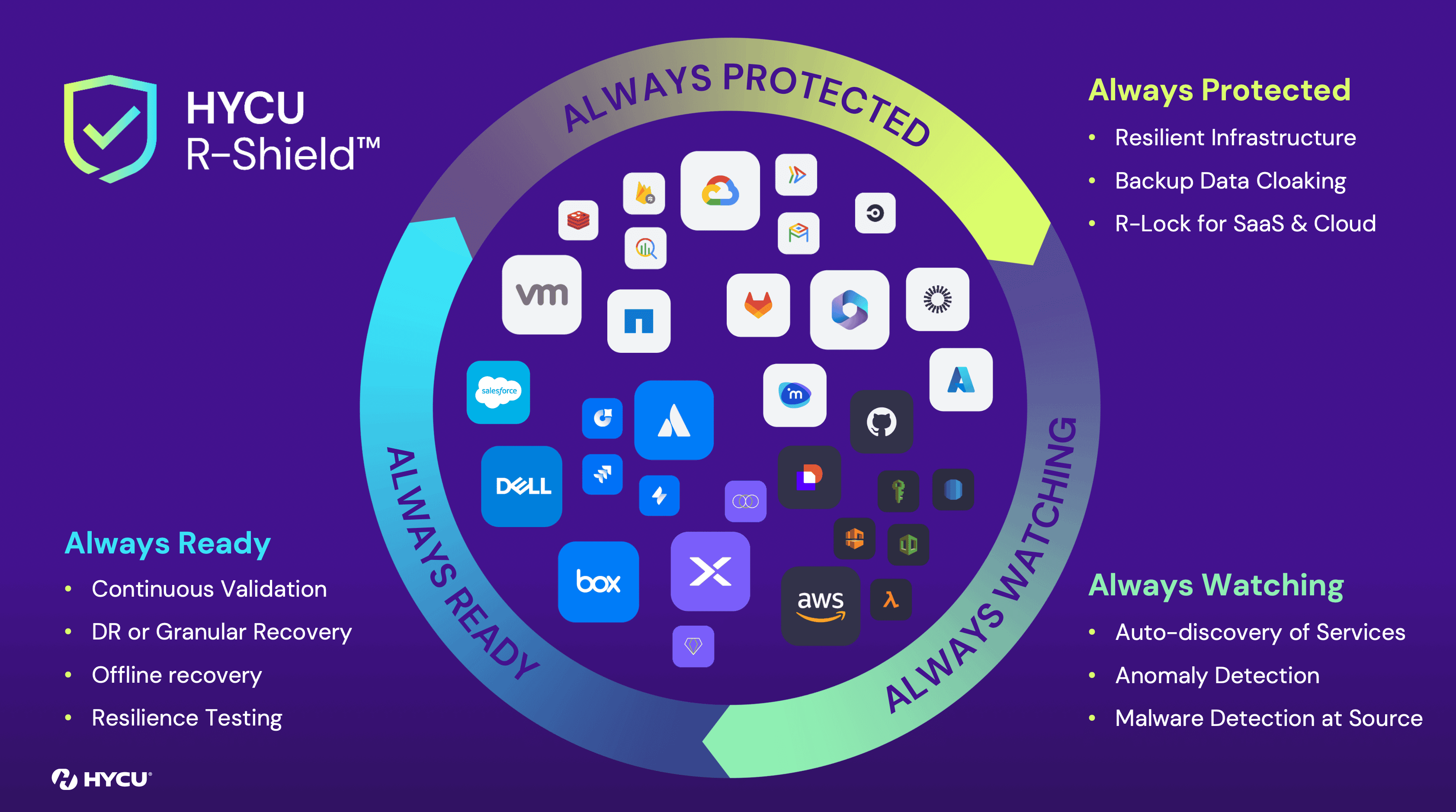
Data protection and recovery was always viewed as a reactive process; data was backed up until a restore was needed. However, with the severe threat of a ransomware attack, businesses can’t wait until an incident occurs. Instead, they must move onto a proactive stance, detecting potential issues early, mitigating them and ensuring that recovery is always possible.
R-Shield brings together solutions already offered by HYCU, such as its hardened Linux backup appliance, backup data cloaking, minimum level permissions and a dedicated backup network with no proxy servers, agents or gateways (all of which represent compromise opportunities for bad actors).
R-Lock defines the process for managing backup data, ensuring block-level immutability, customer-owned storage and isolated multi-tenancy. It is important to highlight that the customer owns their own primary and backup data in the HYCU architecture, which is different from many SaaS data protection vendors in the market.
Proactive
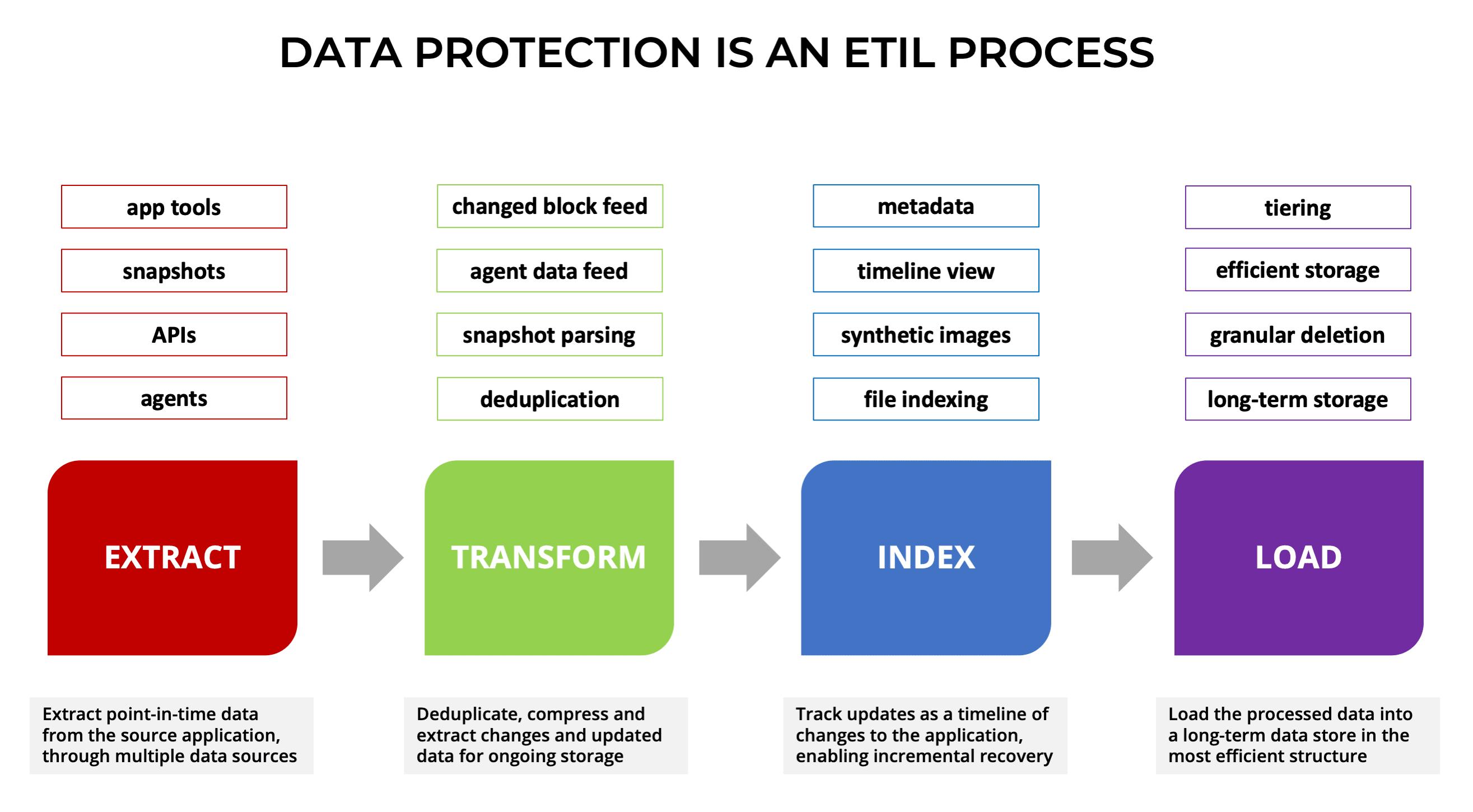
As we have already highlighted, modern data protection must be proactive in design. Within R-Shield, the HYCU platform moves the malware detection process closer to the source of data, for example, a virtual appliance running on AHV or VMware ESXi. This distinction is important as it provides customers earlier warning of a possible issue, before the data has been moved offsite and assimilated into existing secondary data.
In our “ETIL” model (Figure 3), this task takes place during the “extract” phase, when the customer data is still on-site or within an existing public cloud environment, for example.
Offline
Finally, we should highlight the ability of the HYCU platform to perform recovery of data from snapshots, that can also be used to implement offline data recovery. Ultimately, the single premise of any data protection solution is the timely recovery from loss, which must include the ability to restore data quickly, even in the event of a wider platform outage.
The Architect’s View®
As we wrote in February 2024, data protection continues to evolve, as both the platforms being protected change and the risk of ransomware attacks increases. Data protection is Darwinian, with hackers constantly looking for new opportunities to steal information for financial gain, while platform and application developers continue to close loopholes.
The data protection vendors must also evolve their solutions, addressing the changes in a rapidly changing ecosystem. However, simply having a portfolio of products isn’t enough for today’s demanding computing ecosystems. These individual components must be created to work together in a holistic fashion that ensures no data is left out of protection, no data goes unidentified, and all data can be restored in a timely fashion with absolute assurance.
With R-Shield, HYCU has placed a framework around data protection that can be expanded and improved with further products and solutions. Its SaaS protection capability is unique in the market, particularly the R-Scout approach that enables any SaaS vendor to directly integrate into R-Cloud (see our review from February 2024).
We would like to see the R-Shield framework extended with, for example, cleanroom capabilities and the functionality to take proactive backups based on alerts and notifications from SIEM/SOAR platforms. This should also include integration with storage vendors to take hardware-based snapshots where appropriate.
The future measure of success for R-Shield will be the continued expansion of features and capabilities – a measure we extend to any data protection vendor. Building a defined framework is a good start and we look forward to documenting how the R-Shield ethos develops.
Related Content
- Commentary: Data Protection – Evolve or Die
- Ransomware is a Darwinian Problem That Will Never Be Solved
- Research Note: HYCU extends SaaS Integration with R-Scout and Generative AI
Copyright (c) 2007-2025 – Post #0cc3 – Brookend Ltd, first published on https://www.architecting.it/blog, do not reproduce without permission.