

Intel Corporation has announced financial data for the fourth quarter and the full year FY2024. Overall, the data looks disappointing, with a 2.1% annual decline in revenue and 7.2% decline in the Foundry business (which lost almost $7 billion over the year). Much of the poor performance was attributed to Q3 FY2024, so could we see changes on the horizon?
Background
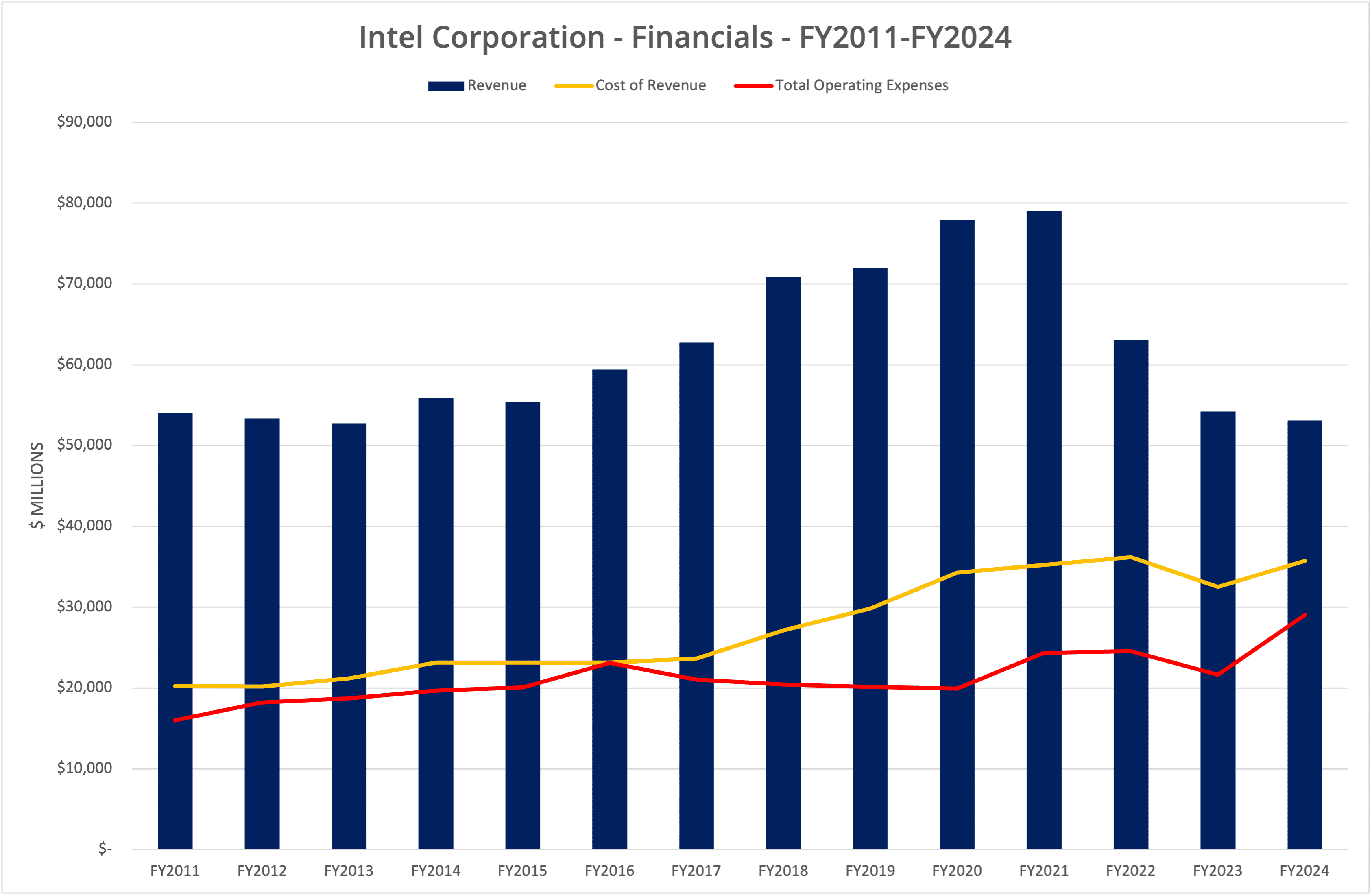
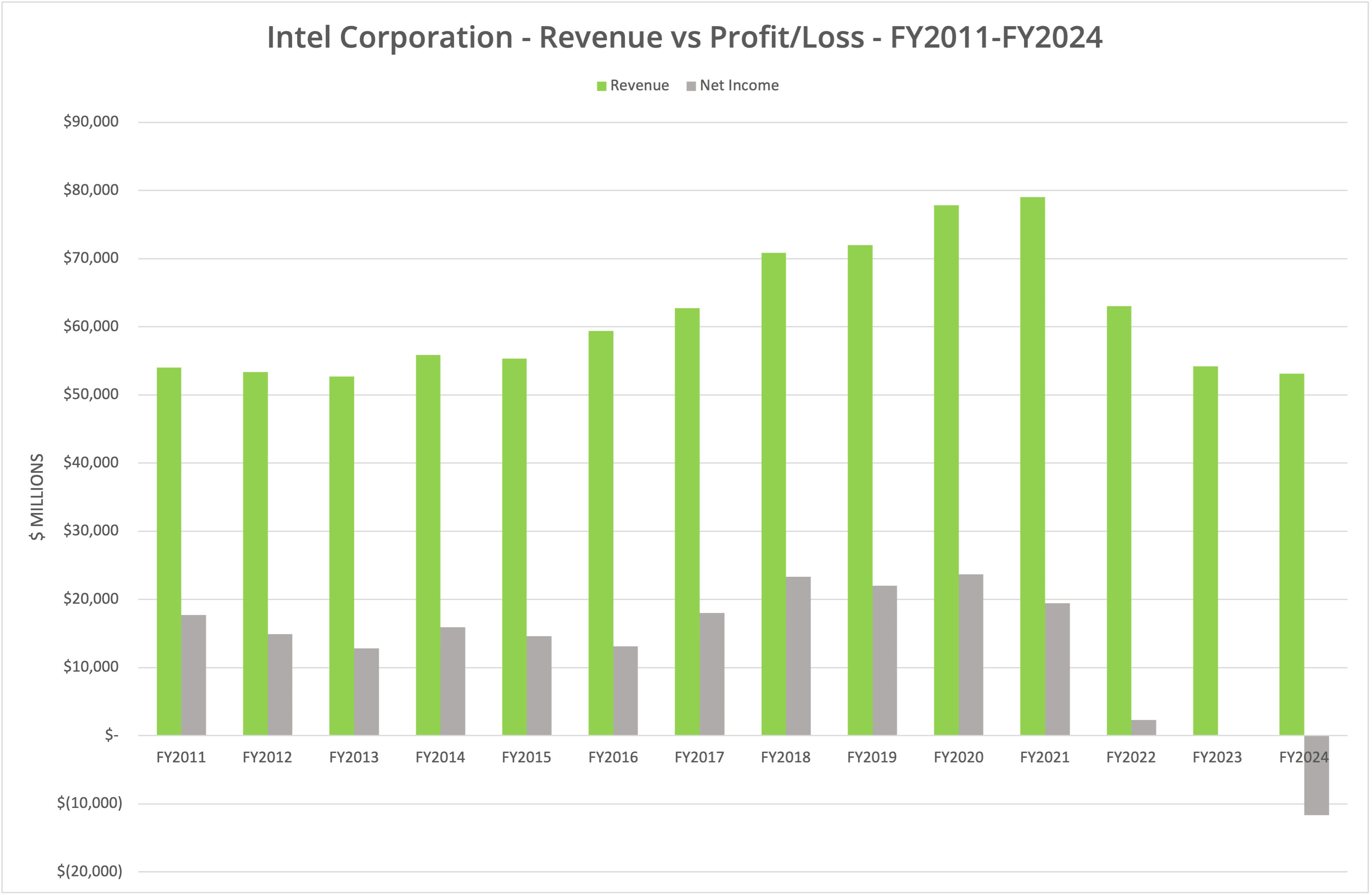
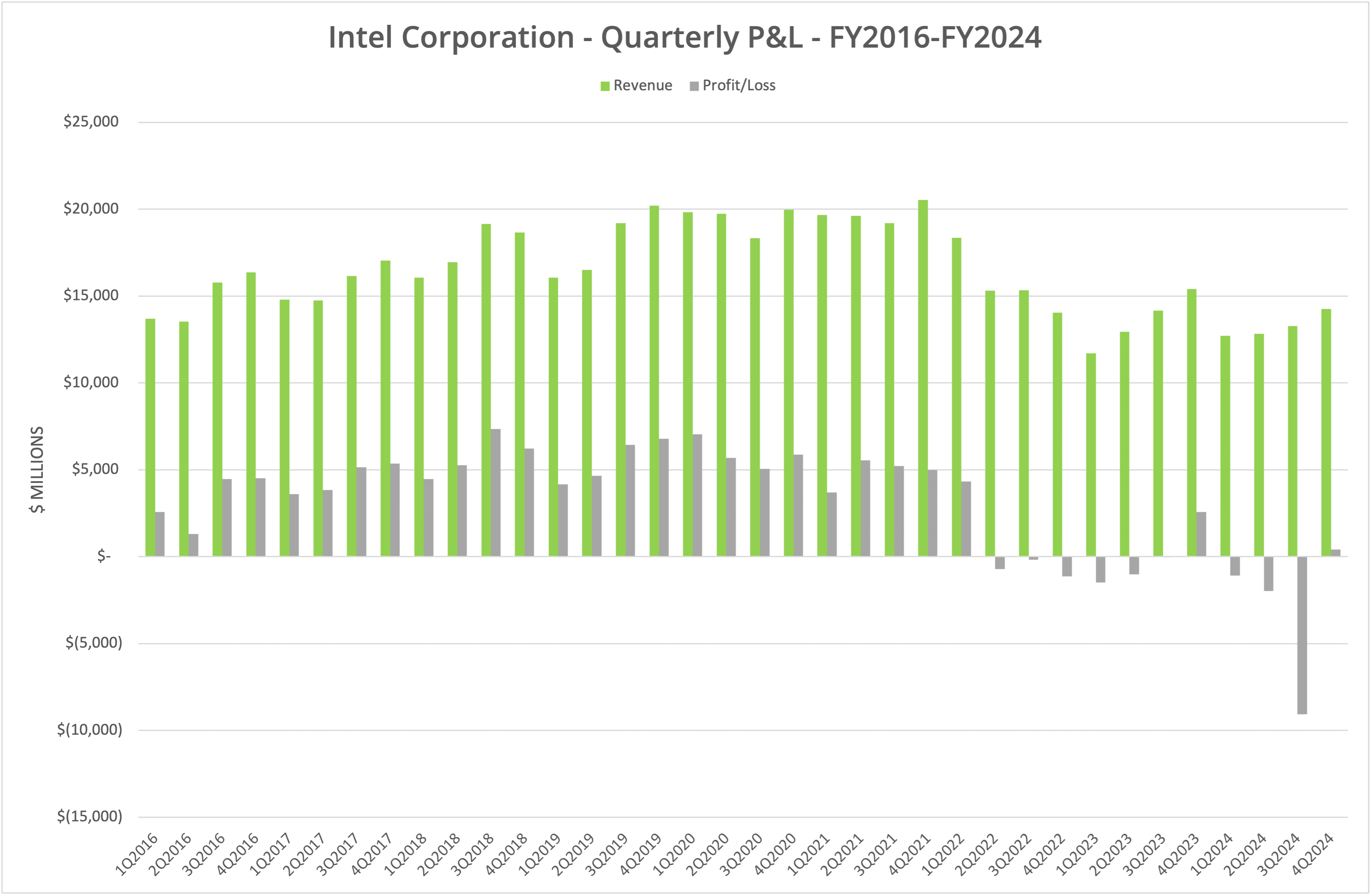
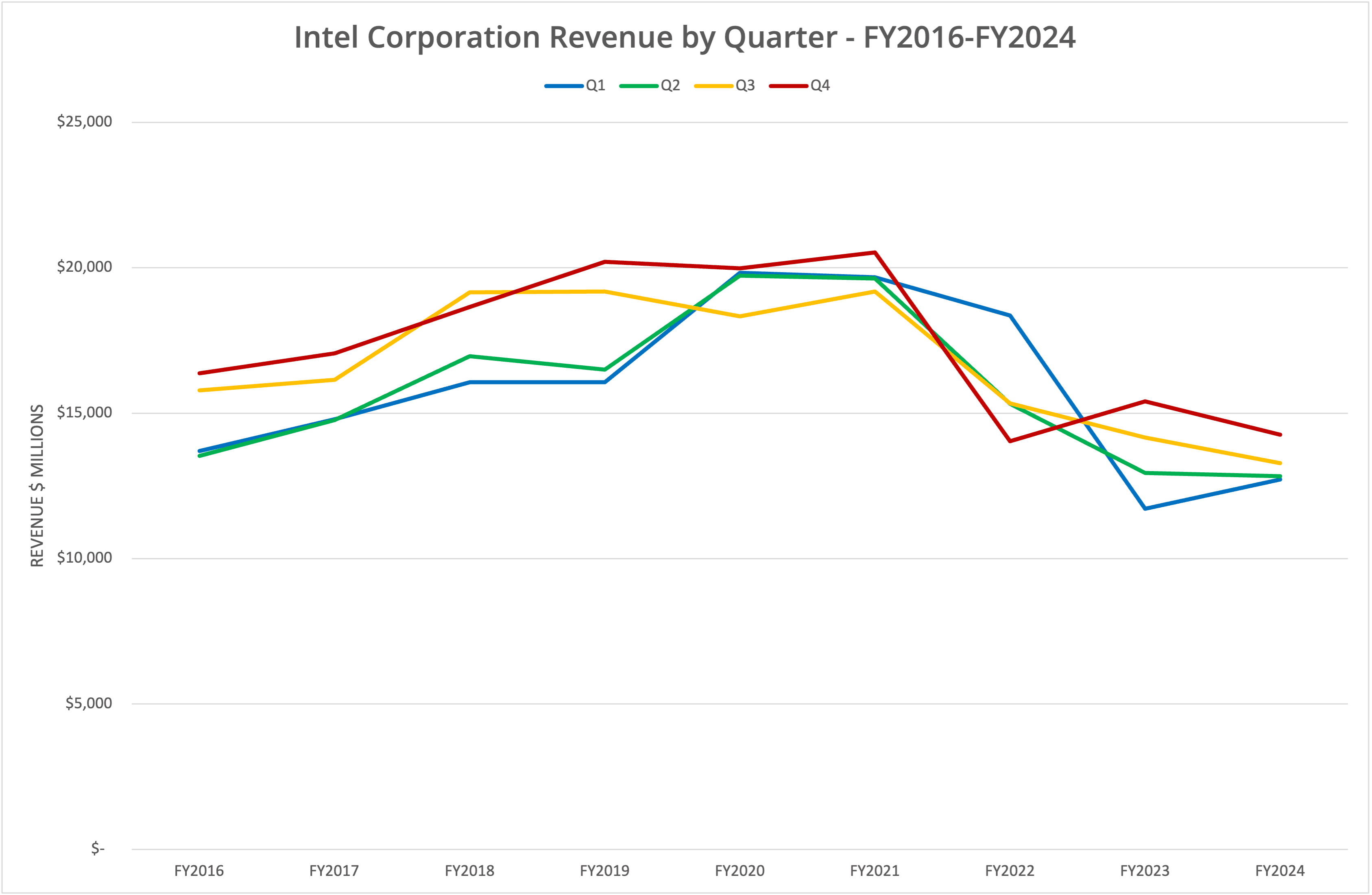
Intel Corporation announced financial results for Q4 FY2024 and the full financial year FY2024, for the period ending 28 December 2024, on 30 January 2025. Revenue for the full year FY2024 was $53.1 billion, down 2.1% on the previous year. For the quarter, revenue was $14.3 billion, down 7.4% on Q4 FY2023. Intel managed to declare a small profit in Q4 ($412 million). However, the company declared an annual loss for FY2024 of $11.7 billion, most of which was assigned to Q3 FY2024.
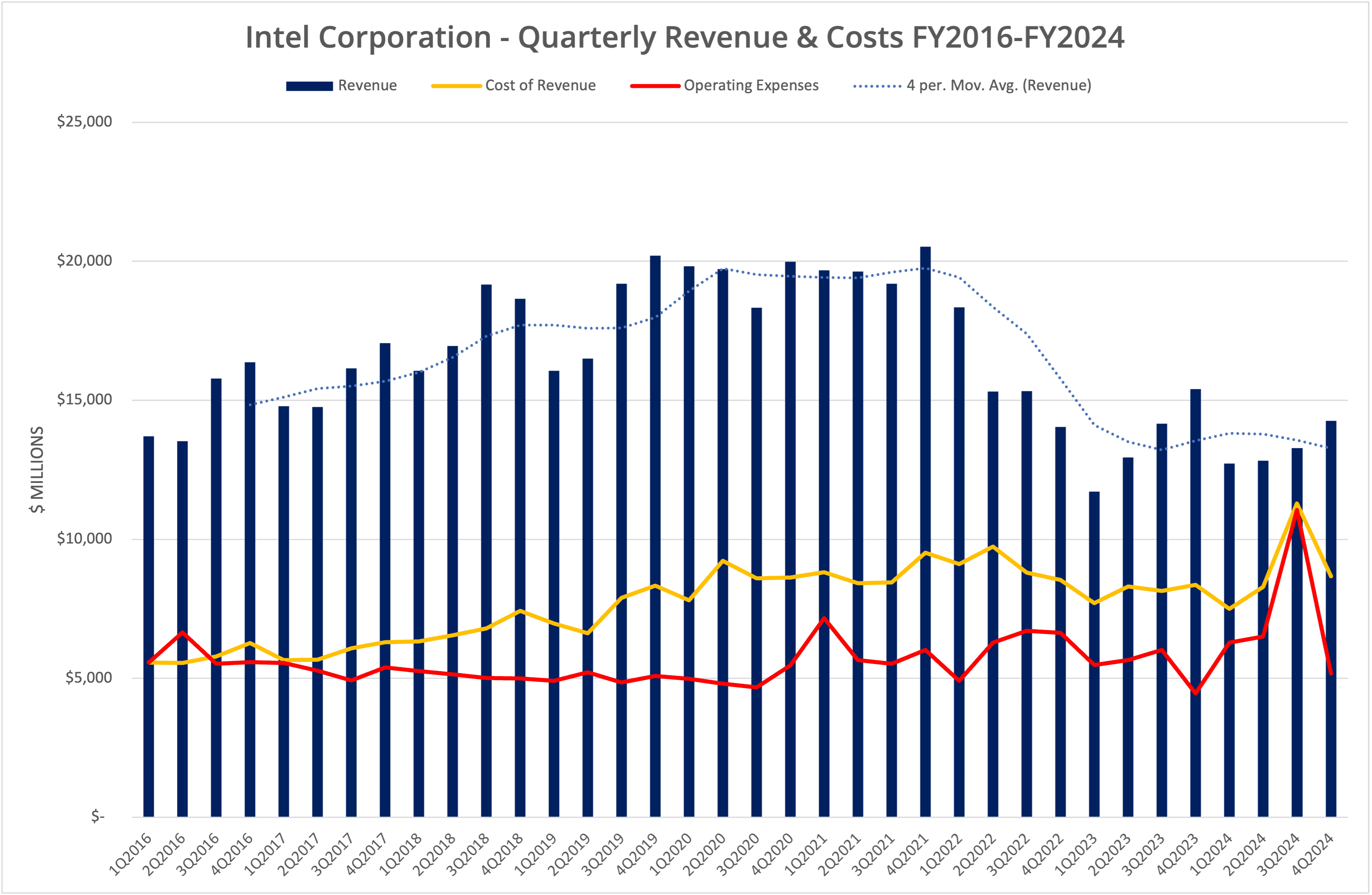
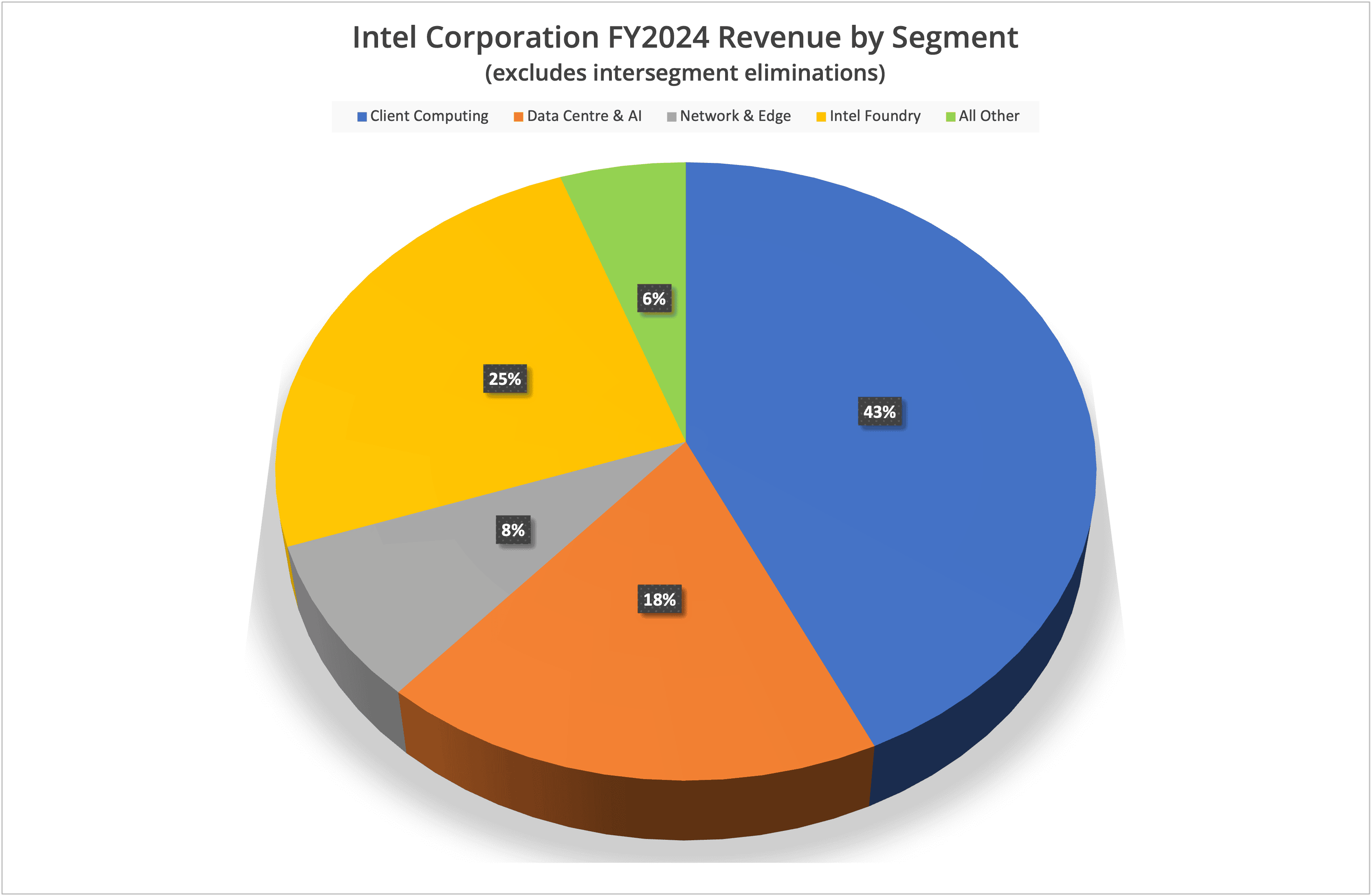
We present the data in 6 graphs, labelled Figures 1 to 6.
Divisions
Looking at the revenue details, we see that most business units delivered lacklustre performance. Client Computing was up 3.5%, Data Centre & AI was up only 1.4%, while Network and Edge was up 1.2% (2.7% for Products in total). For the Foundry business, revenue declined 7.2%, with a $7 billion loss ($13.4 billion loss in FY2023).
As Intel has restated income due to the restructuring of the business to both separate off non-reportable segments (such as Altera) and the Foundry business, it is now impossible to present any detailed breakdown by division with a historical time view. What is clear, though, is that the Foundry business unit continues to lose money, while everywhere else appears to be in “maintenance mode”, just ticking along on idle.
AI
In normal times, the lack of significant growth may not be seen as a problem. Unfortunately, we do not currently live in normal times but in the bubble that is Generative AI. Businesses such as NVIDIA have seen stratospheric growth in revenue and valuations, driven by the sale of high-performance GPUs.
This is an area Intel has failed to exploit, not reaching a conservative $500 million sales target for Gaudi GPUs in 2024. By comparison, AMD claimed approximately $5 billion in Instinct GPU sales, while NVIDIA recorded FY2025 revenue for its Data Centre category of $115.2 billion.
Leadership
Of course, we know that Intel is in a state of flux, Pat Gelsinger having departed as CEO to be replaced by Lip-Bu Tan on 18 March 2025. Tan has a long history in the semiconductor industry, moving over from nuclear engineering and running Cadence Design Systems, Inc. for fifteen years.
At Intel Vision 2025, Tan presented the keynote address, which felt more like a resume review than specific set of goals for the company. It is, of course, early days for his tenure, so the keynote was focused on personal business strategy and beliefs. Exactly how the new leadership style will play out is yet to be seen.
The Architect’s View®
The Q4 and full year FY2024 data shows Intel in a holding position, as the leadership transition unfolds. Embedding a new culture into Intel will take time, a luxury the company arguably does not have. Intel is being attacked from all sides and already being beaten into second or third place by superior products.
The next 24 months will be critical to the survival of the company, which we expect to be significantly transformed under Tan’s leadership. Exactly what that means, we will cover in a separate Commentary post.
Copyright (c) 2007-2025 – Post #755c – Brookend Ltd, first published on https://www.architecting.it/blog, do not reproduce without permission.