

Arm Holdings PLC has announced Q3 FY2025 financial data, with another record quarter. Year-on-year revenue increased by 19.3% to $983 million, with further announcements in Q3 that indicate continued growth in the business.
Background
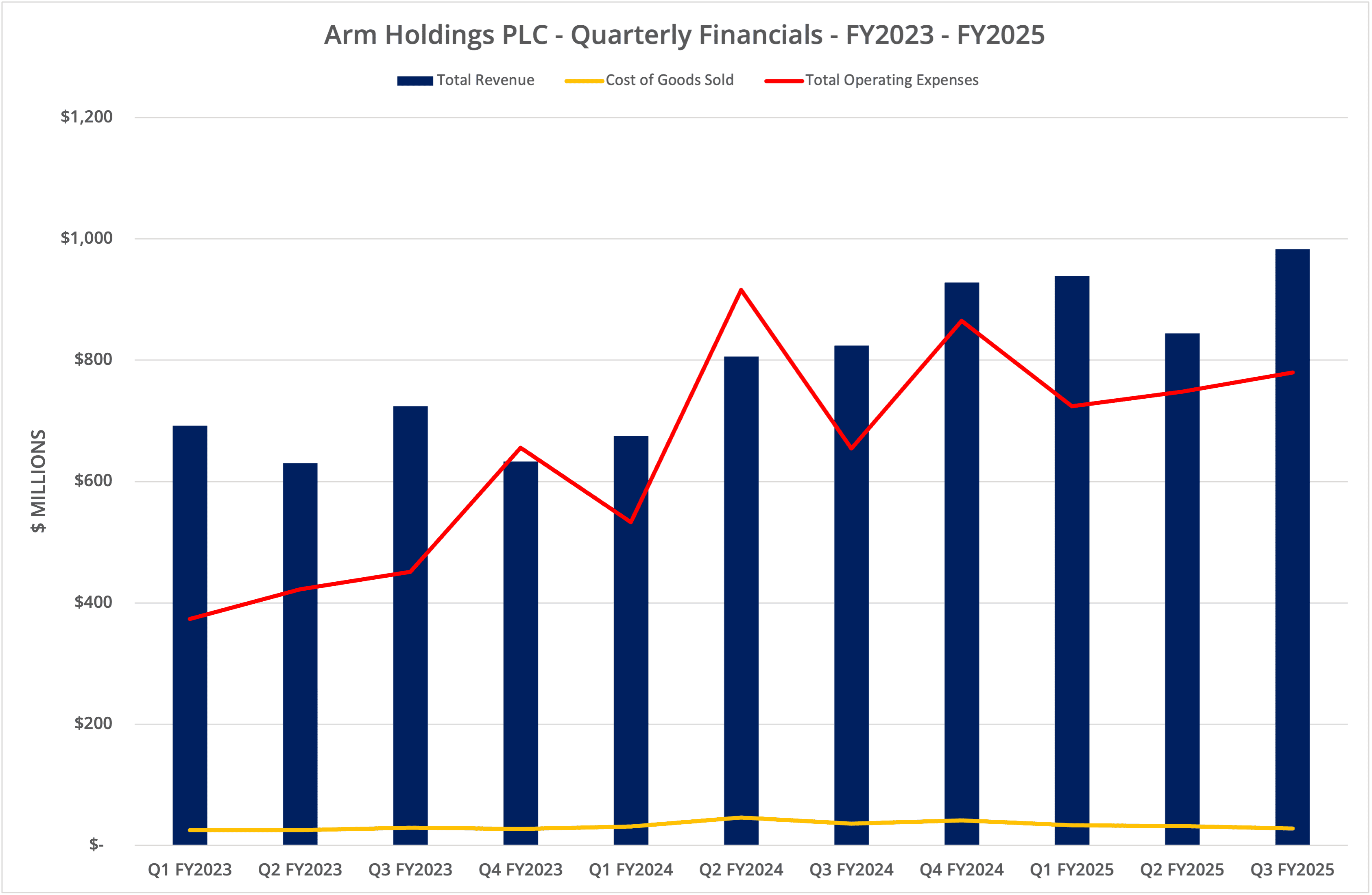
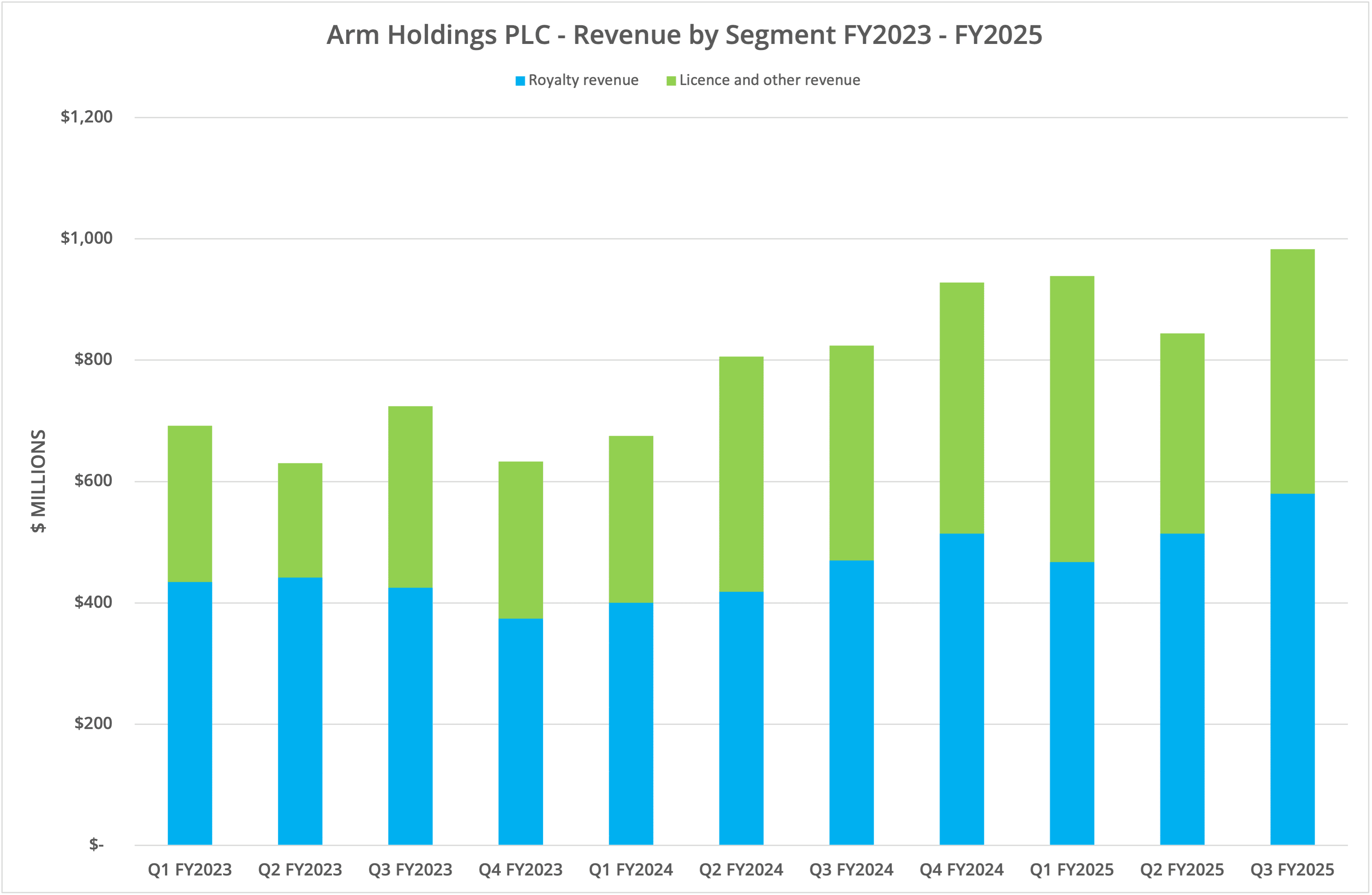
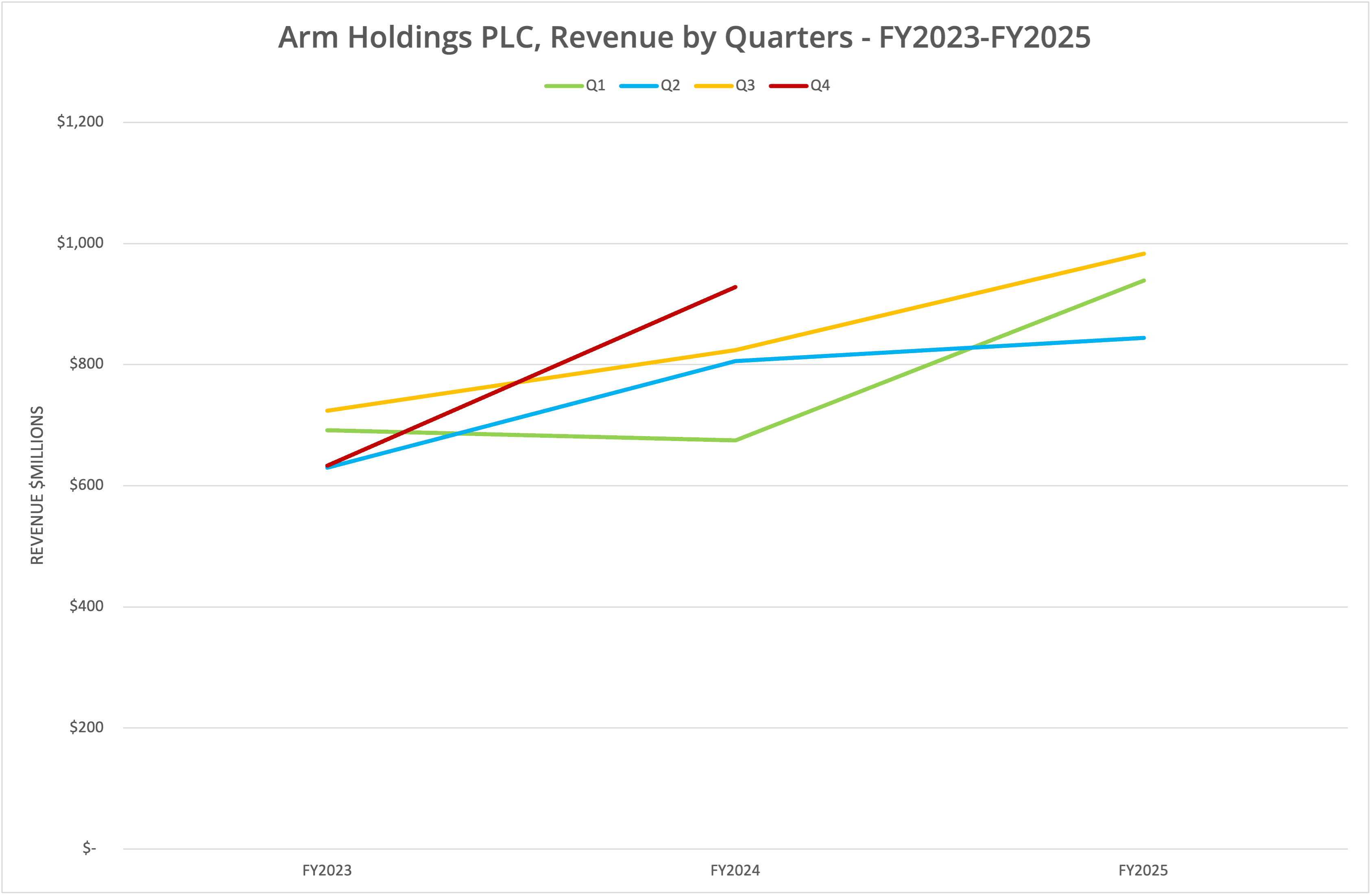
Arm Holdings PLC reported financial data for Q3 FY2025 (the period ending 31 December 2024) on 5 February 2025. Total revenue for the period increased by 19.3% compared to Q3 FY2024, with an increase sequentially of 16.5% over Q2 FY2025. The greatest increase in revenue came from the Royalty segment, up 23.4% over the year. The company declared a profit of $175 million for the quarter.
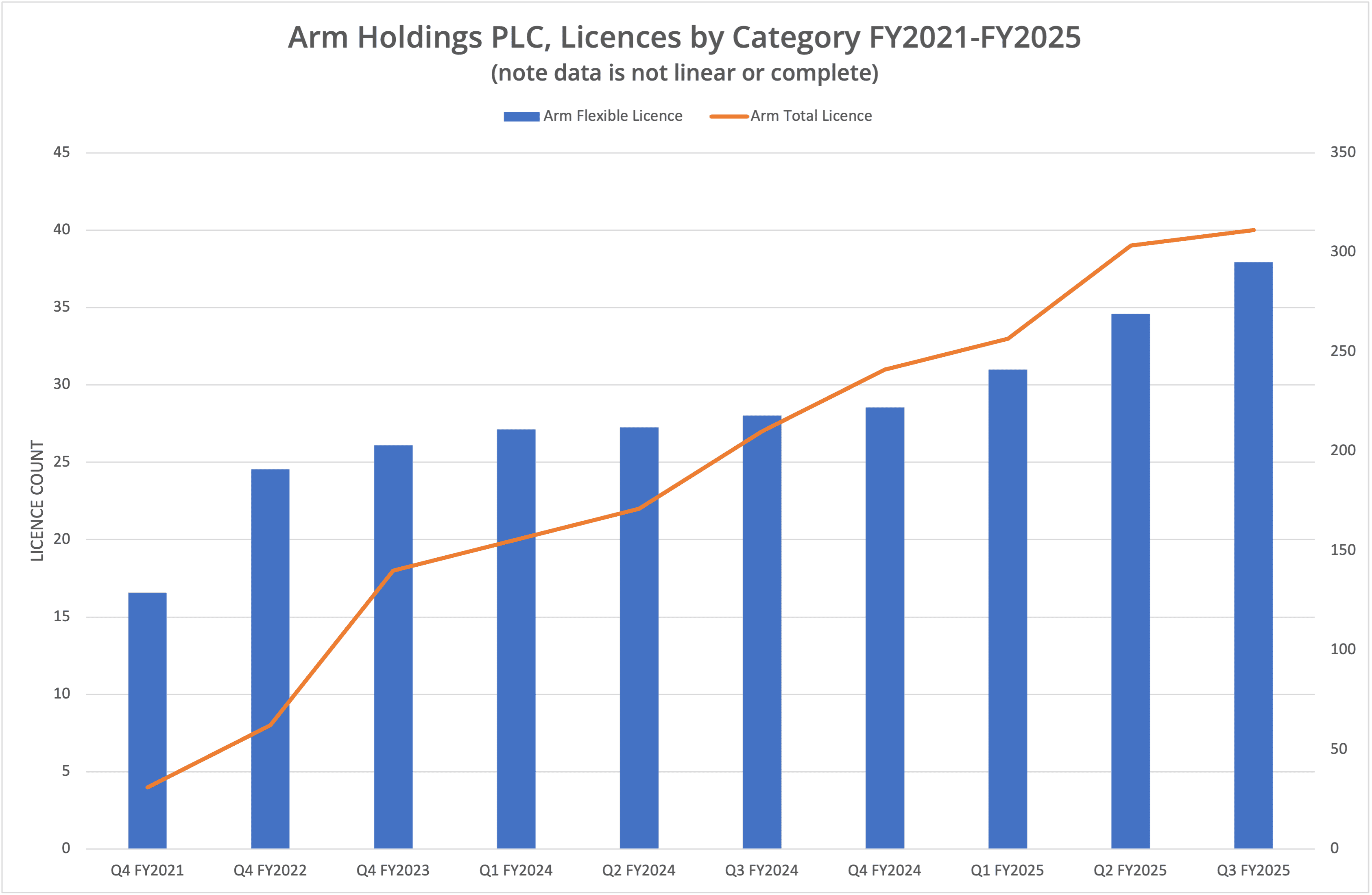
We present the data in four graphs labelled Figures 1 to 4.
AI
Once again, Arm demonstrates growth in its business, with a primary focus on the benefits of the Arm architecture for AI. During the period, the company announced “Project DIGITS” with NVIDIA, which was unveiled at GTC 2025 as the small form-factor workstation DGX Spark. This desktop machine is rated for 1000 TOPS, with 128GB of system memory and a combination of NVIDIA Grace Blackwell and Arm Cortex cores.
Parent company SoftBank announced up to $500 billion of investment in the “Stargate” project, with Arm expected to provide the core CPU capabilities. Elsewhere, Arm partnered with Open AI to develop a platform called “Cristal Intelligence”, aimed at providing the infrastructure for an expected growing market in AI agents.
Enterprise
As we reported in the previous quarter, Microsoft announced Cobalt 100 Arm-based virtual instances for Azure, while Google announced Axion, which is also based on Arm cores. Both of these platforms are now in General Availability. Arm now claims that more than 50% of new AWS CPU capacity is based on the Graviton processor, with 90% of AWS top 1000 customers using Graviton instances.
As reported in the Financial Times, Arm is developing its own hardware, which will be manufactured by TSMC. The first customer for the new products is expected to be Meta.
Headcount in Arm continues to grow, we believe, due both to the focus on custom hardware and the growth of pre-certified CSS solutions. Around 83% of employees are now classed as engineers.
The Architect’s View®
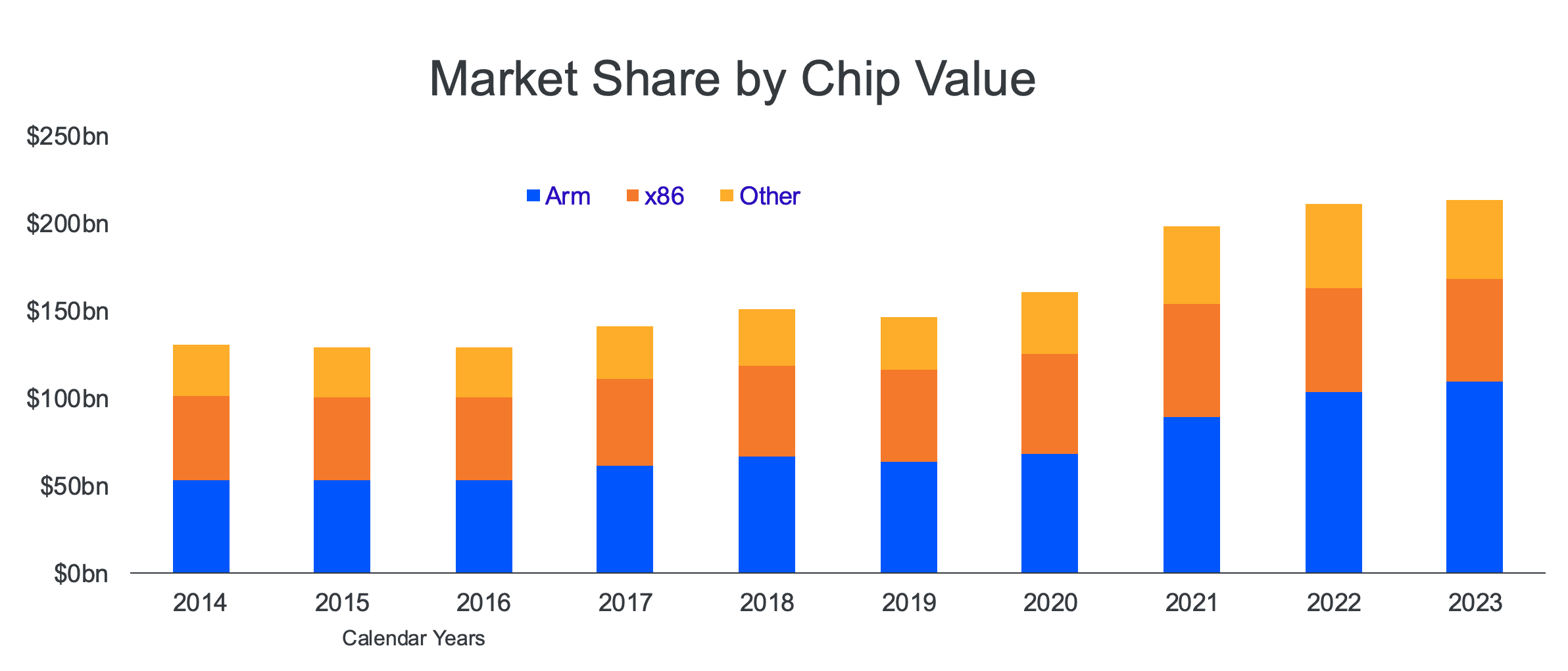
As Figure 5 implies (Arm data, not ours), Arm continues to gain market share compared to x86 and other architectures. This is a trend we expect to see grow further, as an increasing volume of computing workload and investment moves over to AI.
The partnership with Meta heralds a change in direction for Arm, which had previously only offered processor designs and not physical products. With an announcement expected in the summer of 2025, Arm could be in a position to offer data centre hardware, an opportunity we’ve been discussing for years.
Other than a few niche vendors, none of the major integrators has decided to design and build Arm-based servers, presumably out of the risk of alienating Intel and AMD. Choosing to licence Arm and build custom processors would be seen as a decisive move against x86. However, if Arm produces the hardware, then Dell, HPE, Supermicro and others can claim they are simply offering customers choice from the available hardware components on the market.
While Arm continues to have dominance in markets such as mobile, the next TAM expansion opportunity is to exploit the growth in AI. Specifically, this is likely to mean a greater focus on AI agents and IoT, rather than in the data centre (although that is also surely a growth market).
As the competition in the data centre focuses on computing (and power density), we see the edge and inference AI as a market that needs to deliver low power consumption and efficiency. Arm seems well-placed to take advantage of that trend, which we think will be delivered through chiplet and aggregated solutions rather than single monolithic architectures such as x86.
We continue to believe Arm has significant future opportunities for growth and will further expand its share in the processor market.
Copyright (c) 2007-2025 – Post #ebeb – Brookend Limited, first published on https://www.architecting.it/blog, do not reproduce without permission.