

Pure Storage used its recent Accelerate event in London to announce file system enhancements to Purity (the storage O/S), focused on dynamic and real-time application requirements. This includes a new FlashBlade//S100 model for edge and smaller data centres.
Background
Pure Storage has announced a set of enhanced features for the FlashBlade and FlashArray families of storage solutions. “Real-time Enterprise File” describes a set of updates designed to address the needs of modern file serving platforms, while at the same time enhancing the capability and filling the gaps in Purity compared to Pure’s competitors.
Enterprise Features
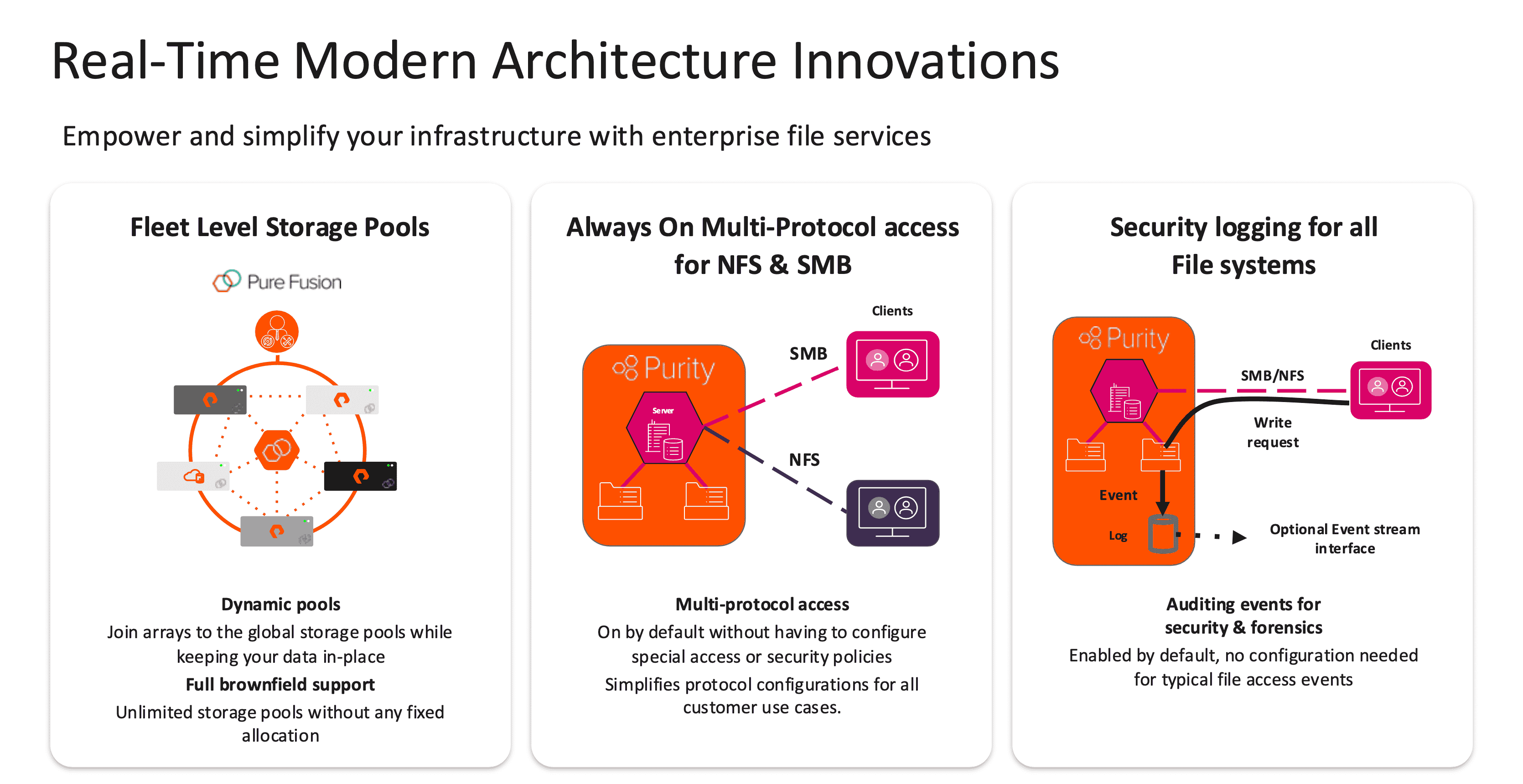
Purity for FlashBlade and FlashArray has been updated with new features that collectively are being marketed as “real-time enterprise file”. Specifically, these are:
- Global Storage Pools for Files – across FlashBlade and FlashArray, multiple systems will act as a single logical pool of storage for file content.
- Multi-protocol NFS and SMB – simultaneous access to data using either SMB or NFS file protocols.
- Enhanced security logging – additional log-based data for tracking and analysing data access on Purity (FlashBlade and FlashArray) systems.
- Quality of Service – QoS for multi-tenant environments with no access blocking.
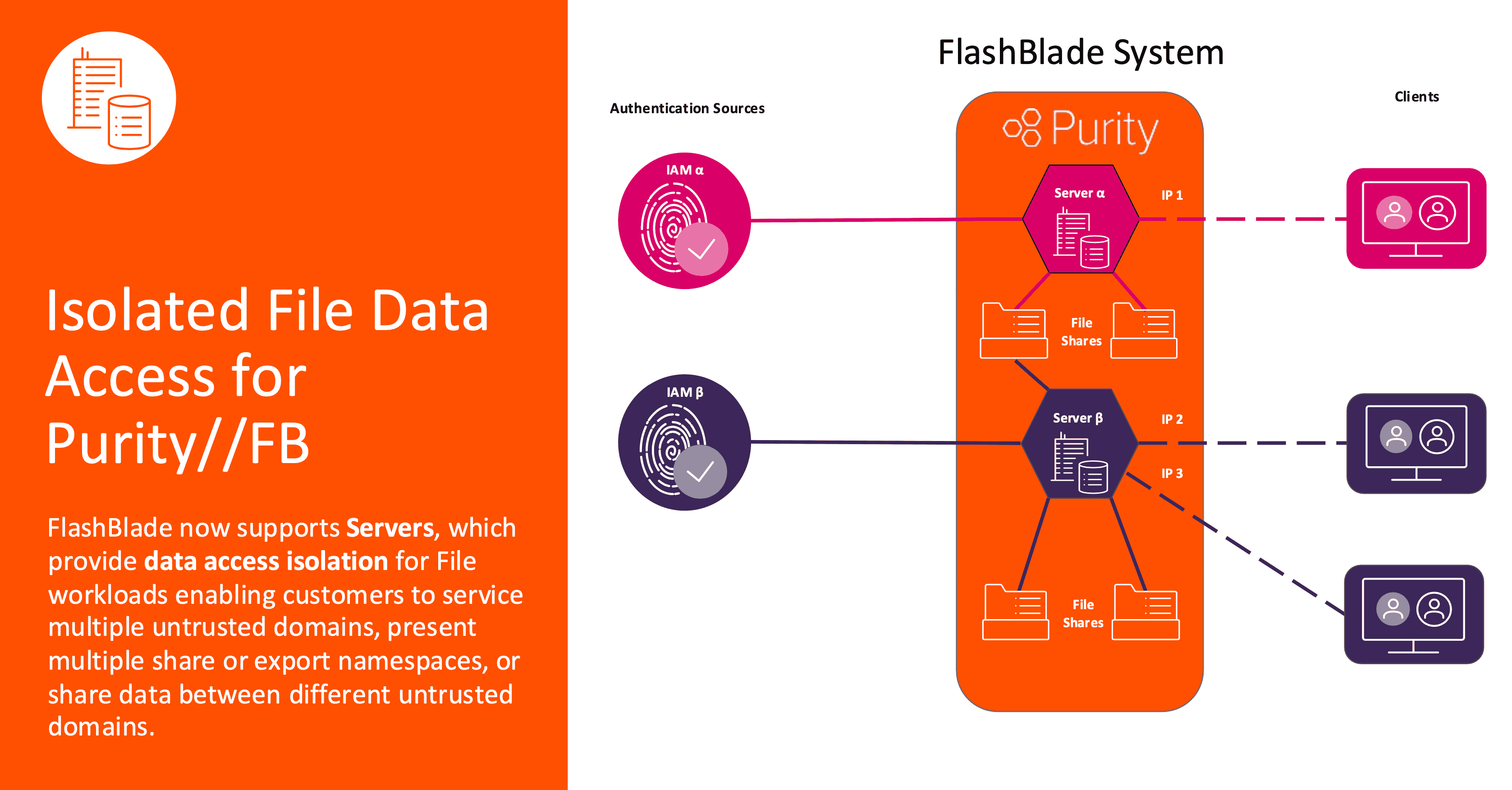
- Isolated File Access – multiple domains for file access on FlashBlade systems.
- Zero-Move Tiering – logical tiering of resources without the need to physically move data.
While individually, these enhancements don’t appear to be uniquely radical, each improves the depth of the file protocol offerings of FlashBlade and FlashArray. Certain features are clearly aimed at gaining parity with the competition, for instance, multi-protocol access using NFS and SMB, which has been a core tenet of the NetApp platform for decades. Similarly, the isolated file access option is reminiscent of storage virtual machines (SVMs) in ONTAP. Others, such as zero-move tiering, play to the strength of the Purity operating system and are more differentiated, as is the capability for globally pooling storage resources (more on this in a moment).
FlashBlade//S100
The new FlashBlade//S100 is an interesting option, offering a slightly smaller configuration than the existing S200 and S500 systems which were launched in June 2022 (see our coverage here). The S100 will start at 126TB of capacity, using seven computing blades and one 18TB DFM per blade (although at launch this will be 37TB DFMs). Systems will scale up to 40 DFMs in a 10-blade system and total capacity of 3PB.
It’s not clear exactly how the S100 differs from the S200 or S500 in any technical capacity, other than supporting 18TB DFMs as the entry point, compared to the 24TB drives in the S200/S500 at launch. These systems are, of course, running QLC media, so that doesn’t qualify as a difference. This could simply be about marketing.
The Architect’s View®
The introduction of FlashBlade//S100 looks to be a strategy of expanding the TAM (total available market) for Pure’s hardware solutions. This move is a regularly used playbook, which has seen new products, including FlashArray//XL, FlashArray//C, FlashArray//E, FlashBlade//E and, of course, FlashBlade//S all come to market in recent years. The gradual transformation towards standardised DFMs across both FlashBlade and FlashArray families makes the interchangeability of components easy to achieve, including the associated cost savings.
The file system enhancements are a more interesting discussion. At introduction, the file protocol features of Purity (on both hardware platforms) could undoubtedly compete with the majority of customer requirements, compared to the likes of NetApp with ONTAP and Dell with Isilon (now PowerScale). Arguably, Pure Storage improved over the shortcomings of Isilon and ONTAP platforms with a bespoke scale-out design that is naturally self-balancing.
However, when it comes to storage operating system features, ONTAP and OneFS have the experience of many years of development. ONTAP is over 30 years old, whereas OneFS is over 20 years old. As a result, Pure Storage now needs to fill the gaps in product maturity that will be expected by advanced file storage users. Looking at the features announced at Accelerate, that is precisely what is occurring.
Of course, Pure’s competition isn’t standing still, with new hardware solutions from NetApp, for example, and an entirely new architecture from VAST Data. There are also some interesting contenders, like Qumulo and WEKA, both targeting specific areas of customer need such as the public cloud and high performance.
One final thought; Pure Storage is developing platforms of hardware that logically span the physical deployment of infrastructure. Over time, we see this as a strong differentiator from other vendors and a key driver of a “private cloud” experience. There is possibly a “bigger picture” story here, with a desire to sell to cloud service providers across the market. Cracking that market could represent a huge payday for the company and its shareholders.
Related Content
Copyright (c) 2007-2024 – Post #ac39 – Brookend Ltd, first published on https://www.architecting.it/blog, do not reproduce without permission.