

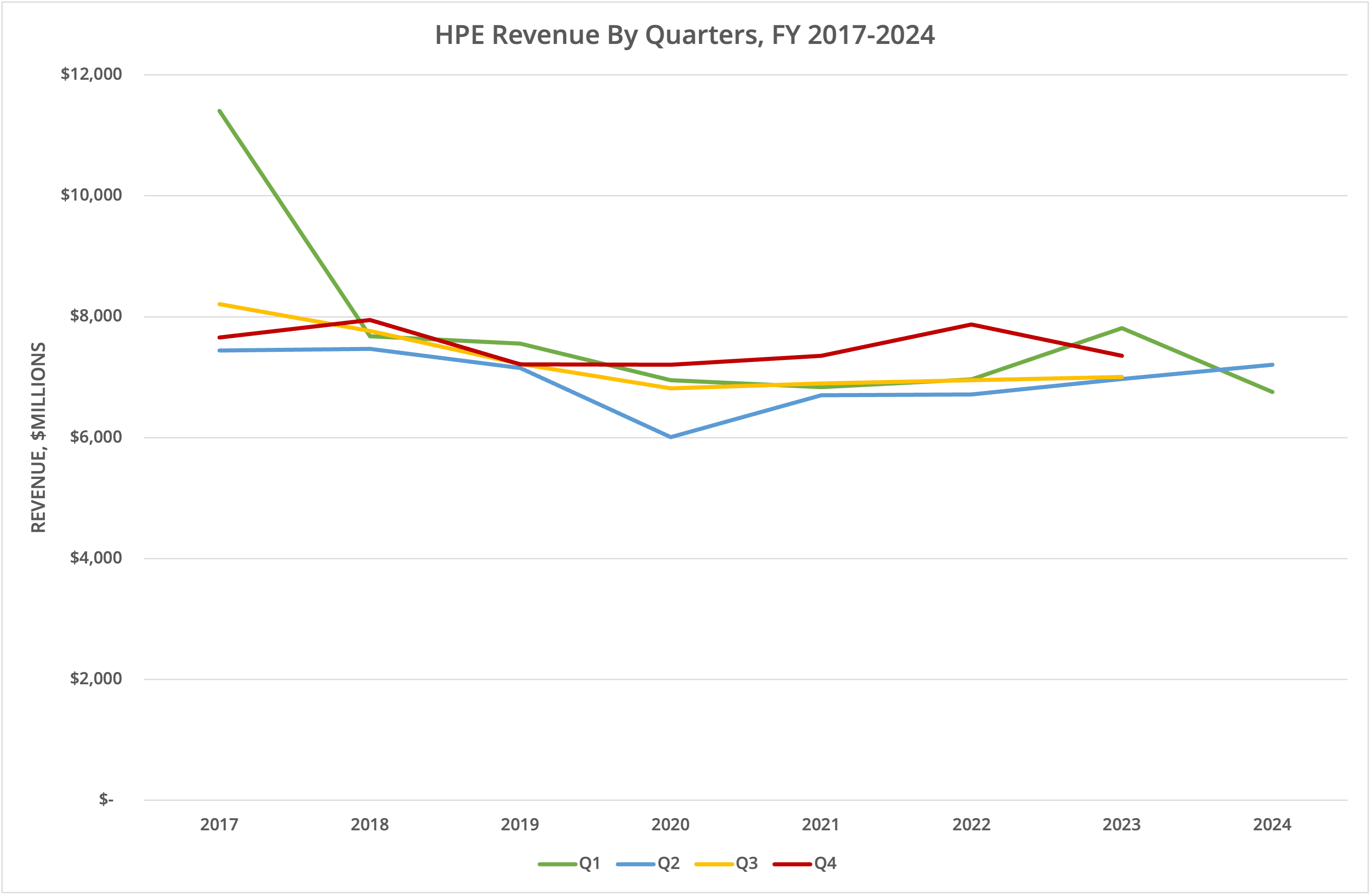
HPE, Inc. has announced Q2 FY2024 financial results that show a year-on-year revenue increase of 3.3% but significant variance by business unit. The new Server reporting segment increased revenues by 18% at $3.9 billion, while Intelligent Edge was down 19% at $1.1 billion and Hybrid Cloud was down 8% at $1.3 billion, year-on-year. Sales of AI-enabled servers clearly saved HPE’s quarter.
Background
HPE, Inc. reported Q2 FY2024 revenue of $7.2 billion, 3.3% up on the same quarter in FY2023. The results were bolstered by an 18% rise in revenue for the Server segment, which brought in $3.9 billion. Hybrid Cloud, which now encompasses storage sales, was down 8% at $1.3 billion and Intelligent Edge was down 19% at $1.1 billion.
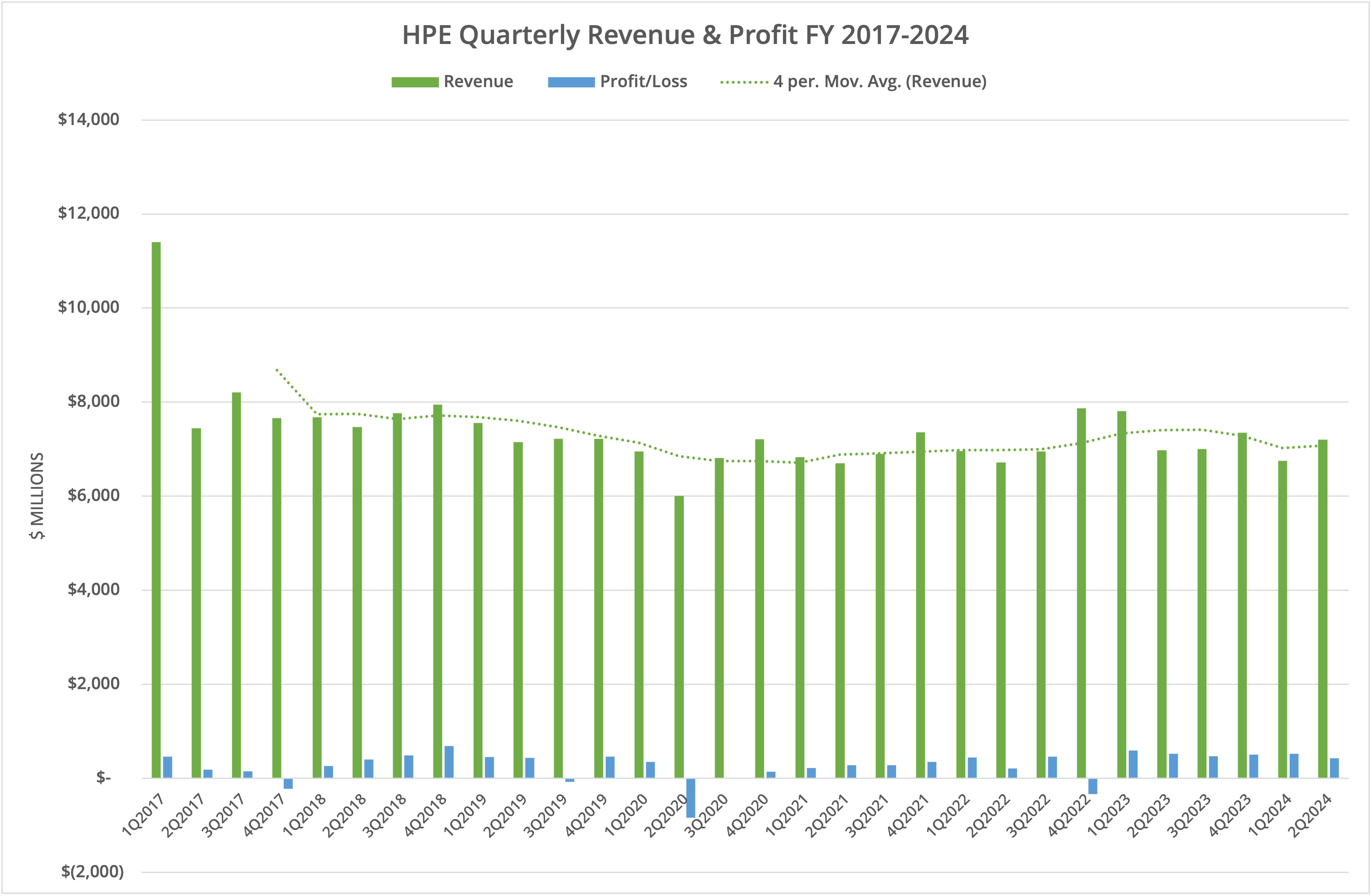
It’s interesting to note that overall gross margin declined to 33% (was 36% the previous year). By division operating profit declined; Server was down to 11% from 14.4%, Intelligent Edge down from 24.7% to 21.8% and Hybrid Cloud was down from 1.9% to only 0.8%.
AI
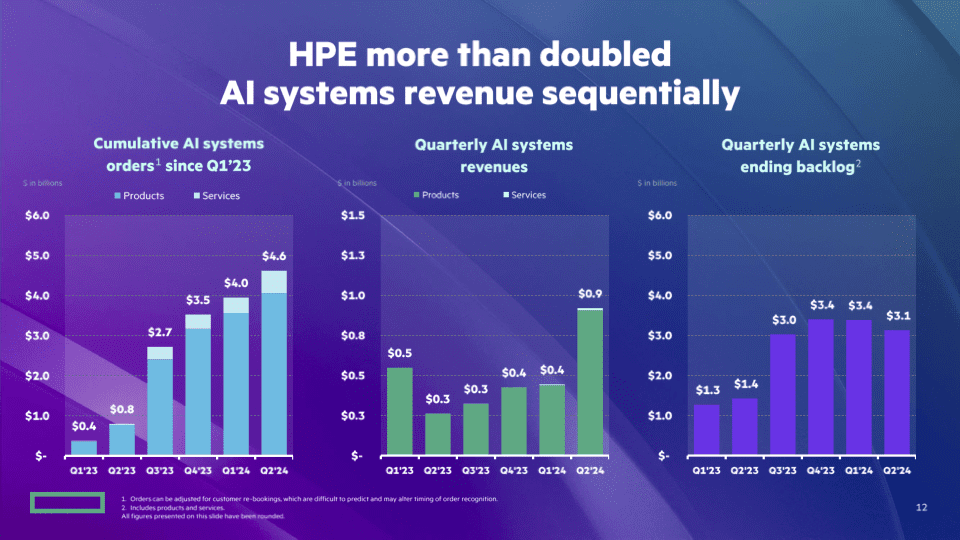
It is clear that server sales with AI-based hardware saved the quarter. The expected uptick has finally arrived, with AI systems revenue doubling from the previous reporting period. Obviously, we don’t follow server sales specifically, but cover HPE for storage and data protection. The Hybrid Cloud segment (which now incorporates storage) declined 8% with an operating profit of only 0.8%. Why is storage not delivering?
GreenLake Block Storage
Earlier this week we posted a research note looking at the evolution of what is creatively called GreenLake for Block Storage built on Alletra MP. Putting aside the awful nomenclature, this platform is essentially the 4th generation evolution of the 3PAR/Primera line, re-engineered to be disaggregated by making the storage media accessible across a local private network (RoCE).
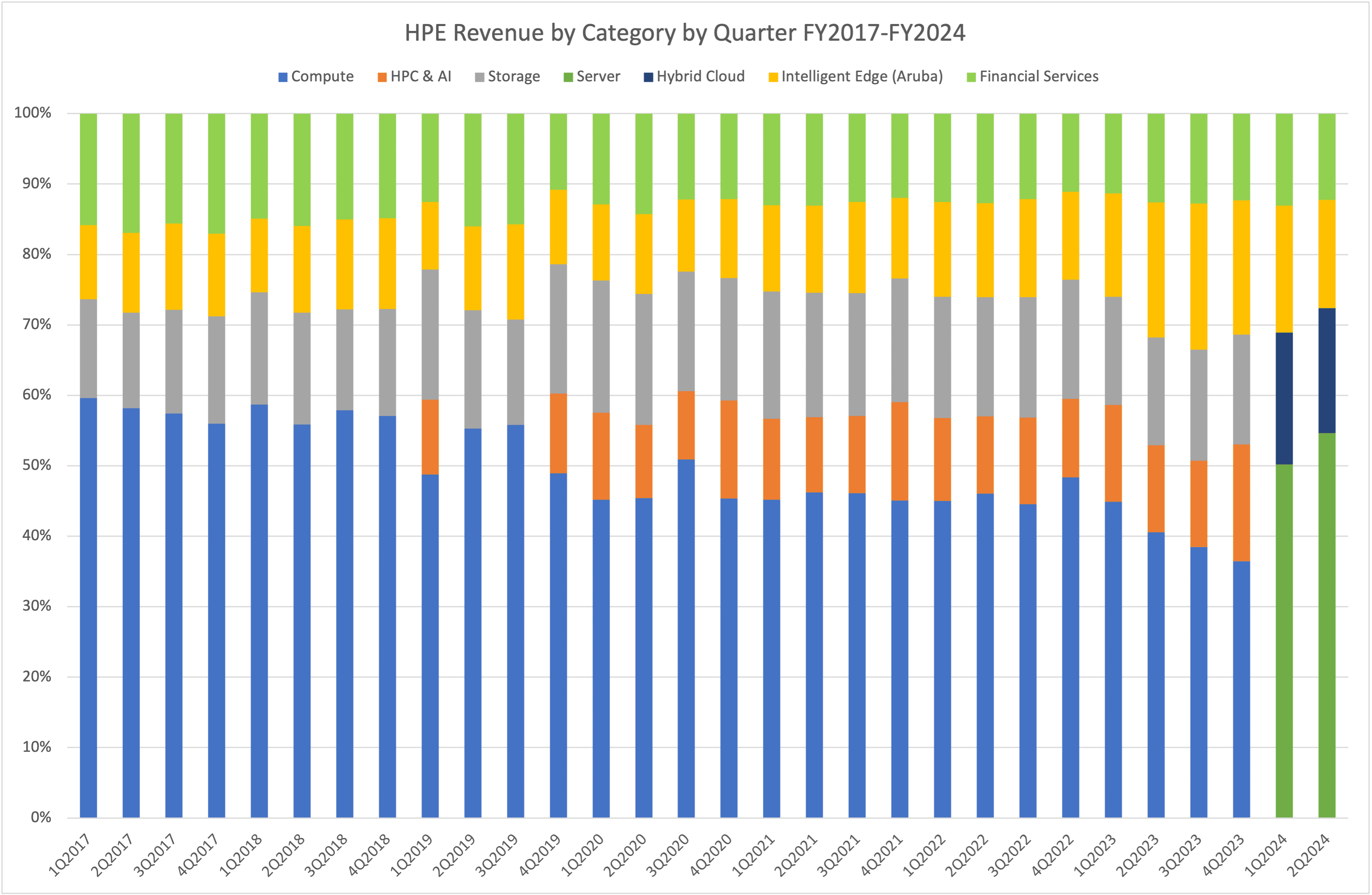
So far, it doesn’t appear that the GreenLake model (both this and the file option using VAST Data software) has managed to reignite storage growth. Other than a re-architected hardware design, we don’t believe that GreenLake Block Storage with Alletra MP offers anything different than when the product was sold as an integrated package. In many respects, the GreenLake Block Storage solution took a step backwards, reducing scalability and performance, which was then incrementally improved over the 2nd, 3rd and now 4th generations.
The Architect’s View®
From HPE’s perspective, the quarter looks good due to the increase in sales from AI-enabled servers. Even in this segment, the gross margin has declined, representing a similar challenge to the issue we recently reported with Dell’s financial results; essentially a lot of the AI hardware is a passthrough with much lower margin. In reality, of the $7.2 billion in sales, AI-based systems represent only $0.9 billion (see Figure 5 from HPE’s financial reports), so significantly more product needs to go out the door to dramatically improve the top line.
The remainder of the portfolio looks shaky, with little positivity. Unfortunately, HPE no longer reports the specifics, but storage clearly isn’t rejuvenating the Hybrid Cloud segment (including the partnership with VAST Data).
HPE Discover is due to take place in only a few weeks. As the GreenLake Block Storage announcement has only just been made, we don’t expect any additional news to come out of the conference. We expect the focus will likely continue to be AI and the land grab for on-premises sales.
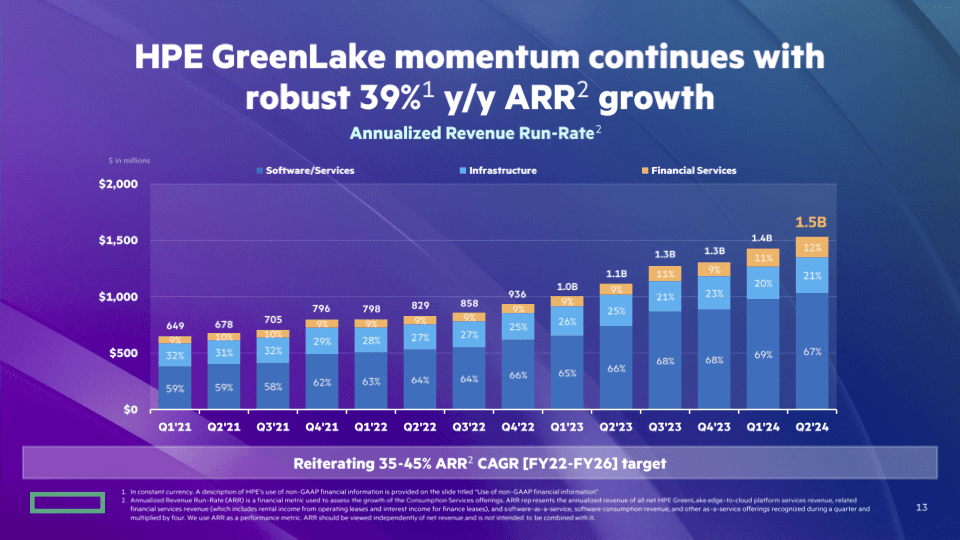
With respect to the GreenLake marketing strategy, we’ve been constantly negative on the success of this consumption-based model. Looking at Figure 4, we can see the growth of GreenLake subscriptions over time. Bear in mind this graph represents recurring revenue as an annualised value. So, the latest data showing $1.5 billion is only around 5% of HPE’s annual revenue. Hardly a major success for a programme that has been running for fie years.
What do the results for HPE and Dell say about the future of the on-premises infrastructure market? Our concern is that the long-term outcome transforms businesses like Dell and HPE into nothing more than box shifters. Solutions integrators may provide some value-add by bringing products together, but integration no longer appears to be a core offering from HPE or Dell.
The real value of modern infrastructure is the software and applications that process data; an area from which HPE and Dell seem to be increasingly moving away.
Copyright (c) 2007-2024 – Post #4eaa – Brookend Limited, first published on https://www.architecting.it/blog, do not reproduce without permission.