

This week, Intel Corporation held Vision 2024 in Phoenix, Arizona, USA, to showcase the latest evolution of three processor platforms. The desktop, server and AI accelerator solutions all saw new releases, with a ongoing focus on silicon for the “AI Era”.
Background
Continuing the momentum of the last 18 months, Intel Vision 2024 represents another opportunity for the company to showcase product developments across three categories. During the keynote presentation, CEO Pat Gelsinger introduced updates on three key platforms. These were Xeon Scalable data centre CPUs, consumer AI PC CPUs and AI Accelerators. Throughout the presentation, AI remained a central theme, with demonstrations of the technology onstage and in the nearby fabrication facility.
AI PC
The AI PC and the hardware that supports it, are central pillars of Intel’s future strategy and direction. At the Innovation 2023 event (September 2023), the first generation of AI PC silicon was previewed before subsequently being formally announced in December 2023. Meteor Lake (branded as 1st Generation Core Ultra) implements a chiplet architecture including an NPU, or Neural Processing Unit, as well as two general processor cores, one for performance (Redwood Cove) and one for efficiency (Crestmont). You can read more on our coverage in this Research Note.
At Vision 2024, Pat Gelsinger unveiled the next generation of Intel Core Ultra based on the Lunar Lake architecture. Intel claims 3x the AI performance of the first-generation Core Ultra processors, with over 100 TOPS (tera operations per second, a measure of AI calculation performance). This compares to 34 TOPS for the first-generation hardware.
No further details on Lunar Lake were provided, although rumours suggest this design could be using the Intel 18A process. Gelsinger hinted that third-generation products were already in fabrication.
Xeon 6
Second to be presented was the next generation Xeon Scalable processor, with two configurations. The efficiency cores model, codenamed Sierra Forest will come first, followed by a performance core model, codenamed Granite Rapids. Both will be produced using an Intel 3 process. Gelsinger claimed 2.5x performance improvement per watt over second generation Xeon, with 2.7x rack density improvement. The quoted example onstage was a theoretical customer reducing from 200 to 72 racks with the same compute power, but with one megawatt of power savings.
Of course, a multi-generational comparison looks better than the step change from 5th generation to 6th generation Xeon, but it is perhaps a reasonable comparison for customers that may be refreshing technology after 4-5 years.
Gaudi 3
Third to be announced was Gaudi 3, the third generation of the AI accelerator technology that came from the Habana Labs acquisition in 2019. Gaudi 3 improves upon the previous generation, with 64 tensor cores (across two 5nm dies, 32 each), with 128GB of HBM2e memory (96GB HBM on Gaudi 2), delivering 3.7TB/s of bandwidth. The third-generation solution will be available in three form factors; as a mezzanine card (OAM), as a universal baseboard and as a PCIe AIC.
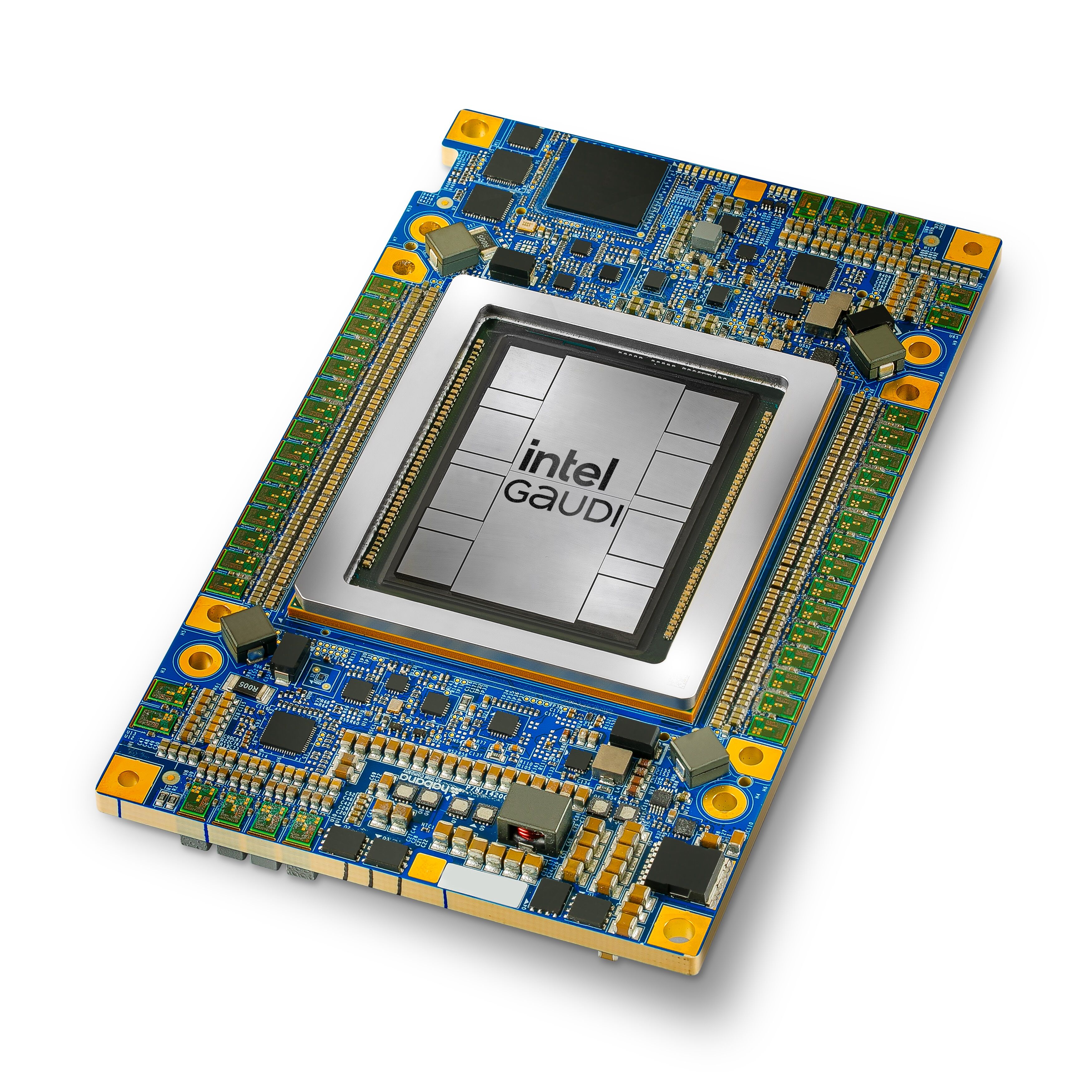
Intel claims 50% faster training and 50% faster inferencing times compared to NVIDIA H100, although the provided links to the NVIDIA developer website with the source models didn’t appear to work.
The Architect’s View®
The onstage keynote was light on detail while continuing to push the AI strategy. There’s no reason to doubt that the delivery milestones of 2024/2025 for these products won’t be met. Gelsinger seems confident on the timescales and has managed to deliver the 5N4Y strategy so far.
However, more interesting is how these new products will stand up against the competition. The Xeon efficiency core architecture, for example, is the answer to the gains made by Arm in the data centre. We need to see how performance compares and how hyper-scalers choose to adopt this technology. AWS, Microsoft Azure, and Google Cloud all now have in-house developed Arm-based CPUs that will compete with the e-core product line.
On the desktop, Gelsinger was keen to point out that Intel was starting to ship second-generation AI PC processors while competitors hadn’t shipped anything. However, that’s not entirely true. Apple, for example, already ships products with a similar architecture (since the M1 processor in laptops). Despite being on the second-generation design, Intel is dependent on operating system and application support, which isn’t there yet. It is worth noting that consumer devices based on Lunar Lake will meet Microsoft’s requirements for an AI PC (greater than 40 TOPS capability).
With regard to Gaudi 3, Intel claims greater performance than NVIDIA H100, but NVIDIA has already announced B100 products so that comparison could quickly become moot. It really depends on product shipping timescales and availability.
Overall, the announcements at Vision 2024 feel like a “progress update” rather than details on anything new. That said, Intel needs to major on consistency and delivery, especially now that the Foundry business has been logically separated out. The next step for the announcements made at this event is to see the detail and how products align with the competition.
Copyright (c) 2007-2024 – Post #9dd9 – Brookend Ltd, first published on https://www.architecting.it/blog, do not reproduce without permission. Images copyright (c) of Intel Corporation, except the financials graphs.