

Veeam Software Group GmbH has announced the availability of the Veeam Data Cloud, protecting Microsoft Azure and Microsoft 365 data. The platform is a rebranding of the Cirrus assets acquired from CT4 in October 2023. Although Veeam previously offered data protection-as-a-service through partners, Veeam Data Cloud is the first solution available directly from the company. We take it for a test run and provide our initial thoughts.
Background
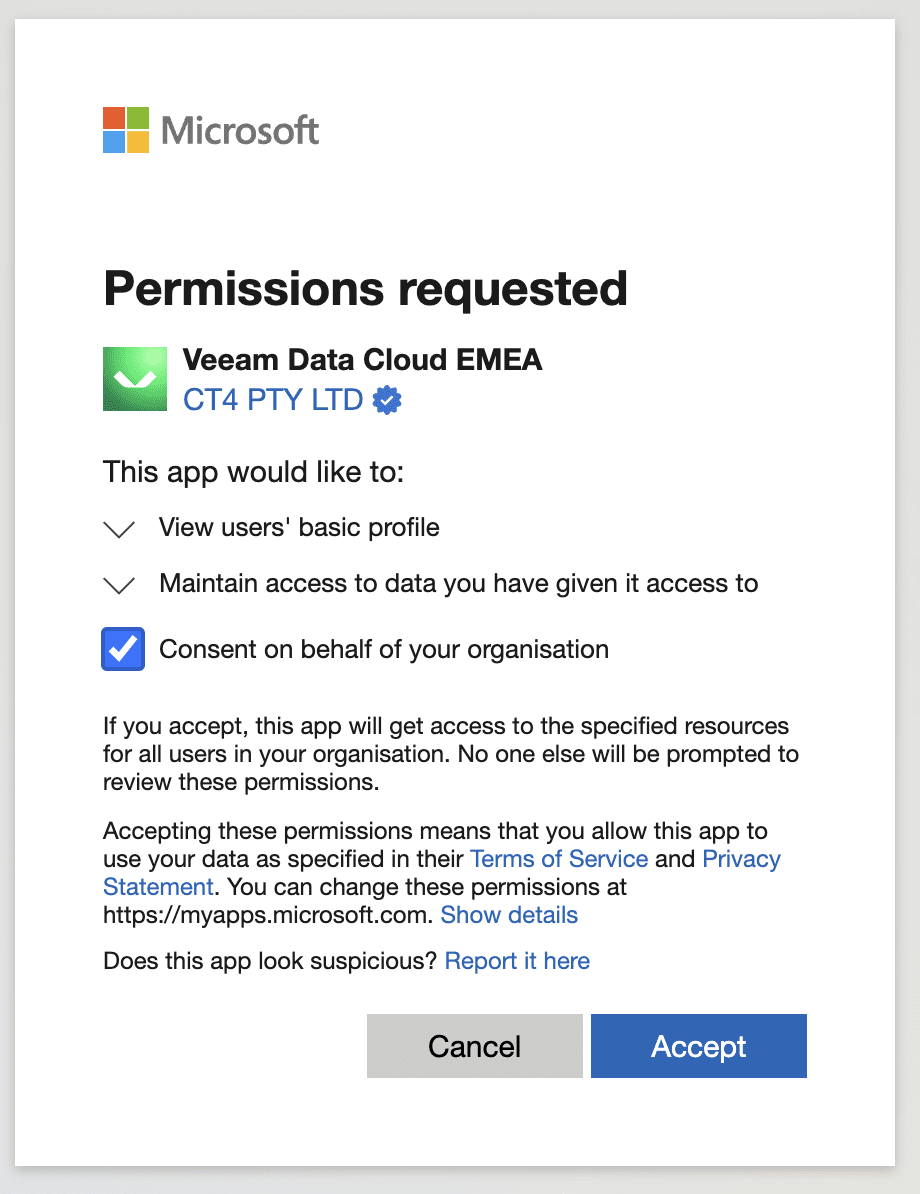
As we highlighted in this blog post, Veeam Software acquired the Cirrus backup-as-a-service solution from CT4 PTY Ltd in October 2023. CT4, previously known as Canopy Tools, had created a solution for protecting data in Microsoft cloud solutions using Veeam Backup for Microsoft 365. From what we can determine, that platform already operates as a marketplace offering in Azure. We determined this by performing a trial of Veeam Data Cloud. Figure 1 shows the permissions request from Veeam Data Cloud during the installation. CT4 PTY Ltd is still attributed as the requestor.
The Offering
Veeam Data Cloud currently supports only Microsoft Azure and Microsoft 365 assets and is only available in Australia, the UK, USA and India. We configured and installed support for Microsoft 365 and tested the backup of email data.
The first issue to note (which isn’t necessarily a Veeam problem) involves credentials management of accounts with Azure and Office 365 where the same email administrator address is used on both portals. The Azure marketplace insisted on using Azure credentials, while the Veeam portal rejected logins with this account. We resorted to using Google Chrome private browsing to ensure the correct sign-in details were used when configuring the Veeam Data Cloud (VDC) Portal.
As expected of all SaaS platforms, VDC requires permission to the appropriate data assets. The user must also specify a licence type, after which a first backup is triggered.
The portal and interface are very basic. Although the documentation indicates it should be possible, we found that the Variable Licensing Model option did not provide the capability to schedule or amend backups. As a result, the initial backup of mailboxes, OneDrive, SharePoint, and Teams was started as soon as we authorised the licence. Subsequent backups (every 24 hours) started at the same time each day, which didn’t necessarily align with the start or end-of-day for users.
We also noticed that the Variable Licence provides no capability to select users or amend the frequency of backups. This may be possible under the Fixed Licensing Model, but the documentation isn’t clear. The display of users is simply a list of all licensed and unlicensed accounts on the Microsoft 365 account. With large organisations, we can see this configuration becoming unwieldy.
Finally, the actual backup process was terribly slow. The initial backup of only four mailboxes with 253,000 objects took 9 hours and 14 minutes. An incremental backup with only 147 objects took 2 hours and 16 minutes, presumably as the system determined changes since the previous backup.
As the software is deployed as a service, we have no visibility of how Veeam assigns resources to each tenant. We would hope that large tenants gain a greater volume of backend resources; otherwise data in Microsoft 365 will go unprotected.
In terms of restore, we didn’t test the process. However, from the portal we can see the solution provides the capability to restore entire mailboxes, folders or individual items.
The Architect’s View®
Veeam needed to make a move into the data protection-as-a-service market, which includes backup (BaaS) and disaster recovery (DRaaS). This first step in acquiring Cirrus from CT4 provides an adequate capability. However, the solution is very much a version 1.0 release, with few options to customise the protection process and a focus on SMB rather than the scaling needed for large enterprises.
We think this position comes from the inherent design of Veeam Backup for Microsoft 365, which is designed to suit the small or medium business market. In the current form, Veeam Data Cloud is unsuitable for larger businesses such as those with regulatory requirements on how email data is processed.
Compared to the rest of the market, Veeam Data Cloud is lagging behind in capability. The solution is stand-alone, with no centralised reporting that would be expected by Enterprise users. Credentials are established at account creation time, so any expansion or re-organisation will need the interface to be re-written for multiple credentials options. The lack of granularity on backup times and frequency will cause issues for many users who need to be more precise with data protection.
This market already has mature solutions from Druva, Commvault (Metallic) and HYCU, to name just a few. Veeam has a long road ahead to catch up. As a result, we still believe that Cirrus and the current incarnation of Veeam Data Cloud is a stopgap solution. Veeam has invested in Alcion, a start-up from the team that developed Kasten container backup, acquired by Veeam in October 2020. We can envisage an acquisition in the future, as Alcion becomes the core solution for Veeam SaaS, once the feature depth has been expanded to cover more platforms than Microsoft 365.
Copyright (c) 2007-2024 – Post #7bc4 – Brookend Limited, first published on https://www.architecting.it/blog, do not reproduce without permission.