

Intel Corporation has held its latest innovation day, providing the industry with an update on technologies and a roadmap for the near future. Pat Gelsinger continues to direct the company back to a predictable path, but does it remain a competitive one?
Background
Innovation is an Intel event designed to showcase the current developments in both hardware and software across Intel’s business units. At the 2023 event, Intel CEO Pat Gelsinger presented the keynote on day one, primarily focused on hardware, while CTO Greg Lavender presented day two’s keynote, mostly focused on software and ecosystems. We’re focusing on hardware in this post, specifically core processing solutions. As every business is doing in 2023, Intel focuses heavily on AI and its implications for both the enterprise and the desktop user.
Intel AI Inside
The day one keynote discussed the future of AI for developers and the desktop. Intel is due to release the 14th generation of its Core mobile technology, known as Meteor Lake, on 14 December 2023. Meteor Lake is built on the “Intel 4” process, the second of five process steps or nodes that Intel promised would be delivered in four years (more on this in a moment).
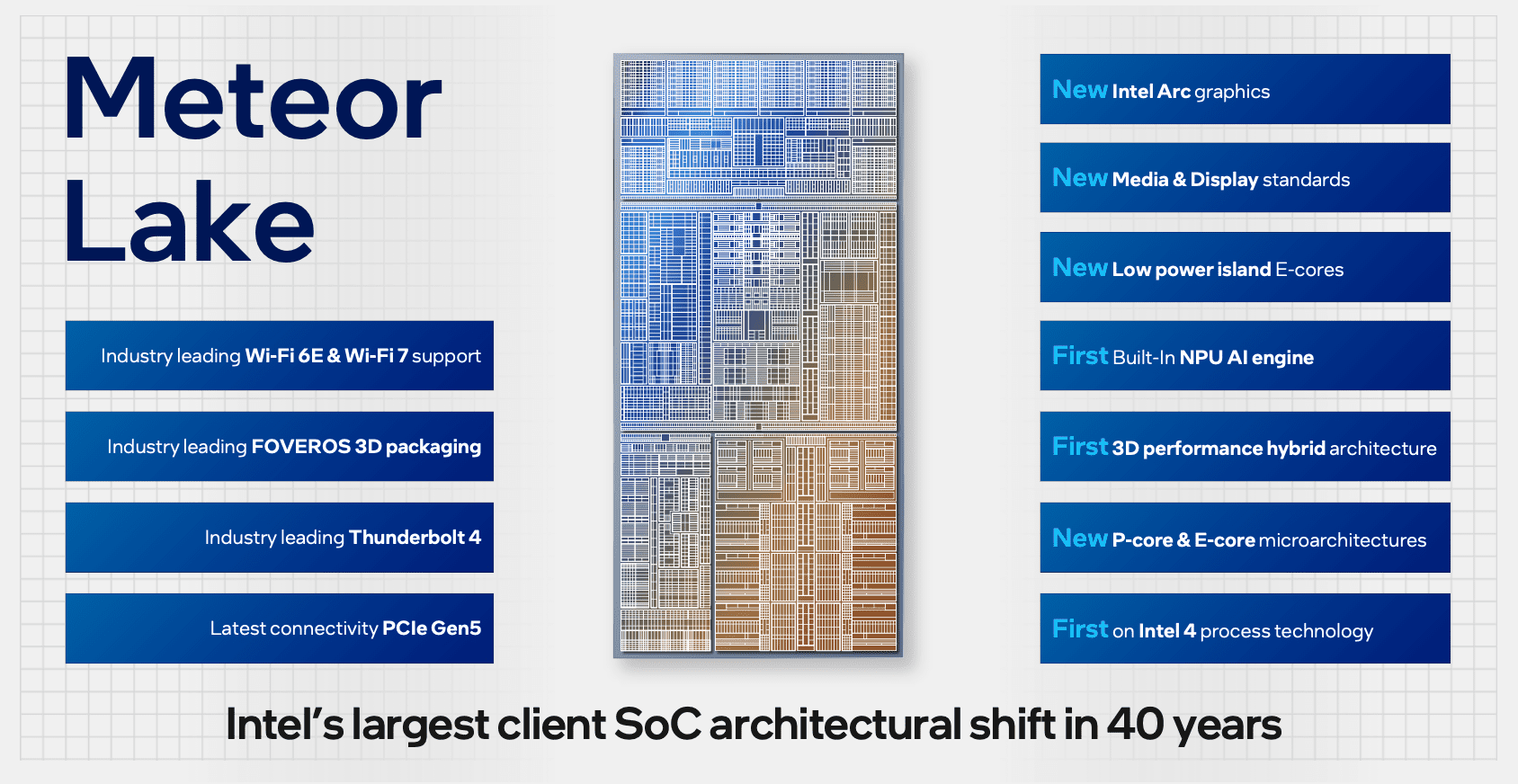
The Meteor Lake processor is a SoC (System on Chip) multi-tiled design, the first that incorporates a mix of new performance (Redwood Cove) and efficiency (Crestmont) cores. Meteor Lake is built from four tiles.
- Compute tile – E-cores (Crestmont) and P-cores (Redwood Cove).
- SoC tile with new “low power island E-cores”, an NPU (neural processing unit) AI engine, improved graphics with 8K support, and HDMI 2.1, Wi-Fi 6E and 7 support.
- Graphics tile, based on the Intel ARC architecture.
- I/O tile, with support for Thunderbolt 4 and PCIe Gen 5.
The Meteor Lake design implements three tiers of processor cores, with low-power E-cores in the SoC and both efficiency and performance cores in the compute tile. Intel believes this “3D” performance architecture will give the best optimisation for mixed workloads. The tiles are assembled with Intel’s 3D “FOVEROS” packaging technology. Overall, Intel claims this is the company’s most significant shift in architecture in 40 years, which is quite a statement as this harks back to the emergence of the first x86 architecture processors of the early 1980s.
Note: Intel incorrectly implied that Meteor Lake would be available in socketed version for desktops. This has been clarified as incorrect. Meteor Lake will be used in all-in-one systems as clarified in multiple news articles issued on 27 September 2023.
Xeon
For the enterprise data centre, Intel confirmed that the 5th generation Intel Xeon, built on the Emerald Rapids platform, will also launch on 14 December 2023. This technology is based on the Intel 7 process node and Raptor Cove microarchitecture. It will support DDR5 memory (up to 8 channels), up to 80 PCI Express 5.0 lanes and up to 64 cores. Future generations of Intel Xeon are codenamed Sierra Forest, Granite Rapids and Clearwater Forest, respectively. These three designs will be built on the Birch Stream Platform architecture. Birch Stream will offer 12 memory channels and be capable of delivering 8800 MT/s (megatransfers per second).
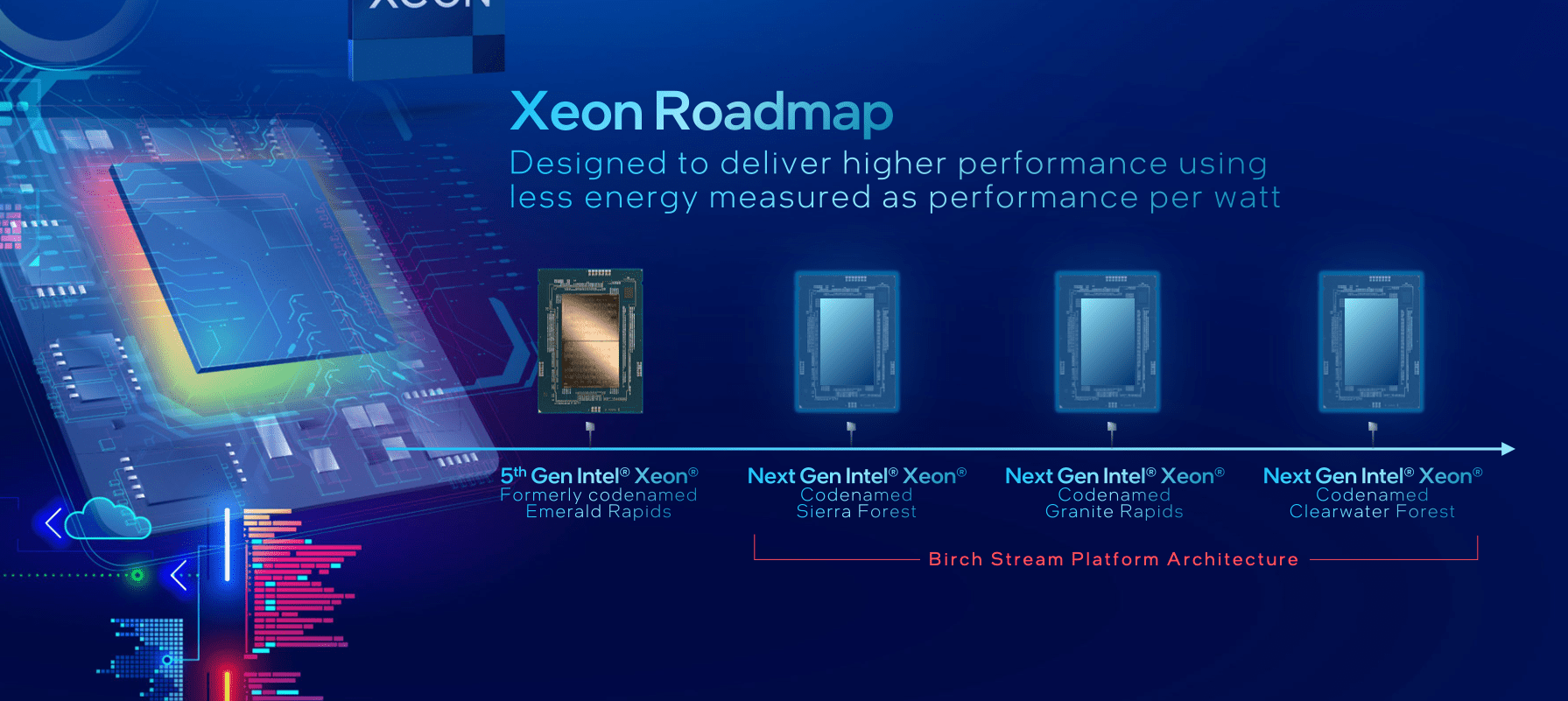
Intel will offer a dual track for the newly named Xeon Processor family after the 5th generation Xeon. Sierra Forest and Clearwater Forest will exclusively use efficiency cores, whereas the Granite Rapids platform (to arrive just after Sierra Forest in 2024) will use performance cores.
- Intel Struggles as Optane is Discontinued
- Intel Under pressure as NVIDIA Announces Grace CPU
- What is Intel Optane?
Onstage, Gelsinger held up a 288-core Sierra Forest processor with a twin-die design. The Sierra Forest line of efficiency core products is aimed at cloud service providers and will compete with CPUs like the AmpereOne we discussed recently.
5 Nodes, 4 years
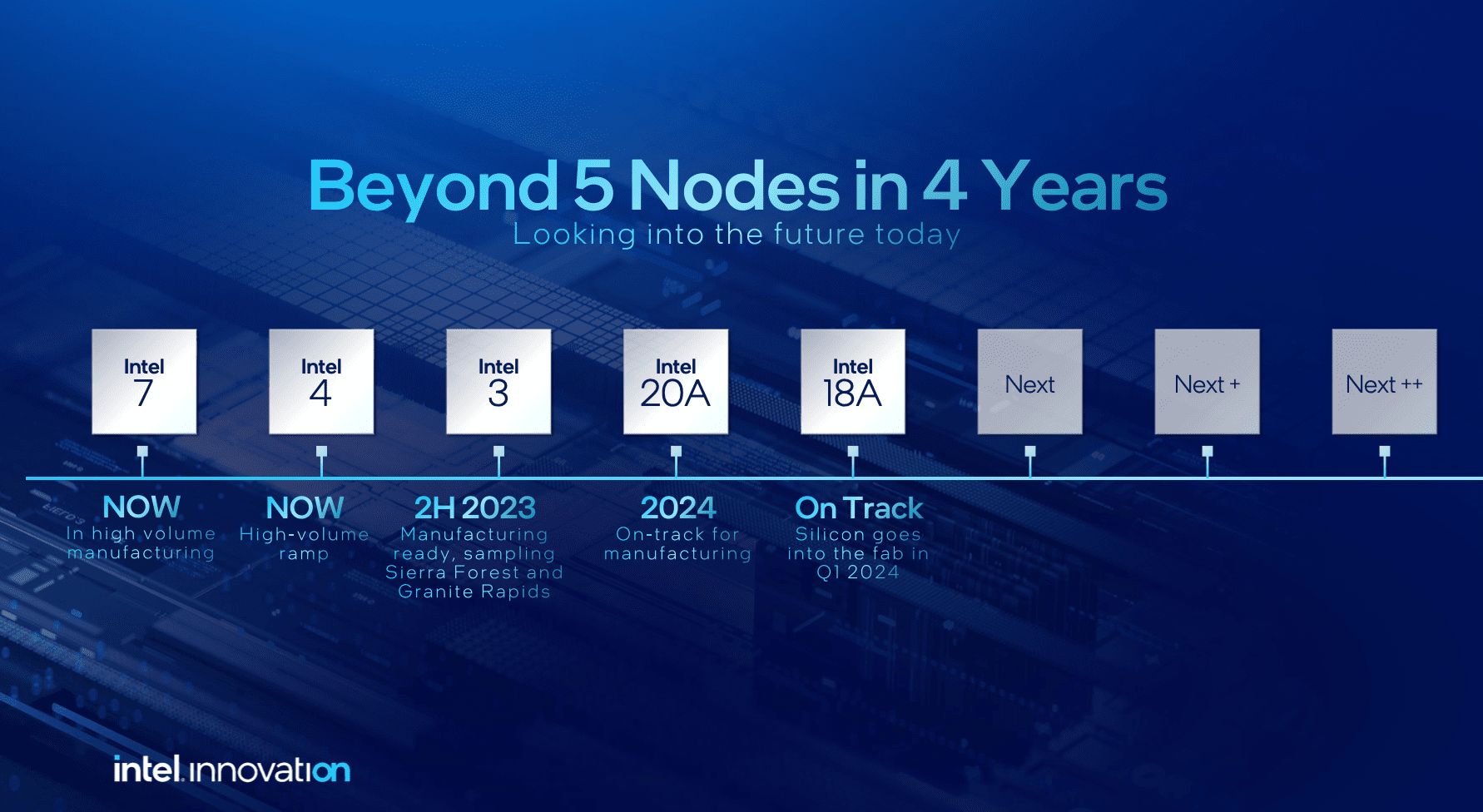
Pat Gelsinger returned to Intel in February 2021, announcing a new strategy, “IDM (Integrated Device Manufacturing) 2.0”, that would see new fabrication plants built in the US. Gelsinger also committed to “5 nodes in 4 years”, placing an emphasis back on core skills of processor development and manufacturing. Those nodes are as follows.
- Intel 7 – previously known as Intel 10nm Enhanced SuperFin (10ESF) and used to deliver the Alder Lake and Raptor Lake processors (12th and 13th generation Core processors, respectively).
- Intel 4 – a 7nm process being used to deliver the 14th generation Core processors (Meteor Lake) and the first to use EUV (extreme ultraviolet) lithography.
- Intel 3 – a 5nm process (we think) that will also exploit EUV and be used to deliver Sierra Forest.
- Intel 20A – used to deliver Arrow Lake, the successor to Meteor Lake, with products expected in 2024. The designation of dimensions changes to use angstroms (where 10 angstroms = 1nm), so this is potentially a 2nm process.
- Intel 18A – used to deliver Xeon processors built on the Clearwater Forest design and Lunar Lake Core processors. This node is potentially a 1.8nm or 18 angstrom process. Products are expected in late 2024.
Migration to smaller node processes requires a change in transistor design. Intel will move to RibbonFET transistor design from the 20A process onwards. The company will also introduce High-NA EUV lithography sometime around or after 18A, with the first High-NA devices being received by Intel towards the end of 2023 (as mentioned by Gelsinger in his keynote).
The Architect’s View®
Intel is still behind the curve compared to the direct competition in the market. AMD, for example, released the Zen 4 architecture in September 2022, using a 5nm process from TSMC. Zen 4 is used in both the desktop (Ryzen) and data centre (Epyc) products, with 4th generation Epyc (launched November 2022) already supporting PCIe 5.0 and DDR5 memory.
At an analyst day in June 2022, AMD announced the development of the Zen 4 “Bergamo” architecture, using new Zen 4c efficiency cores. Specific products featuring up to 128 Zen 4c cores were announced in June 2023. AMD is on track to deliver Zen 5 designs sometime in 2024. As mentioned earlier, Ampere Computing already has C3A nodes deployed in Google Cloud, with up to 192 cores.
Pat Gelsinger needed to take Intel back to its core competencies and focus on processor design and manufacture. To achieve this, he killed off the (loss-making) Optane persistent memory division and sold its NAND business to SK Hynix (creating the Solidgm brand). Intel also floated off Mobileye, an autonomous driving technologies company it acquired in 2017.
Part of the IDM 2.0 strategy announced in 2021 redirected Intel to focus on bringing chip fabrication back in-house. The company announced up to €80 billion of investment in fab technology in Europe in March 2022, having already disclosed plans to invest more than $20 billion in new facilities in Ohio, USA. Some of this manufacturing capability (once completed) will be offered to other companies.
Gelsinger is betting the farm on the success of the IDM 2.0 strategy. We can see two headwinds that could affect the success of the plan. The first is the ability for AMD to keep ahead of Intel, both on the desktop and the data centre. AMD has faster, more scalable products built on more advanced process nodes compared to Intel. Intel needs to find solutions that reverse this position.
The second is competition in the data centre from new processor architectures and designs. Today, the alternative x86 solutions mainly consist of Arm designs, but RISC-V could pose a challenge in the medium term. The reason for this is relatively obvious. The cloud hyper-scalers want to optimise (and/or own) every part of their internal infrastructure, always striving for better price/performance. Custom SmartNICs have delivered enhanced security and additional optimisation at the server level, while optimised processors could create opportunities for future savings if the design and manufacture of those pieces of the pie could be brought in-house.
We believe the cloud hyper-scalers are testing the water with Arm-based designs. If these prove popular (even for internal management tasks), then we may see acquisitions in this area that elevate the use of non-x86 across all cloud platforms. Intel certainly doesn’t want that to happen, building solutions on efficiency cores, for example, to rival the “centi-core” designs already in the market.
Can Intel make it work? Pat Gelsinger has the ability and track record to deliver. In the short term (2-3 years), we should expect to see Intel catch up with AMD. In the medium term (5 years), Intel needs to exceed the capabilities of AMD and deliver solutions as power-efficient as Arm. In the long term (10 years), Intel needs the fab investment to pay off.
We have our milestones in place. Now, we will wait to see if Intel can deliver to them.
Copyright (c) 2007-2023 – Post #bcde – Brookend Ltd, first published on https://www.architecting.it/blog, do not reproduce without permission. Images copyright (c) of Intel Corporation.