

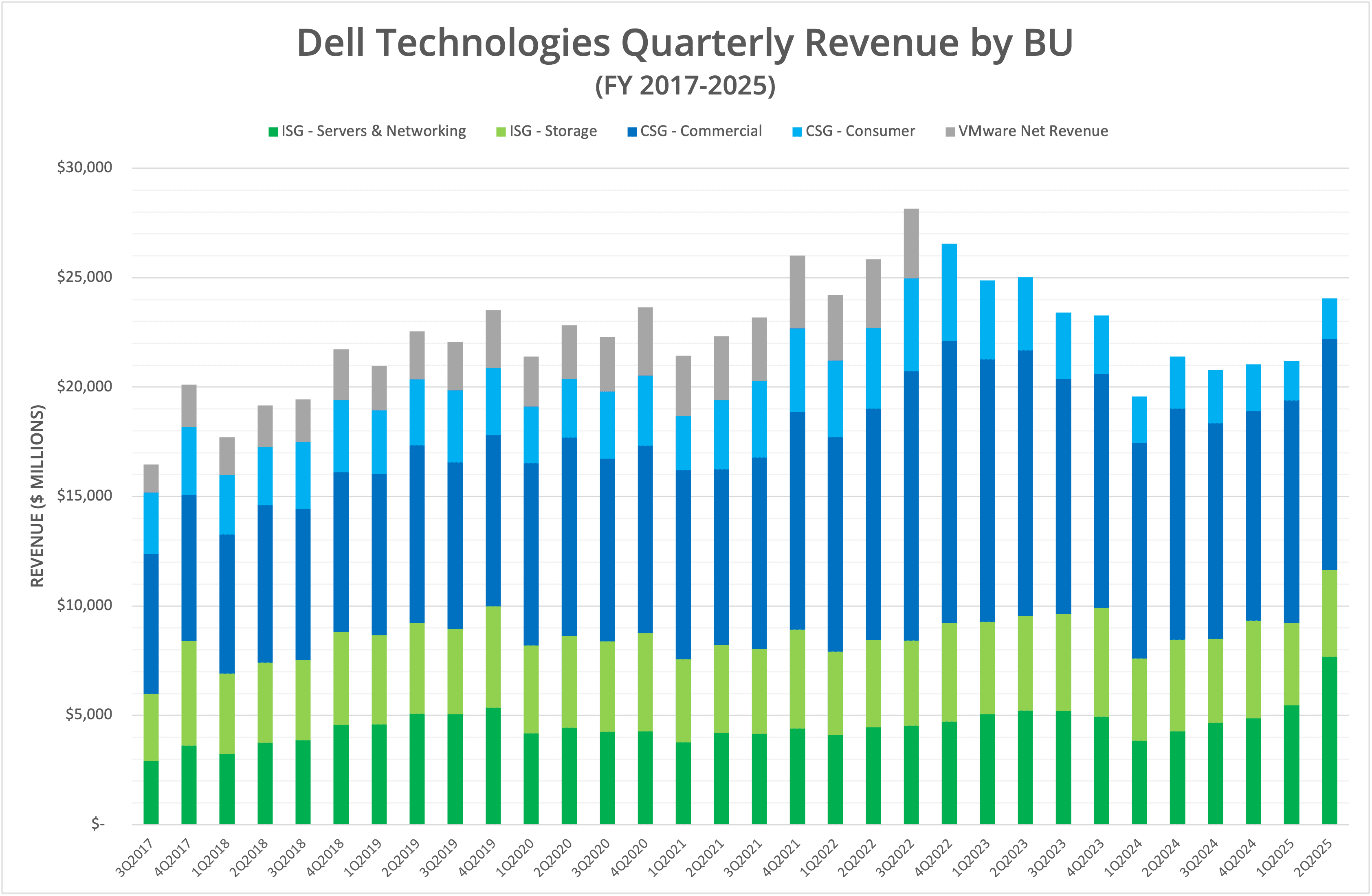
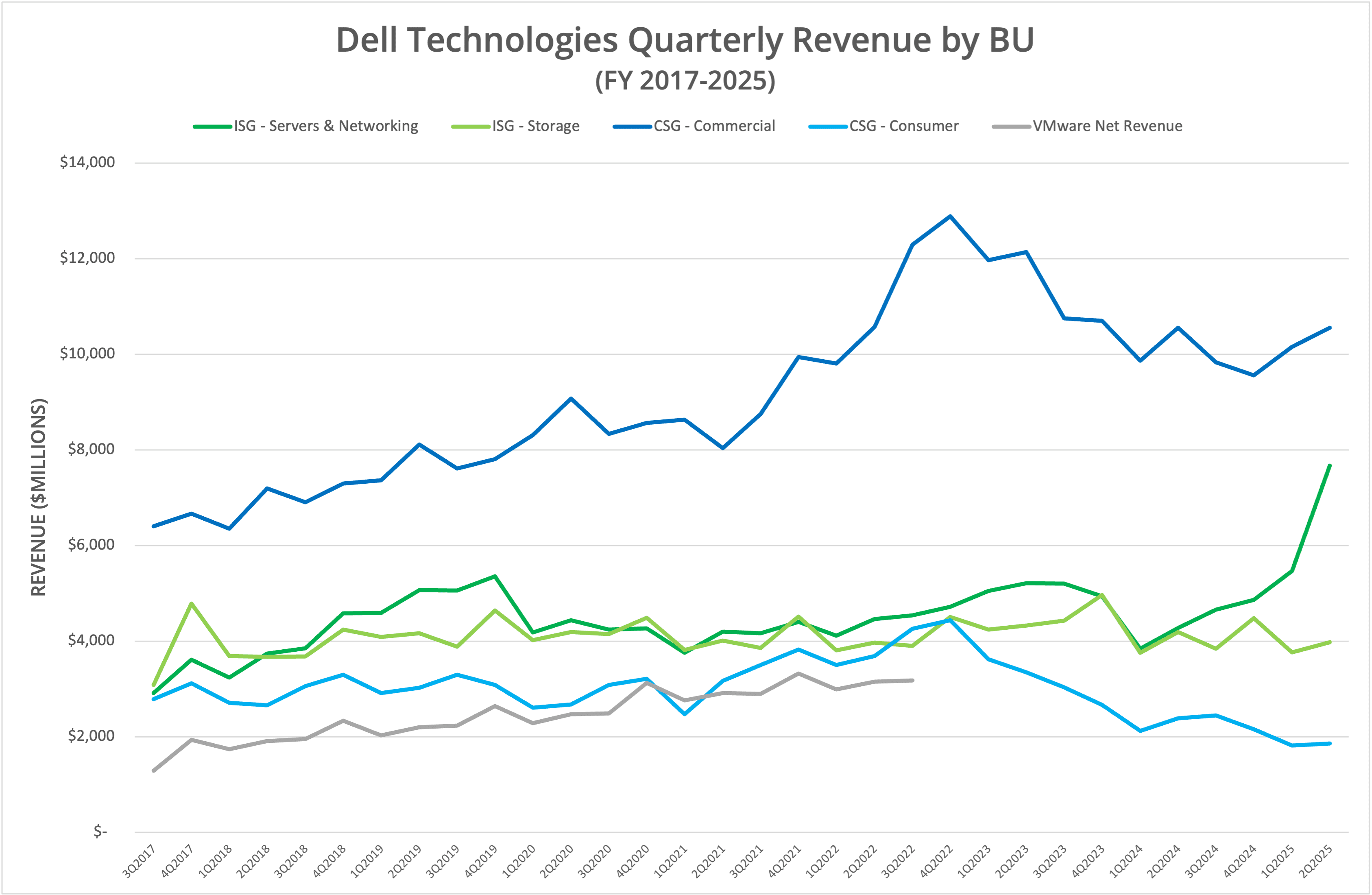
Dell Technologies, Inc. has announced Q2 FY2025 financial results, which show a 9.1% overall growth in revenue for the quarter to $25 billion compared to Q2 FY2024. However, hidden in the data, we see Servers & Networking rising 79.5%, Storage down 5.1%, CSG Commercial flat, and CSG Consumer down 22.2%. Once again, AI-based server sales saved the day.
Background
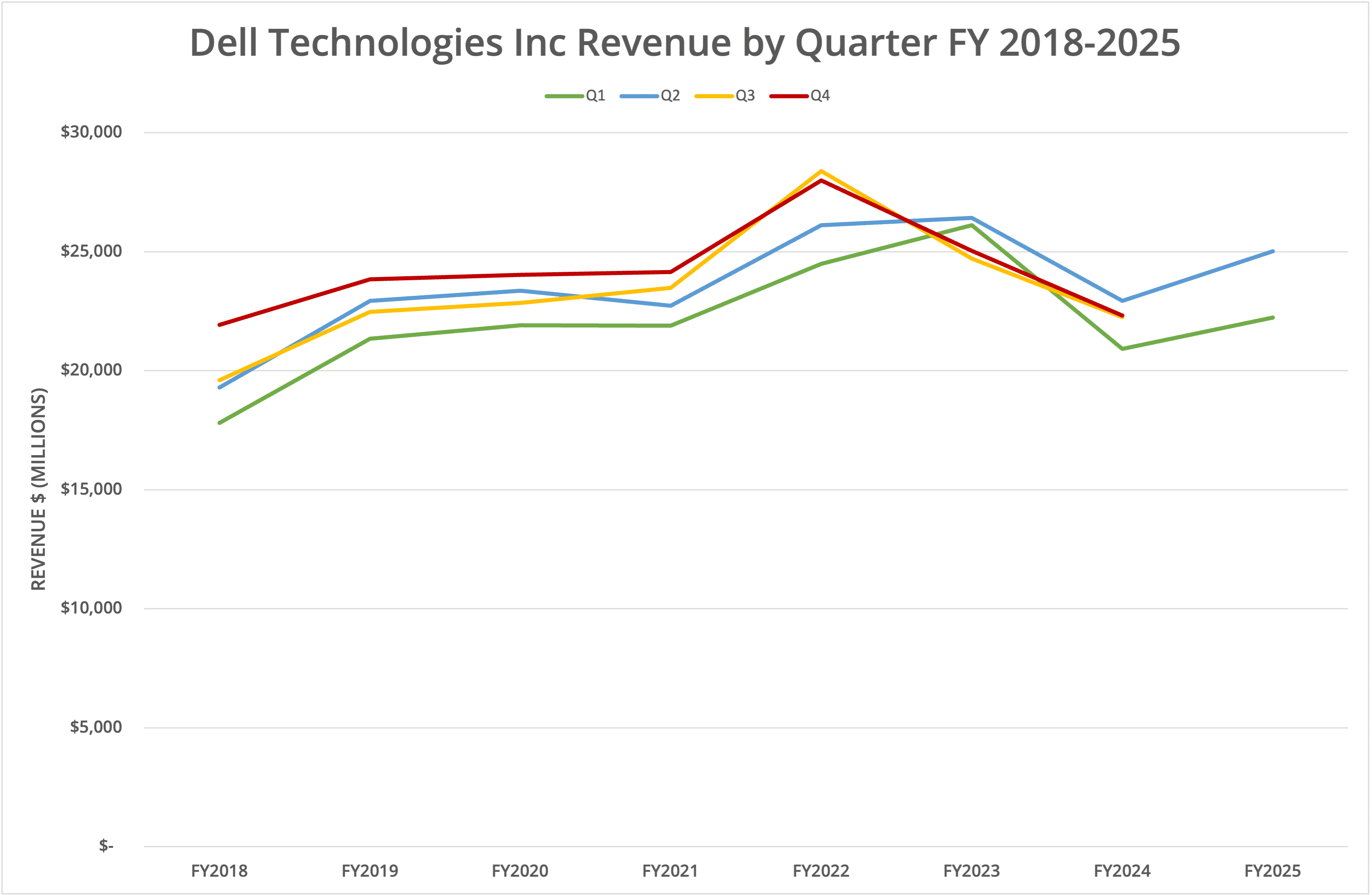
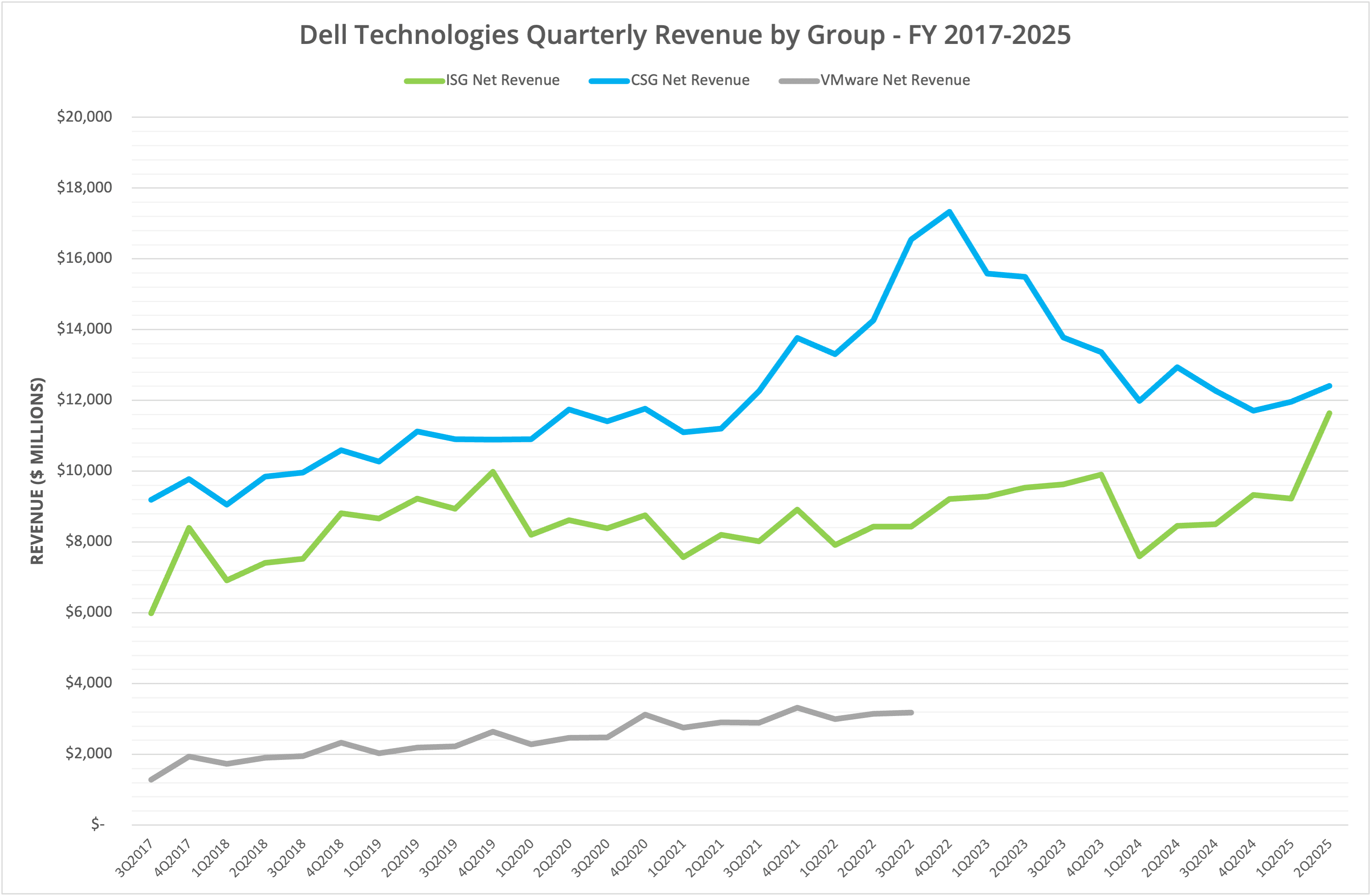
Dell Technologies reported financial data for Q2 FY2024, the period ending 2nd August 2024, on 29th August 2024. Total revenue was up 9.1% at $25.0 billion, with ISG (the infrastructure group) up 37.6% at $11.6 billion. CSG (the client group) was down 4.1% at $12.4 billion. We represent the data in six graphs, two showing annual data, and the remainder showing quarterly data.
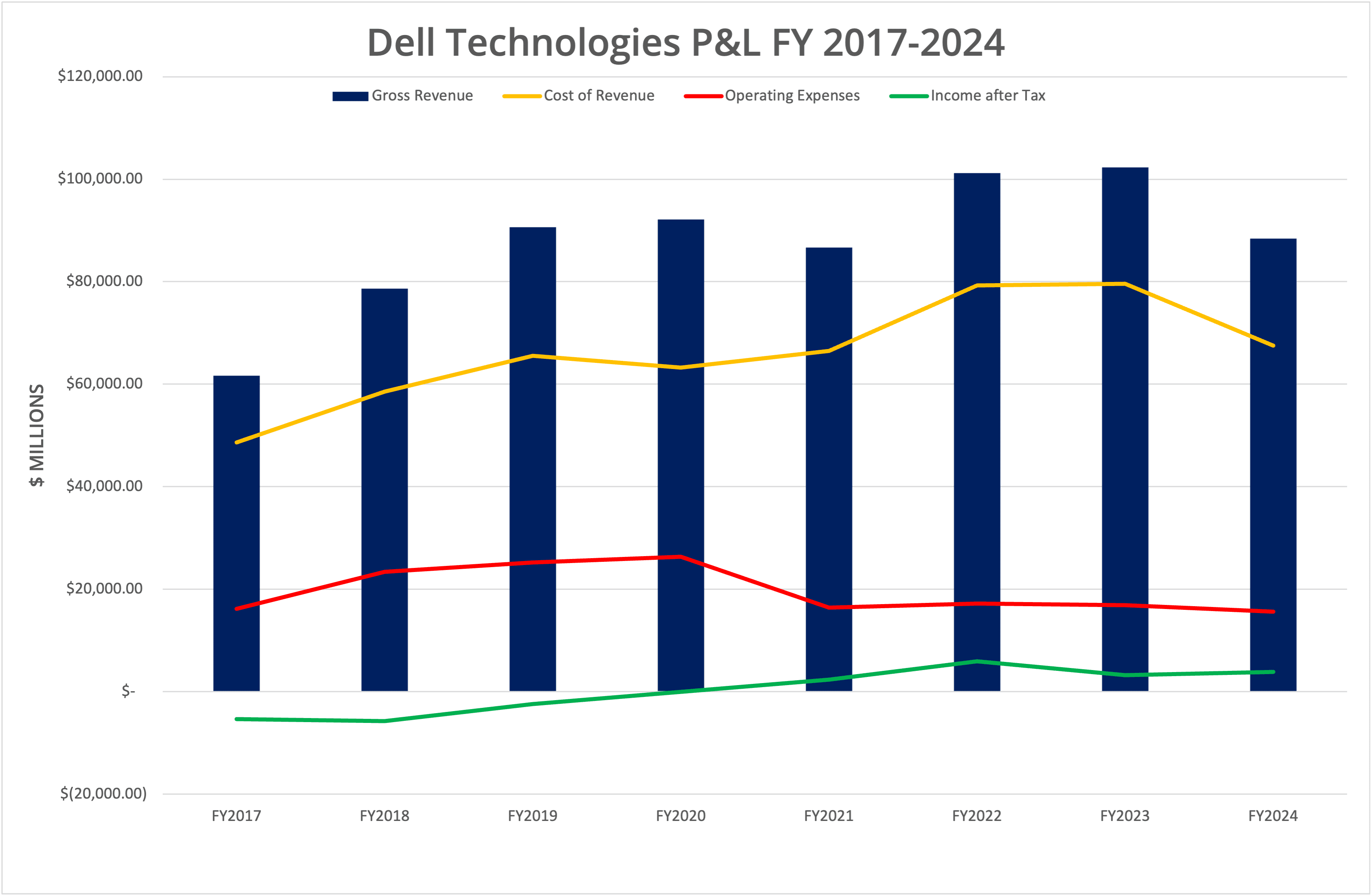
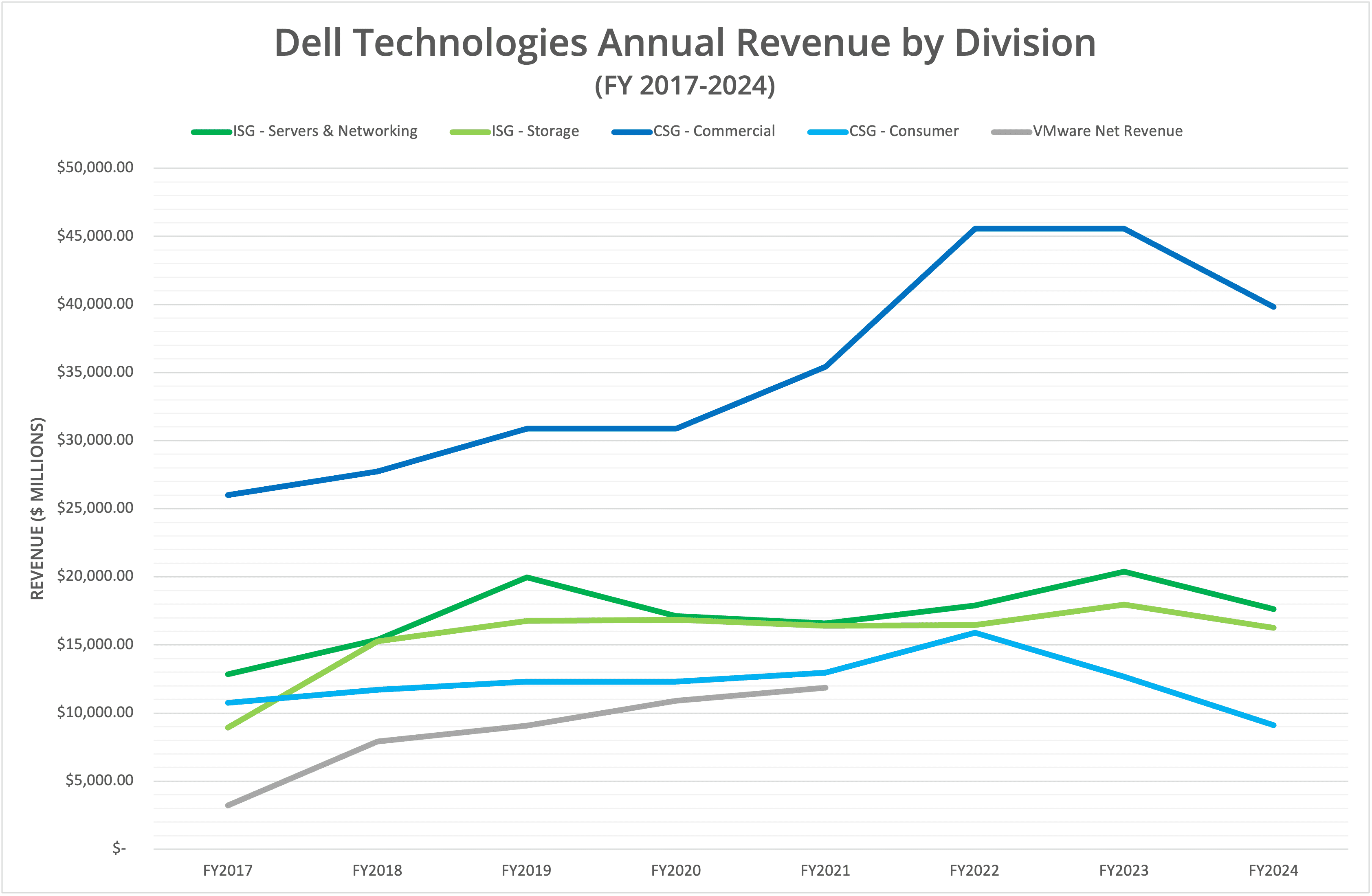
Without a doubt, Server & Networking sales saved the quarter. As shown in Figure 5, Storage has hovered around the $4 billion per quarter mark for the last eight years. CSG (Consumer) has been in decline for the last ten quarters. However, CSG (Commercial) has recovered slightly after the big rise and fall generated by the pandemic. The Server & Networking business has turned upwards to almost a hockey stick growth over the last three quarters, posting an unprecedented 79.5% growth, year-on-year.
Déjà vu
It’s interesting to look back at our analysis for Q1 FY2025, which showed CSG revenue flat (CSG – Consumer declined 14.5%), Storage was also flat. Server/Networking saved Q1 FY2025, repeating the process for Q2. Looking at the Storage business, which is one we follow across the industry, we can see no growth for eight years. This compares to significant improvements, for example, made by Pure Storage (sales & TAM growth) and NetApp, finding alternative routes to market through the public cloud.
Storage
Without wishing to sound like a broken record, Dell still maintains leadership positions in data storage infrastructure without having brought any truly innovative products to market since the acquisition of EMC, quite a remarkable feat. As an example, PowerStore, the midrange replacement for VNX, still lags behind on processor choice compared to its competitors. We would also expect to see significant storage revenue accompanying the AI server sales, but that doesn’t appear to be the case. Perhaps customers are getting their storage elsewhere?
The Architect’s View®
The rapid adoption of AI is undoubtedly fuelling growth in Dell’s server business. But how long will this trend last? A recent report indicated that AI projects fail at twice the rate of normal IT, which is a depressing statistic. However, with only 14% of businesses feeling ready to adopt AI, perhaps there is significant growth still ahead.
We’re more interested in the direction of the storage business. Looking at the current numbers, revenue isn’t much more than VMware used to bring in, yet that revenue stream delivered an operating income of almost 30%. ISG in its entirety only delivered 11% operating income in the last quarter and has historically done much better. Dell was happy to jettison VMware for the cash, what about the Dell storage business? Does it have a long-term future?
Reading the transcript notes from the earnings call on the financial results, it’s clear that the storage business has a heavy reliance on HCI, the VxRail product line. VxRail brings together VMware software and Dell hardware, packaged for simplicity and easy deployment. Conversations in the transcript indicate that the core Dell-owned IP storage products achieved growth (“double digits”) while overall revenue was still down 5%. This implies that HCI sales (which must account for the majority of Storage revenue) suffered badly and caused the overall decline.
Is VxRail really a storage product or some hybrid server/storage combination? It appears not to fit either category entirely but be more reasonably associated with the server market than storage. Therefore, if HCI was attributed to the Server revenue line, would Dell Technologies still be #1 in the storage market? Possibly not.
Naturally, the AI server sales are positive news for Dell. However, we see a gloomier picture in the storage business, with excessive reliance on the legacy VMware partnership. Broadcom and Dell re-committed to the VxRail partnership in June 2024 (press release), with a reported 20,000 customers and 300,000 nodes worldwide. No doubt Broadcom will be hoping these customers continue with Dell, but without a clear indication of a technical roadmap, the door is open for competitors to seize an opportunity and chip away further at those “storage” revenues.
Copyright (c) 2007-2024 – Post #934f – Brookend Ltd, first published on https://www.architecting.it/blog, do not reproduce without permission.