

HYCU, Inc. has announced an upgrade to its R-Cloud SaaS backup solution that uses Generative AI to assist in SaaS platform integration. The new capability (called R-Scout) will speed up the adoption time and reduce the learning curve involved with SaaS onboarding into R-Cloud.
Background
In February 2023, HYCU, Inc. announced R-Cloud, an innovative new platform that delivers data protection for data assets in SaaS applications. Rather than have bespoke coding for each platform, HYCU has developed an API to which vendors code the schema representing the data in their service offering. You can read more about the thinking behind R-Cloud and the market it addresses in the blogs and podcast links at the end of this post.
Who knows the data in its systems better than the SaaS vendor? Arguably, no one, so it makes sense that the vendor takes control of managing the integration process. However, there is a conundrum at play, depending on whether the vendor or HYCU itself does the integration work. If the vendor does it, they probably won’t have familiarity with the R-Cloud API. If HYCU, instead, did it, they potentially wouldn’t have familiarity with each vendor’s SaaS data structures. Someone somewhere has to address the learning curve of developing against unfamiliar systems.
Enter R-Scout.
R-Scout
The entire premise of R-Cloud was to enable any SaaS vendor to onboard through a self-service process. Giving the SaaS vendor control of the onboarding experience provides a much more scalable process to address the 17,000 or more SaaS applications that exist today.
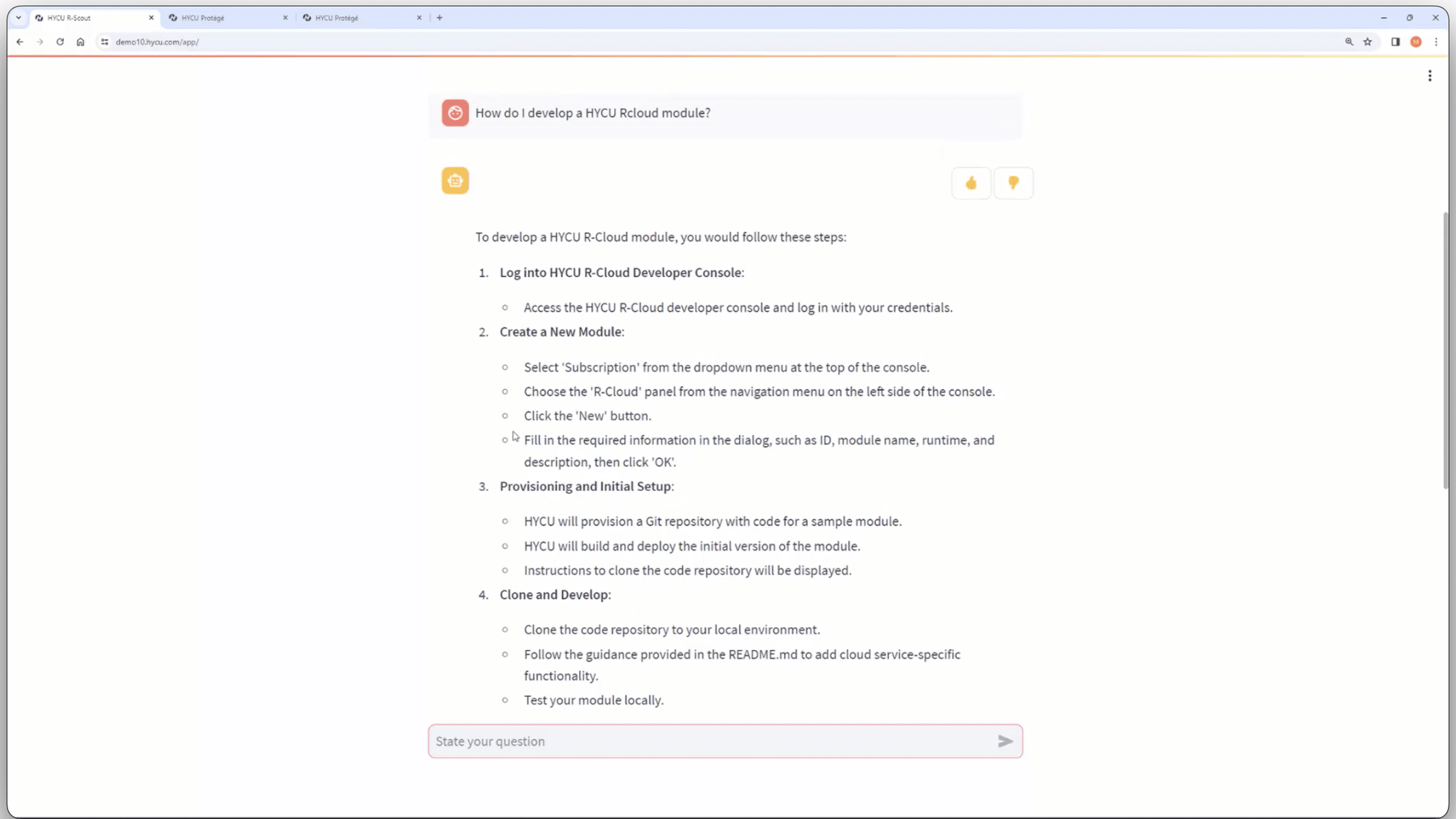
To accelerate R-Cloud onboarding, HYCU has worked with Anthropic (developers of the popular Claude AI assistant) to develop an AI-assisted process to create the code necessary for implementing R-Cloud protection on a SaaS application.
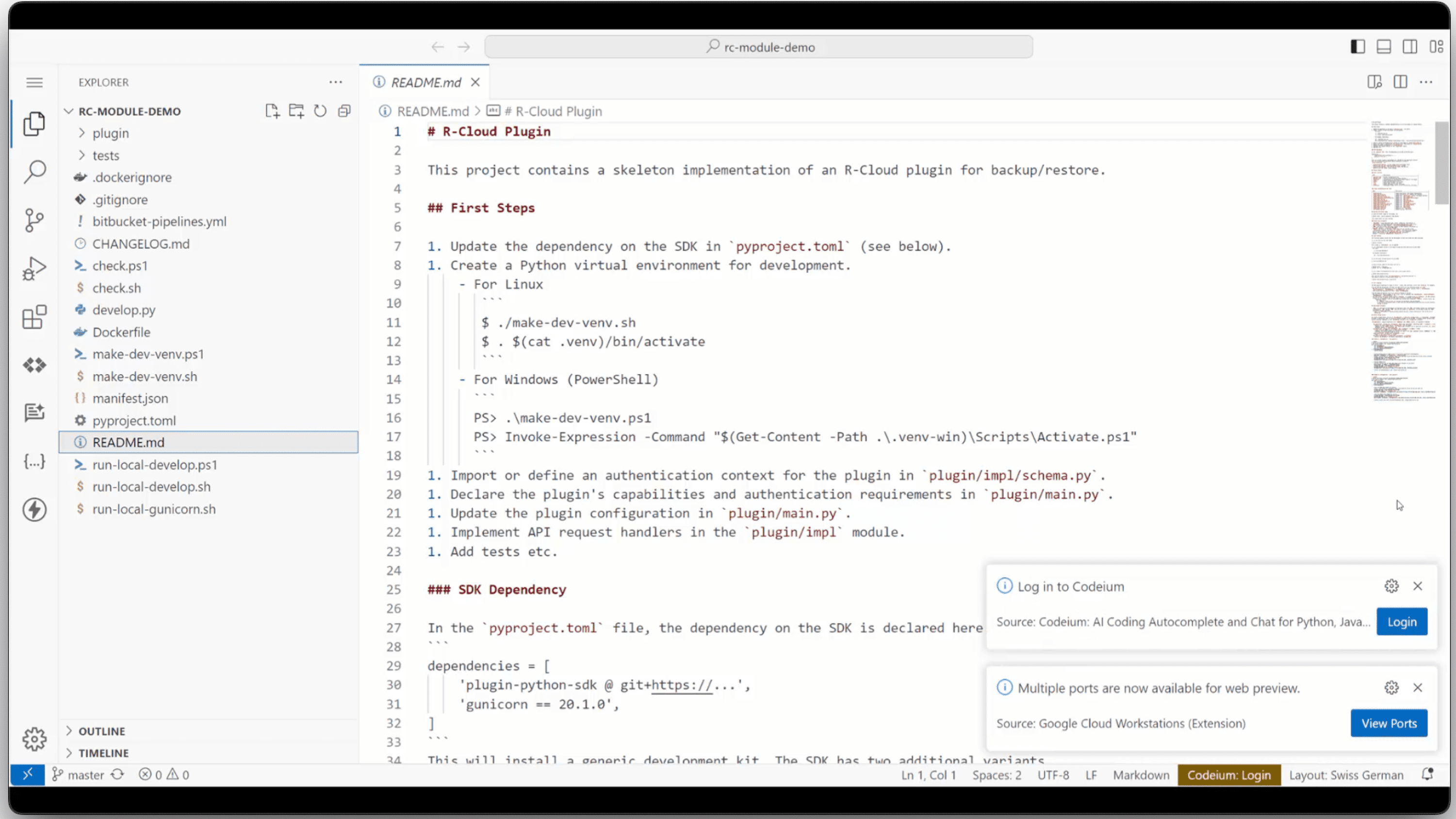
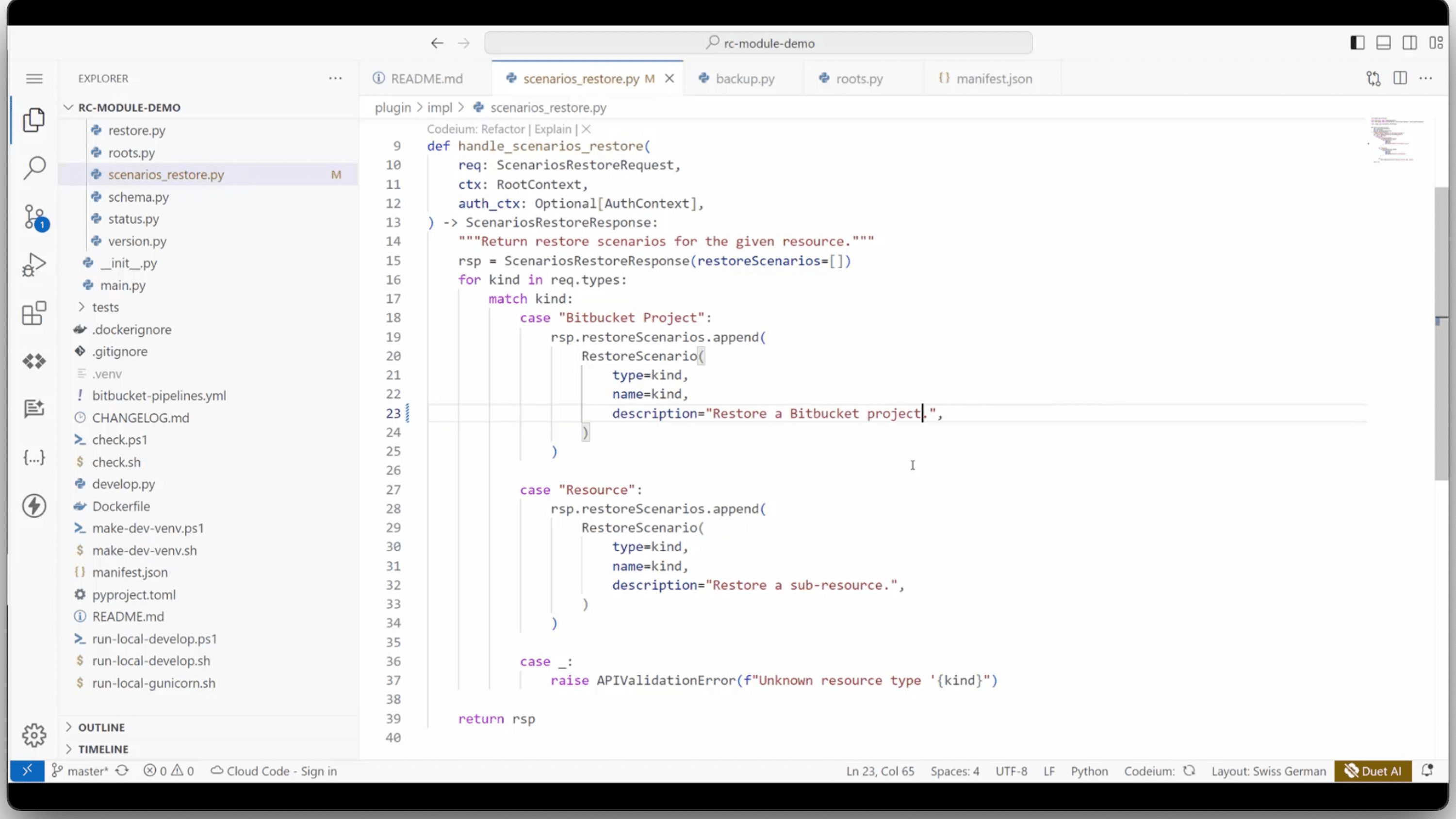
Some of the automated tasks simply build out the Git repository, while other components actually parse the vendor’s SaaS API and build the code (typically Python) to implement the automation. A SaaS vendor can quickly get started and develop the code necessary to implement R-Cloud protection, with only minimal knowledge of the R-Cloud API.
Benefits
There are two obvious benefits from the automation delivered by R-Scout.
- Time to deployment – SaaS Vendors can deliver integration with their platforms faster than would otherwise be achieved without AI-assisted automation. The learning curve is vastly reduced, as R-Scout creates both the templates and actual code to get started testing.
- Risk/error reduction – When APIs are parsed automatically, there is much less risk of coding mistakes being made (especially those that might not be found until testing). R-Scout parses the actual APIs, or documented APIs from the vendor to produce working code for testing.
R-Scout also assists in building test cases and testing the results of coding. All of this is achieved using a chat-based interface, as shown in the figures 2 and 3.
The Architect’s View®
R-Cloud currently supports 64 data sources, 12 months after its initial launch. In November 2023, that coverage was expanded to include AWS Infrastructure-as-Code (IaC) components. It’s easy to think of SaaS platforms as solutions such as Salesforce, Adobe, or Google. However, in the enterprise, IaC and solutions from Slack, Atlassian and Notion (and many more) are increasingly used in business processes, with data loss likely to have significant business impact.
The value of R-Scout is the ability to address the most significant issue involved in onboarding SaaS applications, namely coding for unique and complex APIs. By accelerating and de-risking that process, HYCU is doing everything to ensure R-Cloud is a success for its SaaS customers.
In a wider context, SaaS backup is a must-have feature of modern data protection solutions. The volume of business data in SaaS applications will only increase over the next decade, making efficient SaaS data protection a differentiator for players in the market.
Related Content
- HYCU expands SaaS and IaaS backup with protection for AWS Infrastructure as Code
- HYCU tackles the SaaS data protection challenge with the announcement of R-Cloud
- HYCU Microsite
- Data Unpacked 006 – Introducing HYCU R-Cloud (podcast)
- Data Unpacked 004 – Reflections on Data Management, Security and Protection with HYCU CEO Simon Taylor (podcast)
Copyright (c) 2007-2024 – Post #b4cd – Brookend Ltd, first published on https://www.architecting.it/blog, do not reproduce without permission.